 Historical Figure MBTI
#915 · 7-5-26 · The Rise of Fascism
Heinrich Himmler
Reichsführer-SS · Architect of the Camps
1900 — 1945
11 min read
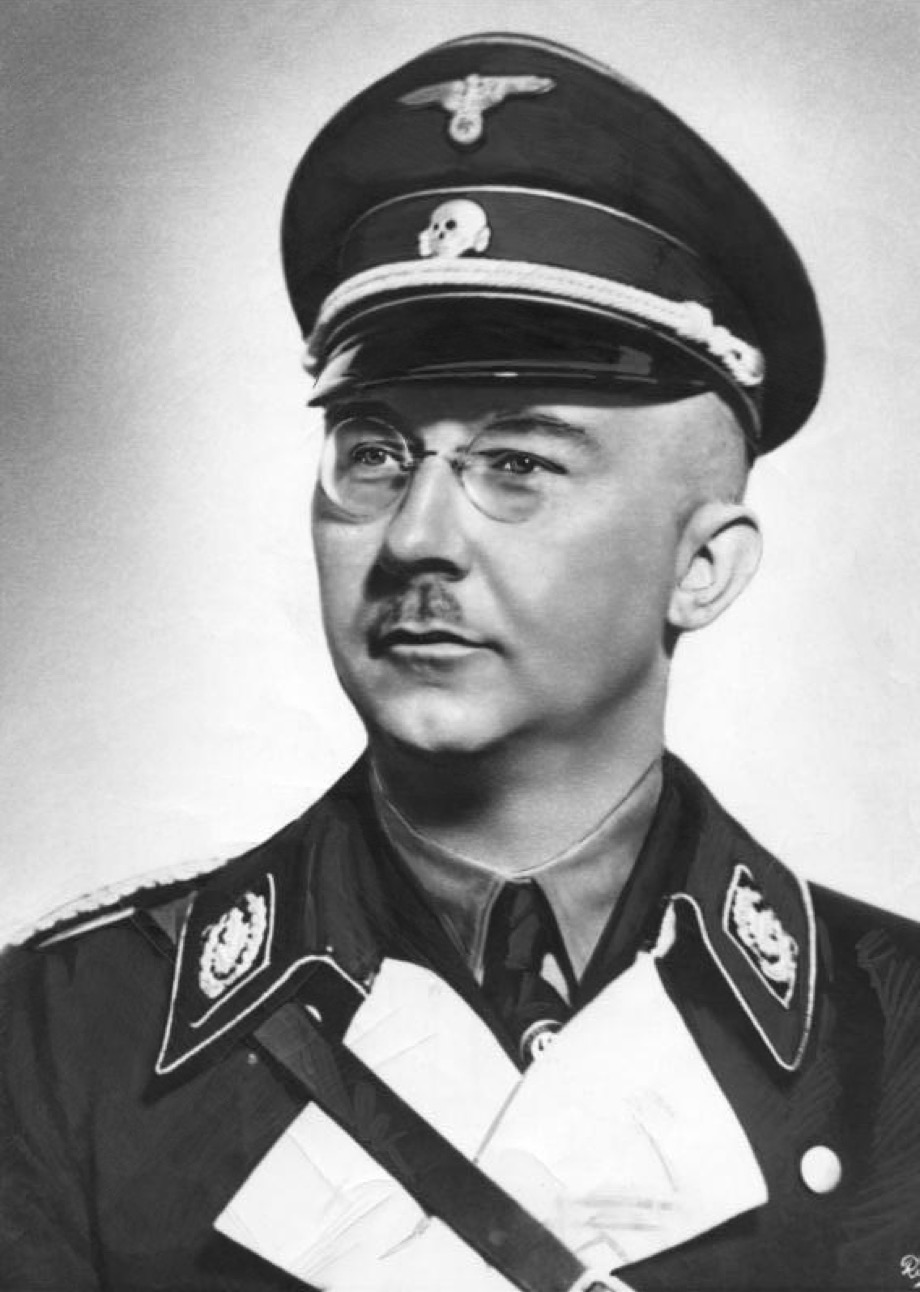
Portrait of Heinrich Himmler (Bundesarchiv)
The Man Who Filed the Murders
As Reichsführer-SS, Heinrich Himmler built and administered the entire Nazi concentration- and extermination-camp system. He personally oversaw the machinery of the Holocaust — the Einsatzgruppen death squads that shot more than a million people in ditches across the occupied East, the sealed transports, the gas chambers at Auschwitz-Birkenau, Treblinka, Sobibór, Bełżec — and he ran the Gestapo and the wider police apparatus that made terror the ordinary condition of German and occupied life. He is, by any honest accounting, among the most direct architects of genocide in human history. Nothing that follows about his psychology is an explanation that lessens that, and nothing about his type makes him a tragic figure. He was a mass murderer who worked from a desk.
What makes him worth studying, and what makes him genuinely frightening, is how unremarkable he looked doing it. Himmler was born in 1900 into a devout, respectable Bavarian Catholic household, the son of a schoolmaster. He trained as an agronomist, kept chickens, worried about his stomach, wrote fussy letters, and impressed almost nobody who met him. Contemporaries described a pedantic schoolmaster of a man, pince-nez and a receding chin, the sort who would correct your paperwork. He was not a charismatic street brawler like Ernst Röhm, not a war hero like Hermann Göring, not an orator like Joseph Goebbels. He was an administrator. That is precisely how he became the most dangerous man in the regime after Hitler himself.
Himmler joined the Nazi Party early and took over the SS in 1929, when it was a bodyguard detachment of a few hundred men subordinate to the far larger SA. Within a decade he had built it into a state within a state: an intelligence service, a police empire, a racial bureaucracy, a network of camps beginning with Dachau in 1933, an industrial concern, and eventually an army of its own. He did this not by seizing power in a dramatic stroke but by accumulating it in files — competencies, offices, jurisdictions, personnel records — the way a diligent clerk accumulates responsibility until nobody can function without him.
Himmler is the archive’s clearest study in ISTJ dominant Introverted Sensing turned murderous: a man whose whole gift was for procedure, precedent and record-keeping, applied without a flicker of moral interruption to the industrial killing of millions.
The Filing Cabinet as an Instrument of Death
Dominant Introverted Sensing is a memory function: it stores detail, compares the present against an accumulated internal record, and finds security in the known procedure. In an ordinary life it produces the reliable auditor, the archivist, the person who remembers which form goes where. In Himmler it produced the Race and Settlement Main Office, where SS men’s fiancées had their ancestry documented back generations before marriage was permitted; the Ahnenerbe’s pseudo-scholarly accumulation of “Germanic” data; and the vast personnel card indexes on which the SS ran. He was a compulsive documenter. He kept detailed lists as a young man of every book he read and every person he met, with judgments attached.
That habit scaled horrifically. The camp system Himmler built was standardized in a way improvised brutality never is: Dachau in 1933 became the training model, Theodor Eicke’s discipline regulations became the template, and the procedure was then replicated across occupied Europe. Prisoner categories were coded by colored triangle. Transports ran to timetables negotiated with the Reichsbahn. Property taken from the murdered — spectacles, hair, gold fillings, shoes — was inventoried and shipped, with receipts. The Holocaust as Himmler administered it was not a riot; it was a supply chain with paperwork at every node, and the paperwork was the point, because paperwork is what made it repeatable.
Si also explains the small-mindedness that ran alongside the enormity. Himmler fussed over the correct cut of an SS uniform, the correct wording of an oath, the correct rituals at his Wewelsburg castle, the dietary habits of his officers. He issued memoranda on the proper treatment of animals while signing orders for the extermination of human beings. This is not irony for its own sake; it is the signature of a mind for which the known, ordered detail is real and the abstract consequence is not.
Empire Built Out of Jurisdictions
Auxiliary Extraverted Thinking is the organizing hand: it structures the world into systems that work, measures output, and consolidates control through institutions rather than personality. Himmler’s rise was a masterclass in it. He took the SS out from under the SA by helping engineer the murder of Röhm and the SA leadership in the Night of the Long Knives in 1934 — supplying the lists, the fabricated evidence of a coup, the executioners — and emerged with an independent organization. He then absorbed the political police forces of the German states one by one until, by 1936, he held the title Chief of German Police and had fused party organization and state power in a single hand.
The same instinct produced the Reich Security Main Office under Reinhard Heydrich, which merged the Gestapo, the criminal police and the SS intelligence service into one integrated apparatus; the Waffen-SS, an army parallel to the Wehrmacht; and a sprawling economic enterprise — quarries, brickworks, mineral water, textiles — that rented camp prisoners out as labor and counted the profits. Himmler measured everything. He wanted body counts from the Einsatzgruppen and got them in itemized reports, tallied by locality and category of victim, which were compiled in Berlin and circulated to a distribution list.
Te is also why he took the killing off the shoulders of individuals and put it onto procedure. Having watched a mass shooting at Minsk in 1941 and been visibly shaken by the physical mess of it, his response was not to stop but to industrialize: to find a method that spared the executioners the strain. Gas vans, then fixed gas chambers, then the whole Reinhard camp system, were the outcome of a management problem solved. He said as much to his own SS generals at Posen in 1943, praising them for having remained “decent” while carrying out the extermination. The obscenity of that phrase is precisely the Te-Si logic at full extension: the deed is a task, the task has a standard, and the standard is what a good officer is judged by.
A Private Code With Nothing Human in It
Tertiary Introverted Feeling in an ISTJ is a quiet, inward value system — deeply held, rarely argued, almost never displayed. Himmler had one, and it was the moral horror at the center of him. He genuinely believed in the racial doctrine, more literally than most of the cynics around him; he believed in loyalty as the supreme virtue, and made “My honor is called loyalty” the SS motto; he believed that he and his men were performing an unpleasant historical duty on behalf of future generations. His Fi never extended to a single person outside the circle it had been trained to include.
This is what makes him the case study in what Hannah Arendt would later call the banality of evil — a phrase coined about Eichmann but fitting Himmler’s whole apparatus. There is no evidence he enjoyed killing; there is abundant evidence he found the sight of it distasteful and told himself that enduring the distaste was itself a form of moral heroism. That inversion — where squeamishness is reframed as sacrifice and mass murder as a burden nobly carried — is Fi corrupted at the root, not Fi absent. A man with no inner values could not have constructed the elaborate self-justification that Posen speech represents.
In private life the same faculty produced sentimentality: affectionate letters to his wife and daughter, a long-standing devotion to his mistress and their children, anxiety about being thought weak. He was, in the domestic sense, unremarkable to the point of dullness. This is not a mitigating detail. It is the finding. The administrator of the death camps went home and worried about his family’s health, and saw no contradiction, because the categories in his head kept the two worlds in separate files.
The Crank Beneath the Bureaucrat
Inferior Extraverted Intuition surfaces in ISTJs as an unruly, poorly disciplined appetite for grand possibility — usually kept in check, occasionally erupting as credulity toward exactly the sort of speculation the dominant function cannot test. Himmler’s eruptions were spectacular. He funded expeditions to Tibet in search of Aryan origins, sponsored research into Germanic runes and witch trials, believed in world-ice cosmology and herbal medicine, and fitted out the castle at Wewelsburg as a quasi-mystical order-house for an SS conceived as a knightly brotherhood. Serious men in the regime privately thought him ridiculous.
The Generalplan Ost is where the crankery and the bureaucracy met and produced something genocidal on a scale beyond even the camps: a projected reordering of eastern Europe involving the deportation, enslavement or death of tens of millions of Slavs to make room for German settlement, worked out in demographic tables. Only Himmler could have generated a fantasy that vast and then insisted on costing it out per hectare. Inferior Ne does not produce good ideas; it produces enormous ones, and a dominant Si-Te machine then tries to schedule them.
It failed him utterly at the end, which is the other classic inferior-function signature. In the regime’s final weeks Himmler — the man whose entire brand was loyalty — opened secret negotiations with the Western Allies through Swedish intermediaries, apparently imagining that he might be accepted as a partner against the Soviets, or even as Germany’s next head of state. It was a delusional read of a situation he had no capacity to model. Hitler expelled him from the Party. He was caught by British troops in May 1945 in a clumsy disguise, carrying false papers, and bit a cyanide capsule before he could be tried. The chief administrator of the Holocaust never had to explain the files.
Why ISTJ Over ISTP
Why not ISTP?
ISTP runs on dominant Introverted Thinking with Extraverted Sensing: tactical, hands-on, improvisational, most alive when reacting to a situation in front of it. Himmler was the exact inverse. He was physically squeamish, a poor shot, an indifferent soldier, and visibly unwell after witnessing a single execution site at Minsk. His response to direct experience was never to adapt in the moment but to retreat to the office and redesign the procedure. Every significant thing he accomplished — the camp system, the racial bureaucracy, the police merger, the SS economic empire — was an act of long-horizon institution-building carried out on paper, delegated downward, and audited afterward. An ISTP kills with his hands and improvises; Himmler killed with a distribution list and a template.
The distinction matters beyond taxonomy. The most murderous thing about Himmler was not appetite or rage, which the regime had in abundance elsewhere, but the capacity to convert atrocity into routine — to make it a job with standards, promotions and quarterly figures, so that thousands of ordinary functionaries could participate without ever feeling themselves to be killers. That is a Si-Te achievement, and it is why the archive files him where it does.
Connected Figures
Further Reading
- Heinrich Himmler: A Life — Peter LongerichThe standard scholarly biography, built on Himmler's own files and correspondence.
- The Third Reich Trilogy — Richard J. EvansThe best single narrative of the regime, placing the SS within the wider machinery of the state.
- Holocaust: A New History — Laurence ReesAccessible synthesis of how the killing programme evolved from shootings to camps.
- Eichmann in Jerusalem: A Report on the Banality of Evil — Hannah ArendtThe contested but foundational account of bureaucratic complicity in genocide.
