 Historical Figure MBTI
#914 · 7-4-26 · The Rise of Fascism
Paul von Hindenburg
President of Germany · The Old Soldier Who Handed Over the Republic
1847 — 1934
8 min read
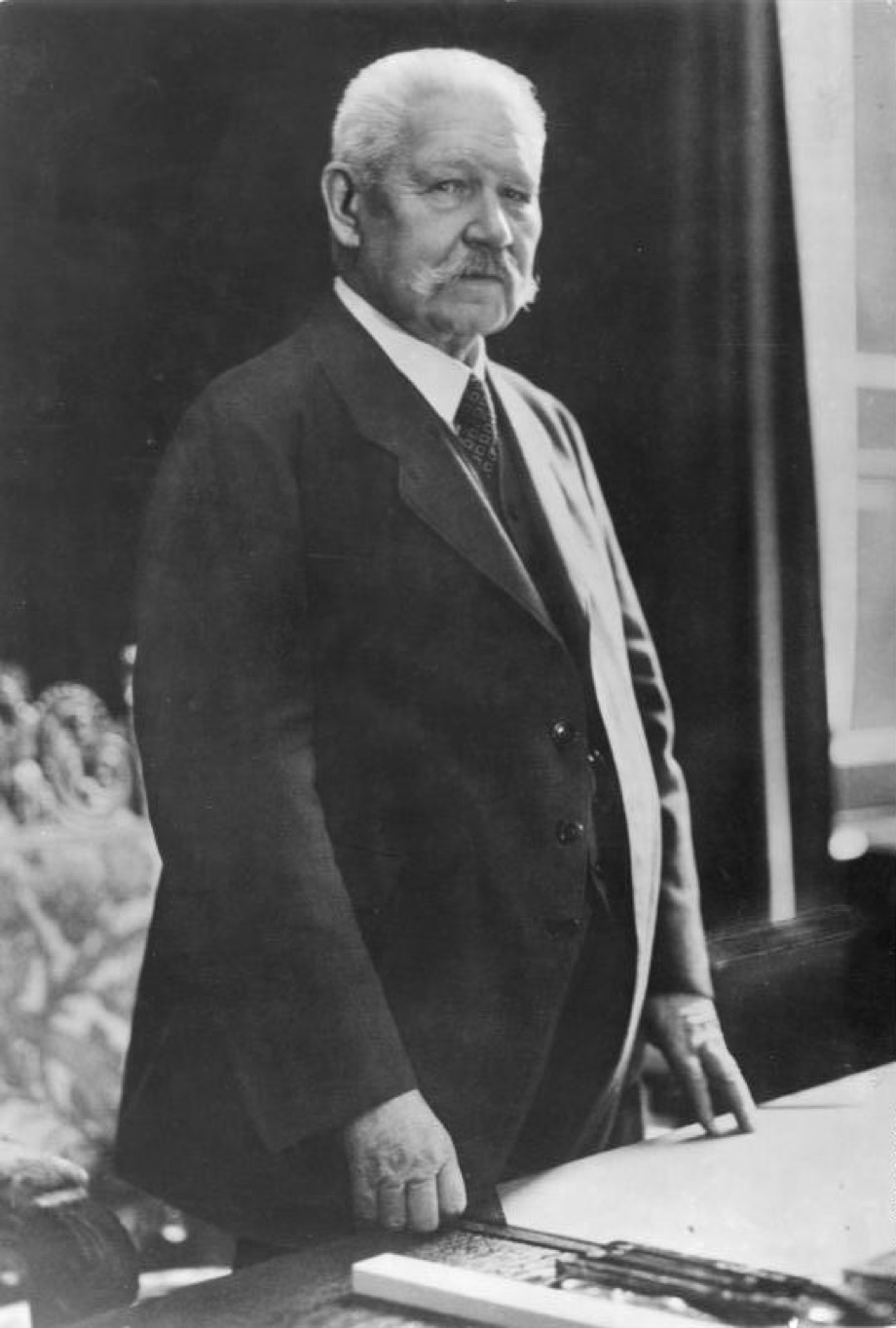
Portrait of Paul von Hindenburg (Bundesarchiv)
The Signature That Opened the Door
On 30 January 1933, an eighty-five-year-old field marshal who privately referred to Adolf Hitler as "that Bohemian corporal" appointed him Chancellor of Germany. He did it on the advice of a small circle of conservative intriguers who assured him that Hitler, surrounded in cabinet by respectable nationalist ministers and hemmed in by constitutional procedure, could be managed. Four weeks later Hindenburg signed the Reichstag Fire Decree, suspending civil liberties across Germany. Eighteen months later he died, and Hitler merged the presidency into the chancellorship and made himself Führer. Hindenburg did not want any of what followed. He enabled all of it.
He had been born in 1847 into the Prussian military aristocracy, fought at Königgrätz in 1866 and at Sedan in 1870, and retired as a corps commander in 1911 expecting nothing further. The war recalled him. At Tannenberg in August 1914 the army he nominally commanded destroyed a Russian force twice its size, and though the operational credit belonged largely to Erich Ludendorff and Max Hoffmann, the name attached to the victory was his. By 1916 he and Ludendorff effectively ran Germany as a military dictatorship; by 1918 he had presided over defeat and then quietly endorsed the stab-in-the-back legend that poisoned the republic he would later head. Elected President in 1925 and reelected in 1932 — defeating Hitler, in the last free presidential election the republic held — he was by then less a politician than a monument.
An ISTJ whose dominant Si trusted the inherited order so completely that he could not see a man who intended to abolish it.
A Man Living Inside 1871
Dominant introverted sensing reads the present against a deep internal archive of what has been. Hindenburg's archive was the Prussia of his youth: the Hohenzollern monarchy, the officer corps as the moral spine of the state, duty as a matter of oath rather than of judgement. He never really accepted the republic he served. He accepted the office, because an oath had been sworn and offices are held by men who honour oaths — and in 1919 he had already given the Reichstag inquiry the testimony that the undefeated army had been stabbed in the back at home, a piece of Si nostalgia that did more damage to Weimar than any single act of his presidency.
The style was unmistakable. He was slow, immovable, ceremonious, and physically vast in photographs — the public deliberately treated him as a monument, and he behaved like one. What Si supplied him was extraordinary steadiness under pressure; what it denied him was any category for a genuinely new thing. Hitler was new. The Nazi movement did not fit into the schema of parties and factions Hindenburg had inherited, because it intended to use that schema to end it. He kept sorting it into the familiar box marked "radical nationalist party that will moderate once it holds office," because that box was the only one his experience had.
Everything Done by the Book
Auxiliary extraverted thinking made him a procedural president. He worked through formal constitutional instruments, took written advice, deferred to legal counsel about what the office permitted, and preferred a defensible mechanism to a decisive one. His great instrument was Article 48, the emergency decree power, which he used from 1930 onward to let Heinrich Brüning govern without a parliamentary majority. Each individual use was constitutional. Cumulatively they hollowed out the Reichstag and taught Germany that the country could be run by presidential decree — a lesson Hitler would collect in full within weeks of taking office.
The appointment itself was Te reasoning at its most catastrophic. The arithmetic presented to him by Franz von Papen was tidy: Hitler as Chancellor, but only three Nazis in an eleven-man cabinet, Papen as Vice-Chancellor with the right to attend every meeting with the President, the army and the foreign ministry in conservative hands. Papen's promise — that within two months they would have Hitler "squeezed into a corner until he squeaks" — was a structural argument, and structural arguments were the kind Hindenburg could evaluate. It was correct about the boxes on the organization chart and wrong about everything that mattered, because it assumed the new Chancellor would play inside the chart at all.
Private Honour, Publicly Useless
Hindenburg held a genuine and inward code — duty, personal honour, the word of an officer — and it produced exactly one moment of resistance worth recording. In April 1933, when the new regime moved to purge Jews from the civil service, he wrote to Hitler objecting on behalf of Jewish veterans of the First World War, and the initial law was amended to exempt front-line veterans and their families. It was a real intervention on a real principle, and it was also the outer limit of what his conscience produced: an exemption for men who had worn the uniform, not an objection to the principle of the purge. Those exemptions were stripped away in 1935, a year after his death.
The same private code was the lever his own circle used against him. He had accepted the gift of the family estate at Neudeck, financed by industrialists and nationalist sympathizers and registered in his son's name in a way that avoided inheritance tax; his son Oskar was implicated in the Osthilfe agricultural subsidy scandal. Whether these were used as outright leverage in January 1933 is disputed by historians, but Oskar and the Neudeck circle were unquestionably the channel through which Papen's proposal reached the old man, and the Fi that made him care intensely about family and personal obligation made that channel the only one that mattered.
No Imagination for the Worst Case
Inferior extraverted intuition is a failure to generate alternative futures, and it is the whole of Hindenburg's tragedy. Asked to imagine what a man with three cabinet posts, the police powers of the Prussian interior ministry, and a private army of three million might do to a constitutional order, he could not do it. The scenario had no precedent in the archive, therefore it was not in the field of possibility. He judged Hitler on manner rather than on stated intent — an uncouth Austrian ex-corporal, socially impossible, obviously not a statesman — and never seems to have taken seriously that the programme printed in Mein Kampf was a plan rather than a pose.
The evidence arrived quickly and changed nothing. Four weeks after the appointment the Reichstag burned and Hindenburg signed the decree suspending freedom of the press, assembly, speech and protection from arbitrary arrest — a Te act, formally correct, of a kind he had performed many times before, and this time the end of German civil liberty. In June 1934 he was reported to have congratulated Hitler on the murders of the Night of the Long Knives for saving the nation. He died at Neudeck on 2 August 1934. Within hours, the offices of President and Chancellor were merged, and the army — the institution whose oath had been the fixed point of his entire life — swore personal allegiance not to the constitution but to Adolf Hitler.
Why ISTJ Over ISTP
Why not ISTP?
ISTP is worth raising for any successful soldier, since the type's Ti-Se pairing produces the gifted battlefield improviser. Hindenburg was not one. Tannenberg's operational improvisation belonged to Ludendorff and Hoffmann; Hindenburg's contribution was steadiness, authority, and the willingness to sign off — the calm fixed point rather than the moving hand. An ISTP works from present data and adapts when it changes, which is precisely what he never did across four years of Nazi ascent. He operated instead through formal constitutional procedure and inherited Prussian hierarchy, following the rulebook of a system that Hitler was preparing to dismantle from inside it. That is Si-Te, not Ti-Se: a man who reasoned from precedent and structure, not from the situation in front of him.
The ISTJ reading is also the least comfortable one, because it refuses the excuse of senility. Hindenburg was old and tiring in 1933, but the decision he made was entirely in character with the man he had been at fifty: institutionally loyal, procedurally scrupulous, incapable of imagining that the procedure itself could be turned into a weapon. The republic was not handed over by a monster. It was handed over by a dutiful conservative doing what the rulebook appeared to allow.
Connected Figures
Further Reading
- Hindenburg: Herrschaft zwischen Hohenzollern und Hitler — Wolfram PytaThe major modern German biography; argues for a far more politically active Hindenburg than the passive-monument tradition allows.
- The Coming of the Third Reich — Richard J. EvansThe best single narrative of the presidential-decree years and the January 1933 appointment.
- Hitler: 1889–1936 Hubris — Ian KershawReconstructs the backstairs negotiations of the Papen circle from the other side of the door.
