 Historical Figure MBTI
#913 · 7-4-26 · The Rise of Fascism
Ernst Röhm
SA Commander · The Brownshirt Purged by His Own Revolution
1887 — 1934
10 min read
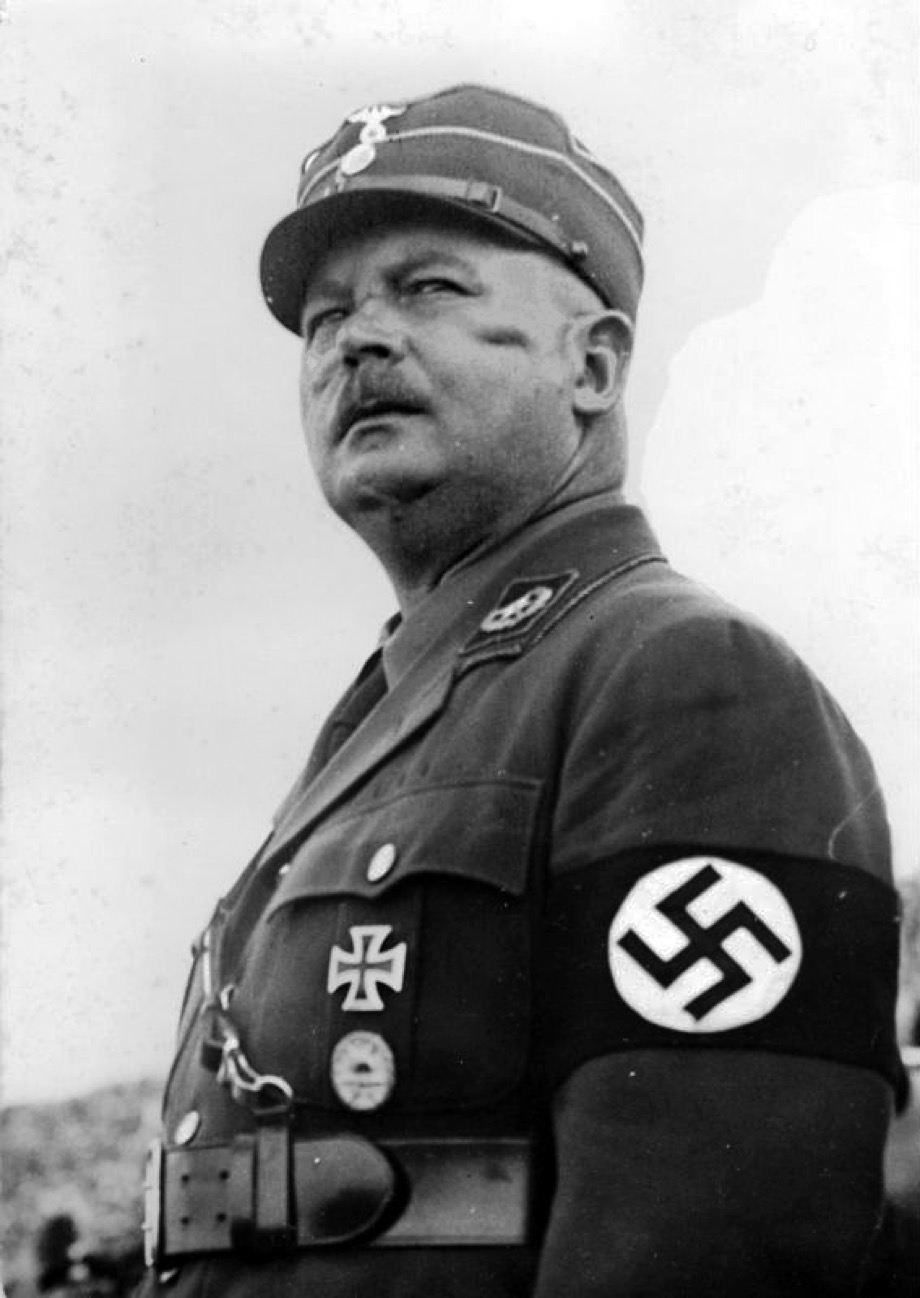
Portrait of Ernst Röhm (Bundesarchiv)
The Street Was the Whole Argument
Ernst Röhm built and commanded the Sturmabteilung — the SA, the Brownshirts — the paramilitary street-violence arm of the Nazi Party. Its function was not symbolic. Its men broke up the meetings of Social Democrats and Communists, beat opponents in the street and in their homes, terrorized Jewish shopkeepers, and in the spring of 1933 seized union halls and ran a network of improvised torture cellars across Germany in which thousands of political prisoners were held and beaten and an unknown number were killed. Röhm did not merely tolerate this; it was the instrument he had designed and the method he believed in. He was, in the plainest terms, the organizer of the violence that intimidated German democracy into surrender.
He was also, within eighteen months of that victory, dead by it. On 30 June 1934 — the Night of the Long Knives — Hitler had him arrested in a Bavarian hotel and shot without trial in a Munich prison cell two days later, along with dozens of other SA leaders and a scattering of unrelated conservative enemies. The official charge was a coup plot. There was no coup plot. There was a three-million-man private army whose commander wanted to absorb the regular Wehrmacht, and a Führer who had decided he needed the generals more than he needed the street.
Born in Munich in 1887 to a railway official, Röhm went into the army and stayed there in spirit for the rest of his life. He was severely wounded three times in the First World War — a shell fragment took away part of his nose and left the scarred face every photograph records — and he emerged from the war with the conviction that the soldier was the only legitimate political actor and that civilian politics was a form of decadence to be broken by force. He wrote it down without embarrassment in his 1928 memoir, and he lived by it until it killed him.
An ESTP whose dominant Se made the physical present the only arena that counted — a man who mistook a street gang for a revolution and never saw the political knife coming.
Fearless in the Room, Blind to the Year
Dominant extraverted sensing lives in immediate physical reality and is at its most capable when that reality is dangerous. Röhm was physically fearless in a way his colleagues found both useful and slightly alarming. He was wounded repeatedly at the front and went back. In the Munich street fighting of 1919 and the beer-hall brawls of the early twenties he was personally present, not directing from an office. During the failed putsch of November 1923 he seized and held the War Ministry building overnight while Hitler's column was being scattered by police gunfire outside the Feldherrnhalle. Confrontation did not frighten him; it clarified him.
The SA he built was Se organizational thinking made institutional. It recruited the unemployed and the demobilized by the hundred thousand and gave them a uniform, a marching column, a beer-hall culture and a weekly opponent to fight — physical goods, available now, to men whose economic future had disappeared. It grew from a few thousand in the mid-twenties to roughly three million by 1934, larger than the army it proposed to swallow. This was a real achievement of mobilization, and it is worth stating that the achievement consisted of arming a mass of men to hurt people in the street.
The same function set the ceiling. Röhm's ambition was concrete and present-tense: more men, more weapons, the SA absorbing the Reichswehr, himself as minister of a new people's army. He called it the "second revolution," but it had almost no ideological content — it was a demand for physical power, stated in physical terms, to be delivered soon. He said it loudly, repeatedly, in public, in 1933 and 1934, to an audience that included the officer corps and the industrialists whose support Hitler was courting. Se sees the field. It does not see the field a year out.
Blunt Arithmetic, Coldly Done
Auxiliary introverted thinking gave Röhm a working, unsentimental calculus of force. He had been a staff captain and he understood logistics: how to move formations, cache weapons, and rotate men through a city so that a rally looked spontaneous and a counter-demonstration got broken up on schedule. In the early twenties he ran the Bavarian paramilitary weapons network, and his usefulness to Hitler was precisely that he could convert street enthusiasm into deployable organization. He thought about violence the way an engineer thinks about load: how much is required here, applied where, to produce collapse.
Ti also made him indifferent to doctrine that got in the way of function, and this is the most revealing thing about him. Röhm was openly homosexual at the head of a movement whose official ideology criminalized homosexuality and which would send men to concentration camps for it. He made little effort to conceal it; the Social Democratic press published his private letters in 1931 and 1932 to destroy him, and the Party closed ranks instead. Hitler's public defence at the time was blunt and entirely instrumental — the SA is a body of fighting men, not a moral institute. Röhm evidently took this as a durable settlement between comrades. It was a cost-benefit judgement that ran only as long as the benefit did.
When the calculation flipped, everything he had assumed to be personal proved to be transactional. Himmler and Heydrich assembled a dossier of fabricated evidence; Göring supplied the Prussian police; the army leadership let it be understood that its support for Hitler's succession to Hindenburg depended on the SA being cut down. The same homosexuality that had been protected for a decade was produced afterwards as public justification for the killings. Röhm's Ti had priced his own loyalty correctly and everyone else's wrongly.
Loyalty as a Barracks Virtue
Tertiary extraverted feeling in an ESTP is real but narrow: it binds a crew. Röhm was genuinely beloved inside the SA in a way the more sinister figures of the regime never managed to be. He drank with his men, spoke to them in the profane idiom of the front, promoted on the basis of nerve rather than pedigree, and generated the fierce small-group loyalty of a good company commander. His SA was held together by personal attachment to him, which was exactly what made it dangerous to Hitler and exactly what could not save him when the pistols came out.
It also governed his relationship with Hitler, and here the asymmetry is stark. Röhm was the only senior Nazi permitted to address Hitler with the familiar du, a privilege that dated to the Munich years when Röhm — the decorated captain with the army contacts — was the senior partner and Hitler the useful speaker. Röhm appears to have believed to the end that this was a bond. His last recorded words, when a pistol was left in his cell so he might shoot himself, were a refusal: if he was to be killed, let Adolf do it himself. Two SS officers did it instead.
Fe of this kind produces comradeship, not politics. It reads the room he is standing in and not the rooms he is excluded from. While Röhm was cultivating his own men he was systematically alienating the constituencies that actually decided his fate — the officer corps he threatened to absorb, the conservatives around Hindenburg, and the rising SS bureaucrats who were building files rather than fighting in bars.
The Blind Spot That Killed Him
Inferior introverted intuition is the weakness that runs through Röhm's entire last year. He could not read the trajectory. Every visible sign of what was coming was available to him: Hitler publicly declaring the revolution complete and demanding an end to talk of a second one; Himmler detaching the SS from SA control; the army bargaining openly over the succession; a stream of warnings from his own subordinates. Röhm's response in June 1934 was to send the entire SA on a month's leave and go on holiday to a lakeside hotel at Bad Wiessee, unguarded, where Hitler arrested him personally at dawn.
Where his inferior function did operate, it produced not foresight but a vague mysticism of the fighting man — a belief that history belonged to whoever held the street, that the soldier-revolutionary was the natural inheritor of the state, that three million brown shirts constituted a destiny. It was an intuition without a mechanism. He never worked out how the SA would actually take the army, or who would pay for it, or what he would do about a Führer who had decided otherwise.
The contrast with the man who killed him is the whole lesson of the cluster. Hitler was dominant Ni with inferior Se: one long vision, punctuated by reckless physical strokes. Röhm was the exact inversion: dominant Se with inferior Ni, all present-tense force and no line of sight. Placed in the same room, the man who could see a year ahead ordered the death of the man who could only see the room.
Why ESTP Over ESTJ
Why not ESTJ?
ESTJ is the obvious alternative for a career officer who built an organization of three million men, and it fails on what that organization actually was. Dominant Te builds institutions: chains of command that function without the founder, written procedure, standardized training, succession that survives a death. The SA had almost none of this. It was a federation of local gangs held together by personal loyalty to Röhm and by the shared physical experience of fighting, which is why it could be decapitated in a single weekend and absorbed into irrelevance within a year — an ESTJ's structure would have outlived him. His goals were physical rather than systemic (more men, more weapons, take the army) and his method was confrontation rather than administration. And no dominant-Te commander sends his whole force on leave and goes to a lakeside hotel while his rivals assemble a case against him.
ESTP is the harder and more accurate reading: a man of enormous physical nerve and tactical competence, genuinely gifted at converting present-moment force into political result, and structurally incapable of seeing the political future in which that force had become surplus. He was useful to the Nazi seizure of power precisely because he thought in the present tense, and he was disposable for exactly the same reason.
Connected Figures
Further Reading
- Ernst Röhm: Hitler's SA Chief of Staff — Eleanor HancockThe standard English-language biography, and the best account of what the SA actually was.
- The Coming of the Third Reich — Richard J. EvansPlaces the SA's street violence inside the collapse of the Weimar Republic.
- The Third Reich Trilogy — Richard J. EvansThe wider series; the second volume covers the Night of the Long Knives and its consolidation of Hitler's power.
