 Historical Figure MBTI
#912 · 7-4-26 · The Rise of Fascism
Rudolf Hess
Deputy Führer · The Flight to Scotland
1894 — 1987
4 min read
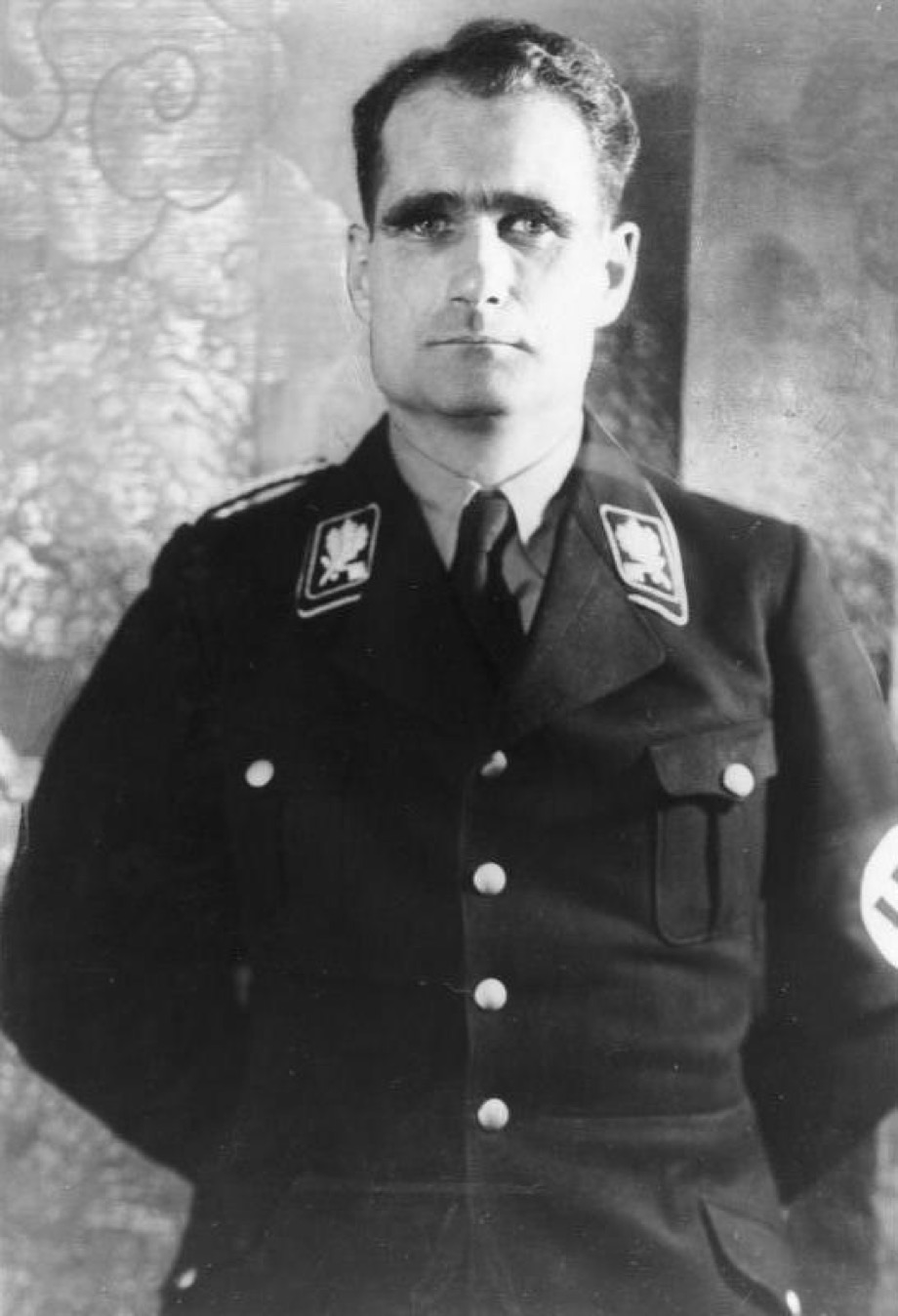
Portrait of Rudolf Hess (Bundesarchiv)
The True Believer Who Flew Alone
Rudolf Hess was one of the earliest and most fanatically devoted of Hitler's inner circle — a founding-generation Nazi who was imprisoned with Hitler after the failed 1923 Beer Hall Putsch and transcribed the dictation that became Mein Kampf. Named Deputy Führer in 1933, Hess held a role that was largely ceremonial, symbolic of loyalty rather than built on real administrative power, and he seemed content with that: he was drawn to astrology, homeopathy, and Rudolf Steiner-adjacent mysticism, and his devotion to Hitler read as near-religious rather than strategic.
That devotion produced the single strangest act by any senior Nazi official: in May 1941, without authorization from Hitler or anyone else, Hess flew a plane solo to Scotland, hoping to personally broker a peace settlement between Germany and Britain. He was arrested within hours of landing and spent the rest of his life a prisoner — first of the British, then of the Nuremberg tribunal, then of Spandau Prison, where he died in 1987 as its last remaining inmate.
Rudolf Hess was an INFP whose dominant Fi convinced him that personal conviction alone could reshape a war, and who acted on that conviction almost entirely alone.
A Conviction Beyond Argument
Hess's dominant Fi is visible first in the sheer intensity and permanence of his personal loyalty to Hitler — a devotion that predated the party's rise to power, survived a prison sentence, and never wavered even after Hess himself had been discarded from any real influence. It was not built on ideological argument so much as an inward, almost sacred certainty about the rightness of the man and the cause, the hallmark of Fi rather than a more externally-oriented Fe loyalty built on visible consensus or social bonds.
That same inward certainty is what sent him to Scotland. Hess believed, with total private conviction, that he personally could negotiate a peace between Germany and Britain — a belief he held so firmly that he needed no committee, no authorization, and no contingency plan beyond his own sense that he was right. He trained himself to fly the distance, told almost no one, and departed on his own initiative. It is Fi at its most extreme: an interior moral and emotional certainty acted out in isolation, indifferent to whether the outside world was prepared to receive it.
A Mission Built on Possibility, Not Plan
Auxiliary Ne appears not as rigorous strategic planning but as an appetite for the improbable — Hess spun out a scenario in which a lone, unofficial emissary could reshape the geopolitics of a continental war, and found it plausible enough to act on. The same speculative, pattern-seeking mind that pulled him toward astrology and fringe esoteric theories is what generated the belief that a single dramatic gesture could unlock a diplomatic breakthrough no official channel had managed.
What Ne did not give him was the practical follow-through to test that idea against reality before committing to it. He arrived in Scotland with essentially no coordination, no authorization, and no real assurance the British were receptive — a gap between imaginative possibility and grounded planning that is characteristic of Ne running well ahead of the weaker judging functions behind it.
Why INFP Over INFJ
Why not INFJ?
An INFJ operating on Ni-Fe would have built the Scotland mission around calculated, socially-attuned persuasion — cultivating contacts, reading the political moment, working channels likely to actually receive the message. Hess did none of that. His flight was strikingly naive and unilateral, an interior conviction acted out with almost no external reality-testing or contingency planning, which is the signature of dominant Fi paired with Ne rather than a strategically patient Ni-Fe mind.
The gap between Hess's certainty and his preparation is the clearest evidence for the type: he was right enough about his own convictions to risk his life on them, and wrong enough about how the world would respond to spend the next forty-six years in captivity because of it.
Connected Figures
Further Reading
- Hess: Flight for the Führer — Peter PadfieldA detailed account of the Scotland flight and its context.
- Hess: A Biography — Roger Manvell & Heinrich FraenkelA comprehensive biography covering Hess's full career and postwar imprisonment.
