 Historical Figure MBTI
#916 · 7-5-26 · The Rise of Fascism
Hermann Göring
Reichsmarschall · The War Hero Who Built an Empire of Theft
1893 — 1946
10 min read
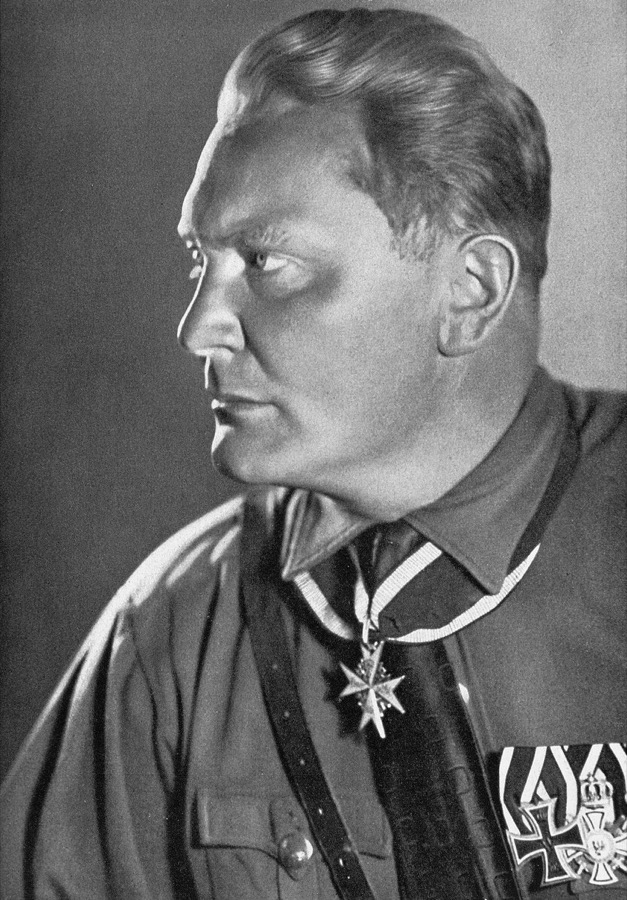
Portrait of Hermann Göring (Bundesarchiv, 1932)
The Appetite That Ate a Continent
Hermann Göring built the Luftwaffe that bombed Warsaw, Rotterdam, Belgrade, London and Coventry, killing civilians by design and by the tens of thousands. He founded the Gestapo and the first Nazi concentration camps in Prussia before handing both to Heinrich Himmler. He signed the 1941 authorization instructing Reinhard Heydrich to prepare a “total solution” of the Jewish question in German-controlled Europe. He presided over the plunder of the occupied countries — their factories, their food, their forced labor, and above all their art, which he collected for himself on a scale no private thief in history has matched. At Nuremberg he was convicted on all four counts, including crimes against humanity, and sentenced to hang.
He was also, of the men in the dock, the most obviously alive. Born in 1893 to a colonial official, raised partly in a castle belonging to his mother’s wealthy Jewish lover, Göring became a fighter pilot in the First World War, won the Pour le Mérite, and finished the war commanding the Jagdgeschwader 1 — the “Flying Circus” that Manfred von Richthofen had led until his death. He was brave in the physical, uncomplicated way that combat rewards: fast reflexes, no imagination for consequences, a taste for the moment. Everything he became afterward was that same appetite enlarged and let loose in a state with no restraints on it.
He joined the Nazi Party in 1922, was shot in the groin during the failed 1923 Beer Hall Putsch, and acquired in the treatment a morphine addiction he never fully shook. By the mid-1930s he was Reich Minister of Aviation, head of the Four Year Plan, Prussian Minister-President, Reich Master of the Hunt, and possessor of more titles than any other Nazi. He built Carinhall, a hunting estate that swelled into a private museum of looted masterpieces. He wore uniforms of his own design, changed them several times a day, and appeared in public painted, jeweled and enormous. He was the regime’s appetite made visible, and for a time Germany found it charming.
Göring is the archive’s clearest ESTP: dominant Extraverted Sensing running the whole man — combat nerve, physical courage, theatrical presence and bottomless appetite — with no faculty anywhere in the stack capable of telling him when to stop.
Everything Now, and All of It
Dominant Extraverted Sensing lives in the immediate physical world: it reacts faster than it reflects, it is drawn to risk and to sensation, and it wants the tangible thing in hand. In the cockpit this made Göring genuinely formidable — twenty-two confirmed victories, a squadron command at twenty-five, and the reputation for fearlessness that gave him political credibility a decade later when the party needed a respectable war hero to stand beside the beer-hall agitators.
It never modulated. As the regime consolidated, the same function that had made him brave made him ravenous. Carinhall filled with Vermeers, Cranachs, Rembrandts and tapestries taken from Jewish collections in France, the Netherlands and Poland; the Einsatzstab Reichsleiter Rosenberg funneled the loot and Göring picked over it personally, visiting the Jeu de Paume in Paris a reported twenty times to make selections. He amassed hunting reserves, uniforms, jewels, a private train, medieval weapons, tigers. He gained weight relentlessly. He took paracodeine tablets by the handful. Appetite in an ESTP is not a metaphor here; it was the organizing principle of a life.
Se also explains his political method in 1933 and 1934, which was direct and brutally physical. He purged the Prussian police and filled it with SA men, created the Gestapo out of the political department, opened the earliest camps for political prisoners, and exploited the Reichstag fire to justify mass arrests within hours of the flames going out. During the Night of the Long Knives he handled the killings in Berlin himself, by telephone and by list. He was not squeamish, not deliberative, and not slow.
The Sharp Mind He Barely Used
Auxiliary Introverted Thinking gives the ESTP a private, unsentimental analytical engine — quick at seeing how a thing actually works, contemptuous of received framing, and capable of dismantling an argument on the spot. Göring had one, and the evidence for it is the Nuremberg trial. Prison psychologists tested him and reported one of the highest measured intelligences among the defendants. Withdrawn from morphine and stripped of forty kilos, he dominated the dock: he ran rings around Robert Jackson in early cross-examination, corrected the prosecution’s military detail, refused to plead ignorance, and forced the tribunal to take him seriously as an opponent rather than a clown.
The same faculty is visible in the technical grasp he showed while actually building the Luftwaffe in the 1930s, when it was a real achievement: a modern air force assembled quickly and in defiance of treaty, integrating aircraft procurement, training, anti-aircraft artillery and paratroops. Ti did the analysis; Se supplied the drive; the result in 1939 and 1940 was an air arm that broke Poland and France in weeks.
But Ti in an ESTP is auxiliary — a tool the dominant function picks up when it wants something, and puts down when the wanting is satisfied. Göring stopped doing the work. He left aircraft development to Ernst Udet, a fellow ace with no aptitude for procurement, and technical policy drifted; Germany went into a long war with an air force designed for short ones and never built the strategic bomber that might have mattered. The analytical capacity was real. The discipline to keep applying it after the fun had gone was not.
The Charm That Made Him Bearable
Tertiary Extraverted Feeling is the ESTP’s social instrument: reading a room, playing to it, generating warmth on demand. Göring was, by wide agreement including that of his enemies, the most likable Nazi — genial, funny, boisterously vain in a way people found human next to the cold fanaticism around him. He was popular with the German public in a way Himmler never was and Goebbels had to manufacture. Foreign diplomats came away liking him. That likability was a political asset the regime spent deliberately.
It also served him inside the court. He read Hitler better than most and for years occupied the position of designated successor, formalized by decree in 1939 and again in 1941. He used the Fe register to smooth conflicts, host, flatter, perform. His two marriages were genuinely affectionate; he named Carinhall for his first wife and kept a shrine to her there.
What Fe at the tertiary position cannot do is generate conscience. It reads what people feel; it does not require that their feelings constrain you. Göring could be charming to a French curator in the morning and sign away that curator’s national collection in the afternoon; he could joke with American psychiatrists in his cell about the very deportations his signature had authorized. The warmth was real and entirely superficial — a social skill, not a moral faculty, and one of the reasons his geniality at Nuremberg was so unnerving to those who watched it.
Promises He Could Not Keep
Inferior Introverted Intuition is the blind spot: the long horizon, the unfolding consequence, the thing that has not happened yet. Göring’s career after 1940 is a catalogue of it. He promised Hitler that the Luftwaffe alone would finish the British at Dunkirk; the army halted and over three hundred thousand men escaped. He promised that Britain could be beaten from the air, then squandered the campaign by switching from RAF airfields — where the pressure on Hugh Dowding’s Fighter Command was becoming unbearable — to the terror bombing of London, because London was the more satisfying target in front of him. Dowding, whose whole method was long-range system-building, was the exact temperamental opposite, and he won.
He promised that no enemy bomber would reach the Ruhr, and offered to be called “Meier” if one did — a joke Germans repeated bitterly for years afterward in air-raid shelters. Most catastrophically, in November 1942 he promised that his air fleet could supply the encircled Sixth Army at Stalingrad by air, a commitment he made without serious calculation and could not come close to meeting. Roughly a quarter of a million men were lost in part on the strength of it.
As the war turned he simply withdrew. He retreated to Carinhall, to his art, his morphine, his uniforms and his hunting, appearing at conferences to be humiliated and then leaving again. In April 1945 he read the succession decree literally, wired the bunker asking whether he should now assume leadership, and was stripped of all offices and arrested for treason. Captured by the Americans, he made himself the star of Nuremberg, was convicted of conspiracy, crimes against peace, war crimes and crimes against humanity, and — denied the soldier’s firing squad he demanded — swallowed a smuggled cyanide capsule hours before his execution. Even the ending was a piece of staging.
Why ESTP Over ESTJ
Why not ESTJ?
ESTJ leads with Extraverted Thinking: sustained institutional discipline, follow-through, and an identity built on the organization running properly. Göring founded institutions but did not maintain them. He created the Gestapo and let it go; he built the Luftwaffe and then stopped supervising its procurement; he took the Four Year Plan and produced targets he never met. His later career is a study in hedonistic drift — Dunkirk, the Battle of Britain, the Stalingrad airlift, all commitments made in the flush of the moment and abandoned when the work got dull. An ESTJ’s vanity attaches to results and rank order; Göring’s attached to uniforms, paintings and applause. Appetite outran follow-through at every stage.
The ESTP reading also accounts for the one thing that genuinely distinguishes him from the other defendants: he was the only one who was formidable in the room. Se-Ti is at its best under live pressure, with an opponent in front of it, and Nuremberg gave him that after five years of having nothing to react to. He was never a builder of systems, as Himmler and Speer were, and never a designer of them, as Heydrich was. He was a man who took what was in front of him — a squadron, a police force, a country, a continent’s worth of paintings — for as long as taking it stayed exciting.
Connected Figures
Further Reading
- Goering: Hitler's Iron Knight — Richard OveryThe best short scholarly life, strong on the Four Year Plan and the economics of plunder.
- Goering — Roger Manvell & Heinrich FraenkelThe older standard biography, still useful on the Nuremberg period.
- The Rape of Europa — Lynn H. NicholasThe definitive account of Nazi art looting and the postwar restitution effort.
- Nuremberg Diary — G. M. GilbertThe prison psychologist's contemporaneous record of Göring in the dock.
