 Historical Figure MBTI
#906 · 7-3-26 · The Rise of Fascism
Neville Chamberlain
Prime Minister · Peacemaker at Munich · The Man Who Trusted a Contract
1869 — 1940
11 min read
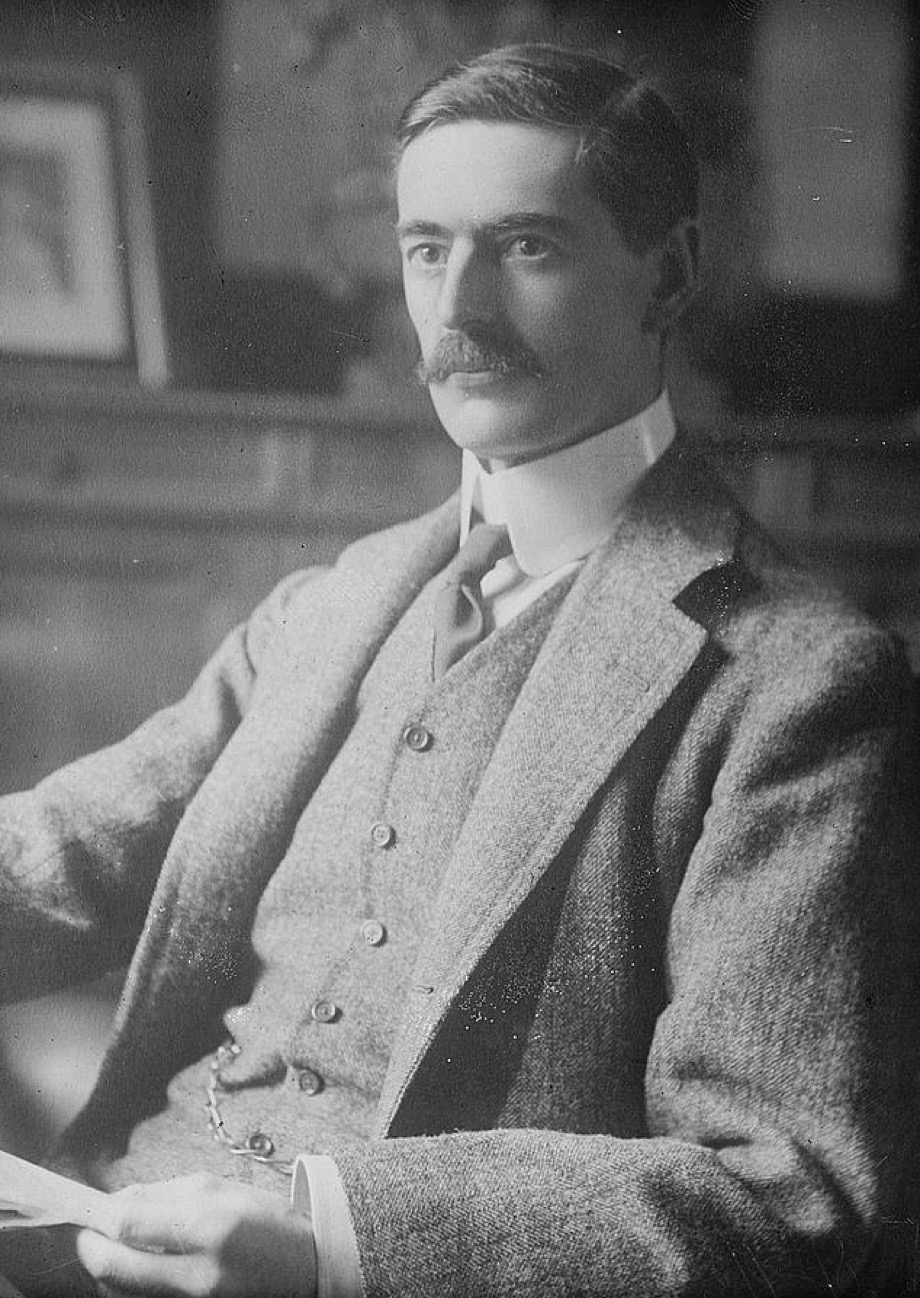
Portrait of Neville Chamberlain
The Ledger and the Umbrella
He is remembered for a piece of paper waved above an airfield crowd, and the memory has flattened him into a caricature: the stiff, wing-collared innocent who believed a dictator’s signature. But the man who flew to Germany three times in fifteen days in September 1938 — at sixty-nine, having never before boarded an aircraft — was not naive in the ordinary sense. He was something more interesting and, in the end, more tragic: a superbly competent administrator applying to Adolf Hitler the only method he had ever known to work.
Chamberlain came out of Birmingham manufacturing, the son and half-brother of political dynasty but himself a businessman first, and he made his name not in Parliament but in a city council chamber. As Lord Mayor of Birmingham he cleared slums, municipalised utilities, founded a municipal bank — the unglamorous, arithmetical work of making a large system function. He did not enter the Commons until he was forty-nine. By the 1930s he was Chancellor of the Exchequer and, in practice, the most effective executive in the government; in 1937 he took the premiership as a man who had spent thirty years demonstrating that hard problems yield to preparation, procedure, and a properly drafted agreement.
That record is the key to Munich. Chamberlain approached the Sudeten crisis as he had approached a municipal contract or a Treasury estimate: identify the grievance, quantify it, concede what is arguable, secure the signature, hold the counterparty to the terms. It was not cowardice. It was an ISTJ’s faith in the durability of a deal properly made — and a catastrophic inability to model an opponent for whom bad faith was not a lapse but a principle.
Chamberlain was an ISTJ whose dominant Si had stored one overwhelming lesson — the slaughter of 1914–18 — and whose Te built, out of that memory, the most methodical peace-making machine any British premier had ever operated.
The Memory of the Somme as Policy
Dominant Si is not nostalgia; it is the conviction that experience already had is the most reliable guide to experience about to be had. Chamberlain’s stored experience was the Great War, and it dominated his political imagination absolutely. He had lost a beloved cousin, Norman, on the Western Front and never quite recovered from it. He spoke of war not as a policy option that had gone badly but as a category of horror that a responsible administrator’s whole duty was to prevent recurring. “In war,” he said, “there are no winners.” That was not rhetoric. It was a data point, held with the peculiar vividness Si gives to things personally lived through.
From the same store came his reading of Versailles. Britain in the 1930s had convinced itself that the 1919 settlement had been vindictive and that German grievance was therefore partly legitimate — a view Chamberlain held not as speculation but as established fact, the way one holds a precedent. If the grievances were real, they could be enumerated; if enumerated, they could be settled. The Sudetenland, with its three million German speakers, fit the template exactly: a wrong done in 1919, correctable in 1938, after which the file would be closed. This is Si’s great strength turned into a trap — the pattern from the past fitted so neatly that no other pattern was searched for.
It is worth noticing what the same function did well. Chamberlain also remembered, precisely, how unready Britain was. He had read the air staff’s estimates of what German bombers would do to London; he had signed the Treasury papers. His judgement that the country could not fight in 1938 was empirical, not fearful, and radar and the Hurricane and Spitfire squadrons that won 1940 were built in the interval he bought. The memory that misled him about Hitler served him accurately about Britain.
Three Flights, and a Signature to Take Home
Auxiliary Te is the drive to impose order on the outer world by direct, efficient action — to stop analysing and start executing. In September 1938 Chamberlain did something no British prime minister had ever done: he got on an aeroplane and went personally to see a foreign head of government, uninvited, because the machinery of ambassadors and notes was too slow to produce a result. Berchtesgaden on the fifteenth. Bad Godesberg on the twenty-second, where Hitler raised his demands and Chamberlain, genuinely affronted, told him the terms were unacceptable. Munich on the twenty-ninth, where the deal was closed with Mussolini and Édouard Daladier in the room.
Te also explains the piece of paper. The Munich Agreement itself was a four-power document about Czechoslovak territory; the sheet Chamberlain waved at Heston was something else — a separate Anglo-German declaration he had drafted himself and pressed on Hitler in his flat the next morning, stating that the two countries would never again go to war with one another. To a Te mind that document was the deliverable. The negotiation had been converted into a written, signed, filed instrument. That is what closing a matter looks like to a man who spent his career on contracts.
And the same function governed how he ran the government. Chamberlain centralised foreign policy in Downing Street, worked through his own adviser Horace Wilson rather than the Foreign Office, and treated the Cabinet as a body to be informed of decisions taken. It was ruthlessly effective and it removed every institutional check that might have supplied the scepticism his own psychology could not generate. When Anthony Eden resigned in February 1938, Chamberlain lost the one senior colleague inclined to argue that the counterparty could not be held to terms — and replaced him with Lord Halifax, who would not.
The Private Code, and the Sense of Being Cheated
Tertiary Fi in an ISTJ is a quiet, interior, unshowable set of convictions about what a decent man does — rarely articulated, fiercely held, and easily wounded. Chamberlain was cold in public and stiff with colleagues, but his letters to his sisters, written weekly for decades, show a man of intense private feeling who measured himself constantly against an internal standard. He believed that keeping his country out of a second bloodletting was the thing he had been put in office to do, and he took the responsibility personally rather than institutionally. “However much we may sympathise with a small nation,” he told the country in his broadcast of 27 September 1938, “we cannot in all circumstances undertake to involve the whole British Empire in a war simply on her account” — a sentence usually quoted as callousness, but written by a man agonising over what his duty actually was.
Fi also explains the most revealing episode of his premiership: his reaction to 15 March 1939, when German troops entered Prague and swallowed the Czech rump that Munich had supposedly guaranteed. His first instinct in the Commons was defensive and legalistic. Two days later, at Birmingham, he abandoned the prepared text and spoke as a man who had been personally lied to. He asked whether this was “the end of an old adventure, or the beginning of a new,” and answered that no reliance could be placed on any further assurance. The tone is not strategic recalculation. It is moral injury — the private code registering that the other party had never intended to keep the contract at all.
What followed was fast, and it is the part of his record most often ignored. Within two weeks Britain had guaranteed Poland’s borders — the first peacetime continental commitment of its kind. Conscription followed in April, the first ever introduced in Britain in peacetime. Rearmament, already accelerating, went to a war footing. On 3 September 1939 Chamberlain declared war, and did it in the flat, exhausted voice of a man reporting the collapse of everything he had built. He then served under his supplanter without complaint.
The Possibility He Could Not Imagine
Inferior Ne is the blind spot: the difficulty of generating alternative readings of a situation, of asking what if this thing is not what it appears to be. Chamberlain could model a hard bargainer, a nationalist with a list of demands, an unpleasant man with a case. What he could not model — because it lay outside every precedent his Si held and every framework his Te trusted — was a counterparty who signed documents as a tactic, for whom the agreement was an instrument of the next aggression rather than a settlement of the last. After Berchtesgaden he wrote that he had got the impression of a man who could be relied upon when he had given his word. That judgement was not stupidity. It was the absence of an imaginative faculty that would have supplied the alternative hypothesis unbidden.
The same narrowness shows in his handling of dissent. Winston Churchill, on the back benches, was reading Hitler through an entirely different instrument — a historical imagination that ran forward in scenarios rather than backward through precedent — and Chamberlain dismissed him as an alarmist with a bad record. The Foreign Office’s own warnings were routed around. Under inferior-Ne pressure the ISTJ does not open up to possibilities; it grips the plan harder, and treats the people generating unwelcome futures as obstacles to be managed.
The end came in the one arena where his methods had no purchase. The Norway campaign of April 1940 was improvised, muddled, and lost, and in the Commons debate of 7–8 May the House turned. Leo Amery quoted Cromwell at him: “In the name of God, go.” He survived the division and lost the country, and on 10 May — the day the panzers crossed into the Low Countries — he resigned. He was dead of bowel cancer by November, having served to the last as Lord President in Churchill’s War Cabinet, running the domestic machinery of the war he had spent a decade trying to prevent.
Why ISTJ Over ISFJ
Why not ISFJ?
The ISFJ reading is tempting because appeasement is often described as a policy of compassion — sparing a generation the trenches. But an ISFJ’s Fe would have organised the policy around people: the mood of the crowd, the suffering of the Czechs, the harmony of the Cabinet. Chamberlain did none of these things. He was famously cold to colleagues, indifferent to the Czechs as a party to the transaction, and contemptuous of critics rather than conciliatory toward them. His logic was contractual, not caretaking — the municipal reformer’s conviction that a wrong specified in writing can be settled in writing. And where an ISFJ’s values live outward as duty to a community, Chamberlain’s lived inward as Fi: a private standard, invisible to his colleagues, which is precisely why his sense of betrayal in March 1939 arrived as personal injury rather than as a shared public grief.
Read as an ISTJ, everything coheres — and nothing is excused. The Si that held 1914 as an unrepeatable catastrophe, the Te that flew three times to Germany to get the thing signed, the Fi that broke when the signature proved worthless, and the Ne that could never once suggest it might. He was not a fool; he was one of the most capable administrators of his generation, deploying his real strengths against the one adversary in Europe those strengths could not touch. That is the shape of the tragedy, and it is a more useful warning than the caricature: competence, correctly applied to the wrong model of the world, is not a defence.
Connected Figures
Further Reading
- Neville Chamberlain: A Biography — Robert SelfThe standard modern life, built on the weekly letters to his sisters — the fullest account of the private man behind the public stiffness.
- Six Minutes in May — Nicholas ShakespeareThe Norway debate and the fall of Chamberlain, reconstructed hour by hour.
- Appeasing Hitler — Tim BouverieA narrative of the whole appeasement decade, unsparing but attentive to what the participants actually believed at the time.
