 Historical Figure MBTI
#908 · 7-3-26 · The Rise of Fascism
Anthony Eden
Foreign Secretary · The Resignation That Warned of War
1897 — 1977
10 min read
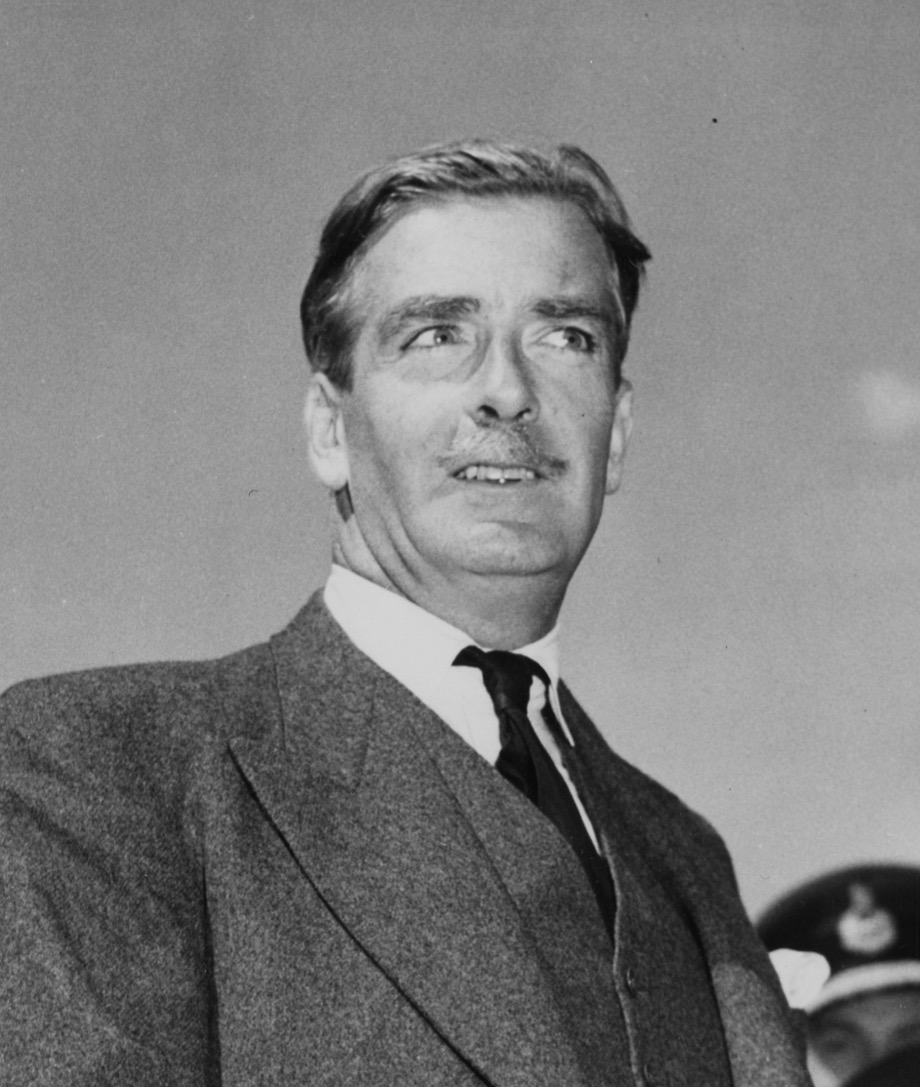
Portrait of Anthony Eden
The Handsome Man Who Walked Out
He was the best-looking man in British politics and never entirely escaped the fact. The homburg, the moustache, the tailoring, the fluent charm in three languages — Eden was the interwar Foreign Office’s idea of itself made flesh, and the press adored him for it. It made him famous young and it made him, later, easy to underestimate: the ornamental diplomat, all manner and no marrow, whose reputation would end in the wreck of Suez.
The record does not support the caricature. Behind the tailoring was a decorated infantry officer who had gone to the Western Front at eighteen, won the Military Cross bringing a wounded sergeant back across no man’s land, become the youngest brigade-major in the British Army at twenty, and lost two brothers to the war. He came into politics with a specific and personal horror of the thing, and with a linguist’s conviction that Europe was a room whose occupants could be talked to. He was Foreign Secretary at thirty-eight — the youngest in modern memory.
And then, in February 1938, he did the thing that fixes his place in this story. He resigned. Not over a grand principle stated in a manifesto, but over the specific question of whether Britain would open negotiations with Mussolini — Mussolini, with Italian troops in Abyssinia and Italian aircraft over Spain — while Neville Chamberlain conducted the approach behind his own Foreign Office’s back. Eden was thirty-nine, the most popular man in the Cabinet, and the heir apparent. He walked out anyway. That decision, more than the charm, is what makes him an ENFJ.
Eden was an ENFJ whose dominant Fe made him the most persuasive man in any room he entered — and whose Ni told him, years before his colleagues, exactly which room the road was leading to.
The Instrument of Persuasion
Dominant Fe is the reading of a room as a live thing — the instinct for what an audience needs to hear, and the ability to bring people with you by making them feel understood. Eden had it to an almost professional degree. At Geneva he became the public face of the League of Nations and of collective security, and the point was not the arguments, which were unremarkable, but the manner: he made a discredited institution look serious because he took it seriously in front of people, and Britain’s young voters loved him for it. The “Peace Ballot” generation of 1935 had a face, and it was his.
The same faculty made him a genuinely gifted negotiator. Sent to Berlin, Moscow, Rome and Warsaw in 1935 as Lord Privy Seal, he was the first senior British minister to sit across from Hitler and to sit with Stalin, and in both rooms he did what Fe does: established rapport, read the man, came away with a personal impression rather than a memorandum. Later, as Churchill’s wartime Foreign Secretary, he was the one sent to hold the alliance together in exactly the situations where relations, not documents, were the medium — Moscow in December 1941, the endless management of de Gaulle, the Free French and the exiled governments in London.
Fe also explains the cost he paid. He minded being disliked; he minded the press turning; he was thin-skinned in a way colleagues found wearing, and he suffered from what those around him called nervous strain in crises. A dominant feeling function pointed outward makes a man exquisitely sensitive to the temperature of a room, which is a superb diplomatic instrument and an exhausting way to live.
Where the Road Was Going
Auxiliary Ni is convergent foresight: not a survey of possibilities but a single line drawn forward through the data until it arrives somewhere. Eden’s line was drawn early. Over Abyssinia in 1935 he fought inside the Cabinet against the Hoare–Laval pact, which would have handed Mussolini the better part of a country the League had promised to protect; the deal leaked, Hoare fell, and Eden replaced him. Over the Rhineland in 1936, over non-intervention in Spain, over the Anschluss he was consistently the voice arguing that each concession was not a settlement but a rung.
The February 1938 resignation is Ni acting on a small case for large reasons. The immediate issue looked minor: Chamberlain wanted formal talks with Rome, and had been receiving unofficial approaches through his sister-in-law and the Italian ambassador while the Foreign Secretary was not told. Eden’s objection was not procedural pique. It was that opening negotiations with Mussolini at that moment, with Italian “volunteers” still in Spain, would teach the dictators the one lesson he most wanted them not to learn: that pressure produced conversation, and conversation produced concessions. He had seen where the sequence ended. He resigned on 20 February, and Churchill wrote afterwards that he lay awake that night in a sea of despair, seeing “one strong young figure” walk out on the whole business.
Ni is also why his warnings sound so unlike Churchill’s. Churchill argued in vivid, proliferating scenarios — the Ne of a historical imagination in full spate. Eden was quieter and more singular: he did not so much predict events as insist, with a certainty he could not always evidence, that a direction had already been set. It is a harder case to make in a Cabinet room, which is part of why he lost it.
Presence, Tailoring, and No Man’s Land
Tertiary Se is the appetite for the physical present — style, immediacy, the well-judged act performed in real time. Eden’s was unusually visible. The clothes were a political instrument: a soft black felt hat became so associated with him that Britain called the style an “Anthony Eden,” and the impression of effortless finish was carefully maintained. He was, along with Churchill, among the first British politicians to be genuinely good on newsreel and later on television — media that reward presence rather than argument.
The same function had shown itself in a far grimmer setting. On the Ypres front and at the Somme he was decorated for going out under fire to bring in a wounded man; at twenty he was running a brigade staff. Se supplies the capacity to act decisively inside a situation as it happens, without waiting for the analysis to close, and it left him with a physical courage that nobody who worked with him ever doubted, however much they doubted his nerve in office.
Its shadow appears at the end. The Suez adventure of 1956 — the secret collusion with France and Israel, the seizure of the canal, the humiliating reversal under American pressure — was in part a tertiary function running the show: the immediate, decisive, personally satisfying stroke against a man he had convinced himself was Mussolini returned. He was ill, medicated, and exhausted; he acted, and the act was catastrophic. He resigned in January 1957, his health broken, having held the premiership for less than two years.
The Argument He Could Not Quite Build
Inferior Ti is the weak spot: the difficulty of constructing a cold, internally watertight case that stands independent of the person making it. Eden knew things; he was less good at proving them. His resignation speech to the Commons was gracious, restrained, and curiously unconvincing as an indictment — he declined to make the wounding argument, and the House came away unsure quite what the difference of principle had been. The gap between what he saw and what he could demonstrate is the recurring frustration of his career.
It shaped his relationship with the machine as well. Where Chamberlain routed policy through Downing Street and Horace Wilson, Eden’s answer was personal — loyalty, relationships, his own standing with the Foreign Office — rather than a systematic counter-case. When Lord Halifax took the seals a fortnight later, the department’s scepticism about appeasement lost its advocate at the Cabinet table without ever having been written down as a doctrine anyone could inherit.
Under prolonged stress, inferior Ti curdles into brittle, over-personalised logic, and Suez is the textbook case. The chain of reasoning that took him to collusion with Paris and Tel Aviv — Nasser as Mussolini, the canal as the Rhineland, 1956 as the year to refuse to be 1938 — was an analogy doing the work of an analysis. He had learned the right lesson in 1938 and applied it, eighteen years later, to the wrong century.
Why ENFJ Over ESFJ
Why not ESFJ?
Everything sociable about Eden — the charm, the rapport, the sensitivity to how a room felt about him — would fit an ESFJ perfectly well. What does not fit is February 1938. An ESFJ’s Si serves the group as it actually exists: precedent, loyalty, the cohesion of the party and the government one belongs to, with harmony maintained above private conviction. Eden blew up his relationship with his own Prime Minister, split his party, and left the government at the summit of his popularity, over a question of foreign-policy direction that most of his colleagues could not yet see was a question at all. That is not sociable conformity; it is a convergent inner conviction about where events were heading, overriding every consideration of group comfort. Ni, not Si, was the thing that made the walk-out possible.
Read as an ENFJ, the whole arc holds together, including its ending. The Fe made him the most persuasive Briton in any European capital and the most easily wounded man in any British Cabinet; the Ni gave him a foresight he was never able to argue into a decision; the Se gave him the newsreel presence and, at the last, the fatal taste for the decisive stroke; and the Ti left him, in the crisis that ended him, reasoning by analogy from the very episode that had made his name. He was right in 1938 and wrong in 1956 for closely related reasons, which is the most human thing about him.
Connected Figures
Further Reading
- Eden: The Life and Times of Anthony Eden — D.R. ThorpeThe authorised modern biography, and the fullest defence of the man behind the Suez caricature.
- Appeasing Hitler — Tim BouveriePlaces the February 1938 resignation inside the full narrative of the appeasement decade.
- Facing the Dictators — Anthony EdenThe first volume of his own memoirs — his account of Geneva, Abyssinia and the resignation, self-serving but indispensable.
