 Historical Figure MBTI
#930 · 7-8-26 · The Second World War
Philippe Pétain
Head of Vichy France · The Hero Who Became a Collaborator
1856 — 1951
10 min read
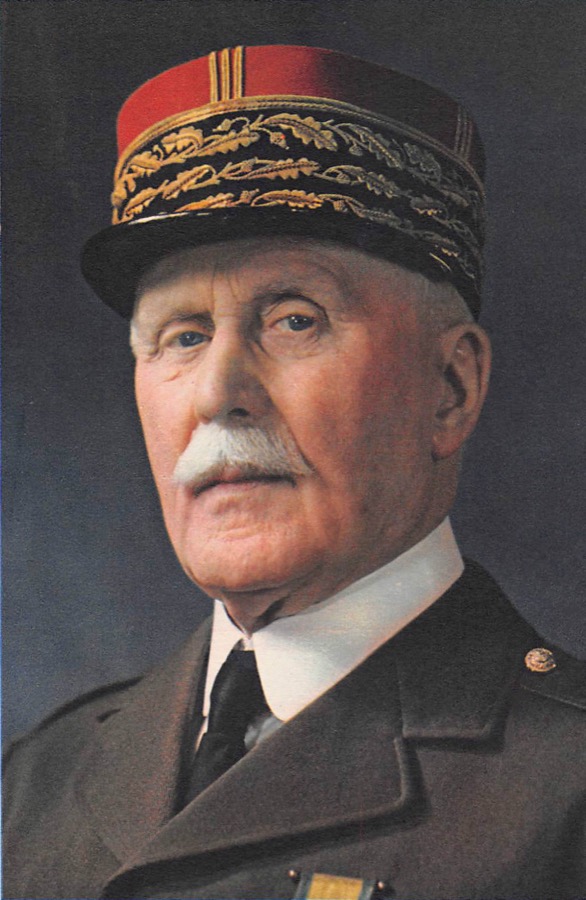
Philippe Pétain, official portrait, 1941 (public domain)
The Hero Who Signed
Philippe Pétain was the most revered soldier in France, the victor of Verdun, the marshal whose name schoolchildren learned alongside the Republic's. In June 1940, at eighty-four, he took power in a collapsing country and signed an armistice with Nazi Germany. He then presided over the Vichy regime, which of its own initiative enacted antisemitic laws excluding Jews from French public life, interned foreign Jews in French camps run by French police, and cooperated in the deportation of some seventy-five thousand Jews from France to the Nazi death camps, of whom fewer than three thousand returned. In 1945 a French court convicted him of intelligence with the enemy and sentenced him to death. He died in prison on the Île d'Yeu in 1951. No fall in modern European history is steeper, and none is more instructive, because almost nothing about the man changed between the two halves of it.
That is the difficulty Pétain poses. He was not a fanatic, not an ideological Nazi, not a man seized by some late derangement. He was in 1940 what he had been in 1916: cautious, methodical, contemptuous of romantic offensives, convinced that the first duty of a commander was to conserve his men and the ground he could actually hold, and profoundly sceptical of politicians and their enthusiasms. Those exact qualities had made him the one general at Verdun the poilus trusted. Applied to the catastrophe of June 1940, they produced collaboration, and then complicity in genocide.
The comfortable reading — that he was senile, or a figurehead, or that he shielded France from something worse — has not survived the archives. The Statut des Juifs of October 1940 was drafted without German demand, and the surviving draft carries handwritten amendments in Pétain's own hand, hardening it. The National Revolution he proclaimed — Travail, Famille, Patrie in place of Liberté, Égalité, Fraternité — was his own program, an authoritarian, clerical, agrarian France he had wanted for decades and that defeat finally made possible. He was not a passenger. He was the author.
Pétain is an ISTJ of the darkest kind: a dominant Si that could only read 1940 through the template of 1916, and a Te that administered the resulting surrender with the same procedural discipline it had once brought to holding a line.
A Man Who Never Left Verdun — Si
Pétain's entire military reputation rests on a single empirical insight: that firepower had outgrown flesh, that the offensive à outrance taught in the French staff colleges was a way of feeding men into machine guns, and that the answer was artillery, rotation, defense in depth and the husbanding of lives. He was an obscure colonel at fifty-eight because he had said so when it was unfashionable. Then 1914 proved him right, and 1916 at Verdun made him a legend — divisions rotated through the meat grinder, the Voie Sacrée kept open by relentless logistics, no men spent for glory. In 1917, when the army mutinied after Nivelle's offensives, he was sent to fix it, and did so with leave rotations, better food and selective executions: care and discipline in the same hand.
Every one of those lessons is stored experience, and dominant Si does not merely remember such things — it treats them as the reliable map of how the world works. The trouble is that the map was drawn in 1916. Between the wars Pétain, as inspector-general and briefly war minister, presided over the doctrine that produced the Maginot Line: the continuous fortified front, the methodical battle, artillery-led and slow. He is on record dismissing the Ardennes as impenetrable to a large force. When a difficult subordinate named Charles de Gaulle — whose 1938 book Pétain had partly ghost-supervised and then quarreled over — argued for independent armored formations, the marshal treated it as the sort of untested theorizing the last war had discredited.
So when the panzers came through the Ardennes in May 1940 and France collapsed in six weeks, Pétain read the disaster through the only frame he had. In 1916 France had endured by not overreaching, by conserving what could be conserved, by refusing the gambler's offensive. In 1940 the same instinct said: the army is broken, the front cannot be restored, further fighting will only destroy what remains of the country — therefore stop, accept terms, preserve the soil, the people and the state, and wait. De Gaulle's argument that the war was global and long required imagining a future unlike anything in the file. Pétain had no such faculty, and never had.
The Administration of a Surrender — Te
What makes Vichy monstrous rather than merely pitiable is that it was competently run. Pétain did not simply capitulate and retire; he built a state. Within a month of the armistice the National Assembly at Vichy voted him full constitutional powers, and he issued acts abolishing the presidency, suspending parliament and vesting legislative and executive authority in himself as Chief of the French State. Then came the machinery: a purge of the civil service, an oath of loyalty for officials and magistrates, the dissolution of the trade-union confederations, a corporatist Peasant Charter, youth camps, a veterans' Legion, censorship offices, special courts. It is the work of a man who thinks in organizational charts and believes that a country is fixed the way a demoralized army is fixed — by imposing order, hierarchy and procedure from the top.
The same instinct produced the crimes. The Statut des Juifs of 3 October 1940 defined Jewishness by descent and barred Jews from the civil service, the officer corps, teaching, the judiciary, the press, cinema and radio; a second statute in June 1941 extended the exclusions and imposed a census. A law of 4 October 1940 authorized prefects to intern foreign Jews by administrative order, which filled Gurs, Rivesaltes and Les Milles with families no German had asked for. Vichy created a Commissariat-General for Jewish Affairs to run aryanization — the seizure and resale of Jewish property — as an ordinary department of state, with forms and appeals and auditors. In July 1942 French police, not German, carried out the Vél' d'Hiv roundup in Paris, arresting more than thirteen thousand people including over four thousand children whom the Germans had not even requested, and Vichy negotiated their inclusion in the transports. Bureaucratic thoroughness is not a mitigating detail here. It is the mechanism.
Te in this configuration is not creative. It does not ask whether the objective is right; it optimizes the execution of an objective handed to it by Si — in this case "preserve the French state and its authority." Every concession bought a little more nominal sovereignty: the unoccupied zone, the fleet at Toulon, the empire, the administration. Pétain traded people for the appearance of a state, kept trading after November 1942 when the Germans occupied the southern zone and the appearance was gone, and was still signing when he was carried off to Sigmaringen in 1944 as the Reich's prisoner. The ledger balanced. Nothing in it was human.
The Gift of His Person — Fi
"I make France the gift of my person to attenuate her misfortune." That sentence, from the broadcast of 17 June 1940, is the tertiary function speaking, and it explains more about Vichy than any policy document. Pétain genuinely believed himself to be the last honest man in a country ruined by politicians, financiers, schoolteachers and the moral laxity of the interwar years. Defeat, in his private accounting, was deserved — a punishment for decadence — and his role was expiatory: to absorb the humiliation personally so that France could be purified by it. That is a moral conviction, held inwardly, entirely uninterested in whether anyone else shared it.
Tertiary Fi is also why he was so immovable and so self-righteous. He did not consult, in any real sense; he received advisers and then decided by reference to his own sense of what was fitting. He kept Pierre Laval, whom he despised, because the arrangement seemed necessary, then dismissed him in December 1940 in a small palace coup, then took him back in April 1942 under German pressure — each time on a private judgment of national necessity rather than on advice or affection. At his trial in 1945 he read a single statement asserting that he had sacrificed his prestige to shield the French people, then refused to answer any question for the remaining three weeks. He never conceded an error. To the end, the internal ledger showed him in credit.
The vanity should not be understated. He was intensely conscious of his own standing — the marshal's baton, the personal cult Vichy propaganda built with portraits in every classroom and a hymn, "Maréchal, nous voilà," sung by children. A man with strong extraverted feeling seeks connection; Pétain sought veneration, a colder thing, and mistook being loved by the nation for evidence that what he was doing to it was right.
No Second Future — Ne
The catastrophic failure of June 1940 was a failure of imagination, and it is exactly where inferior Ne lives. Pétain could not hold in his mind a world in which Germany, then master of the continent from the Pyrenees to Poland, subsequently lost. He told the cabinet that Britain would have her neck wrung like a chicken within weeks; on that premise, an early armistice secured better terms than a late one, and the fight-on faction were fantasists. He was not being cowardly. He was reasoning correctly from a single scenario, and he had no capacity to generate the others — a long war, an American entry, a Soviet front, a France liberated by allies rather than by treaty.
Worse, inferior Ne turns paranoid when it does operate. Vichy's explanation for the defeat was not doctrine or armor or air power; it was a conspiracy of the unworthy — Jews, freemasons, communists, foreigners, the anti-clerical schoolteachers of the Third Republic — and the Riom trials were convened in 1942 to establish it judicially against politicians including Paul Reynaud, until the proceedings began to demonstrate that the army's own preparations had been the problem and the Germans shut them down. That is the shadow: the intuition unavailable for foresight, and available only for suspicion.
Why ISTJ Over ISFJ
Why not ISFJ?
The ISFJ reading is seductive because of Verdun: the commander who counted his men, rotated his divisions and answered the 1917 mutinies with leave and hot food looks like Si-Fe protectiveness, and Vichy propaganda spent four years selling exactly that image — the grandfather sheltering France in his arms. But Fe organizes around actual people and their bonds, and Pétain's decisions never did. He was not warm; even his admirers found him glacial, distant, sparing of speech, indifferent to subordinates he had used up. His care for the poilus was a doctrine about the efficient use of manpower before it was an affection, and once the doctrine required it he signed the executions after the mutinies as readily as the leave rotations. And no feeling-for-others function produces the Statut des Juifs, an internment law, or a negotiation over how many children to include in a transport. Vichy ran on a cold survival calculus and a rigid faith in hierarchy — Te executing Si, with Fi supplying the private conviction that this was noble.
The typology is not an excuse and does not soften anything; it explains a mechanism. A dominant Si that could only see 1940 as a version of 1916, an auxiliary Te that would administer whatever objective it was handed, a tertiary Fi certain of its own nobility, and an inferior Ne with no access to an alternative future: those four together will reliably produce a man who mistakes surrender for stewardship and then organizes the consequences with a clear conscience. Ordinary rigidity, placed at the summit of a broken state, was sufficient. It did not require a monster.
Connected Figures
Further Reading
- France: The Dark Years 1940–1944 — Julian JacksonThe best single-volume account of the occupation, Vichy's own initiatives included.
- Pétain: A Hero's Fate — Herbert R. LottmanA full biography running from Verdun to the Île d'Yeu, strong on the 1945 trial.
- Vichy France: Old Guard and New Order, 1940–1944 — Robert O. PaxtonThe book that ended the alibi, showing collaboration was sought by Vichy rather than imposed on it.
- Vichy France and the Jews — Michael R. Marrus and Robert O. PaxtonThe documentary record of the Statut des Juifs, aryanization and the deportations.
