 Historical Figure MBTI
4 min read
#179 · 3-19-26 · Ancient Athens
Eudoxus of Cnidus
The Architect of Invisible Foundations
† 355 BCE
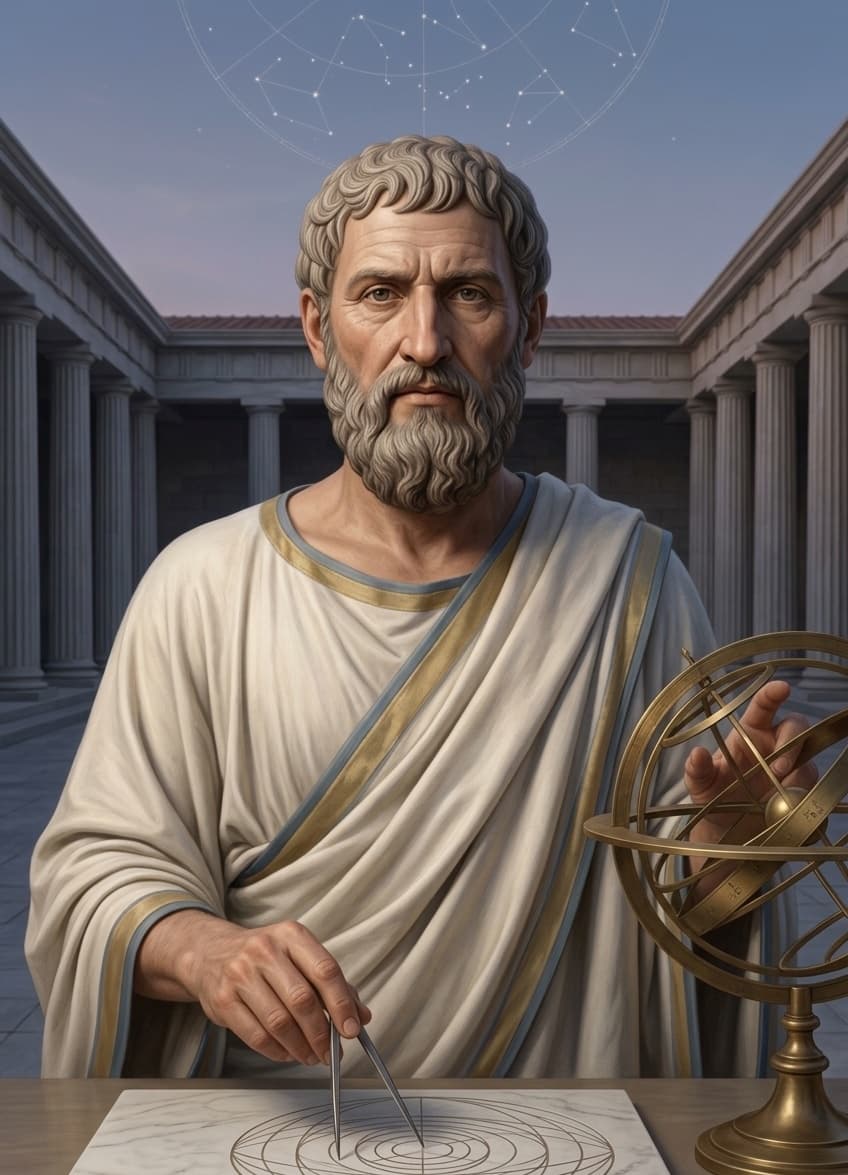
AI-assisted portrait of Eudoxus of Cnidus
The Logic of Foundations
Eudoxus did not leave behind a body of work. He left behind a structure.
Born in Cnidus, he moved across the intellectual centers of the Greek world—studying under Archytas, engaging with Plato and the Platonic Academy, and contributing to mathematics, astronomy, and philosophy in ways that would echo far beyond his lifetime.
And yet, his own writings are almost entirely lost. What remains is something subtler: methods, systems, and ideas preserved through others—most notably in the work of Euclid and Aristotle.
He is not remembered for what he said. But for what still works.
The Psychological Verdict
Eudoxus is often grouped among great system-builders of antiquity, and from a distance, this can resemble visionary philosophy. But a closer look reveals a different pattern: not the pursuit of a singular truth, but the construction of internally consistent frameworks.
He reads most clearly as INTP.
Ti — Dominant
Eudoxus’ defining contribution—the theory of proportion—addresses a foundational inconsistency in Greek mathematics. The discovery of irrational numbers had destabilized earlier systems, exposing gaps that could not be resolved through existing methods. Eudoxus did not bypass this problem.
He rebuilt the framework.
Rather than asserting new principles, he redefined how relationships between quantities could be understood so that the system would remain logically coherent—even in the presence of incommensurables.
This is Ti at its core: not expanding knowledge outward, but ensuring that what exists holds together internally. Not vision. Validation.
Ne — Auxiliary
His work extends across multiple domains—mathematics, astronomy, geography, and ethics—but what connects them is not a singular guiding vision. It is structural exploration.
His model of concentric spheres, preserved through Aristotle, attempts to explain celestial motion through layered geometric systems. It is not empirically precise, but conceptually elegant—an exploration of how different structures might account for observed phenomena.
This reflects Ne: not settling on one answer, but generating frameworks that could work. Possibility, constrained by logic.
Si — Tertiary
Despite his innovations, Eudoxus operated within the established traditions of Greek mathematics. His work builds on prior systems rather than discarding them, and its preservation through Euclid suggests a compatibility with existing formal structures.
There is continuity in his approach—a respect for what came before, even as he modifies it. This is Si in a tertiary position: grounding new frameworks in inherited ones.
Fe — Inferior
What is notably absent is any strong emphasis on persuasion, rhetoric, or ethical framing in a social sense. Even his ethical views—such as identifying pleasure as the highest good—are preserved through the analysis of others, rather than through compelling personal argumentation.
His focus is not on aligning with others. It is on aligning the system.
Analysis
Why not INTJ?
Eudoxus’ scale of influence can resemble that of a visionary thinker. But the orientation is different.
INTJs tend to compress complexity into a singular, unifying principle—a central vision that organizes all domains. This is evident in figures like Plato, whose philosophy converges toward the Form of the Good.
Eudoxus does not converge. He reconstructs. His work does not seek one ultimate explanation, but multiple internally consistent ones. His astronomy is not a vision of reality’s essence, but a model that accounts for its behavior. His mathematics does not declare truth, but ensures coherence.
This is not Ni-driven synthesis. It is Ti-driven construction.
The System That Remains
Eudoxus is one of the few figures in history whose legacy survives almost entirely without his voice. No treatises. No dialogues. Only structures that others found too useful to discard.
In that sense, his work achieved something rare. It disappeared into the foundation. Not the thinker you remember. But the logic you still use.
Not the voice that shaped the ideas. But the logic that sustained them.
Connected Figures
Further Reading
- A History of Greek Mathematics — T. L. HeathThe standard English-language reference on Greek mathematical thought, with detailed coverage of Eudoxus' theory of proportions and the method of exhaustion.
- The Mathematics of Plato's Academy — D. H. FowlerReconstructs the mathematical practice of the Platonic Academy, including Eudoxus' contributions to ratio theory and the philosophical context in which they arose.
- Early Greek Science: Thales to Aristotle — G. E. R. LloydPlaces Eudoxus within the broader development of Greek scientific thought, tracing the move from cosmology to mathematical astronomy.
