 Historical Figure MBTI
4 min read
#188 · 3-20-26 · Ancient Athens
Aristotle
The Architect of Knowledge
384 – 322 BCE
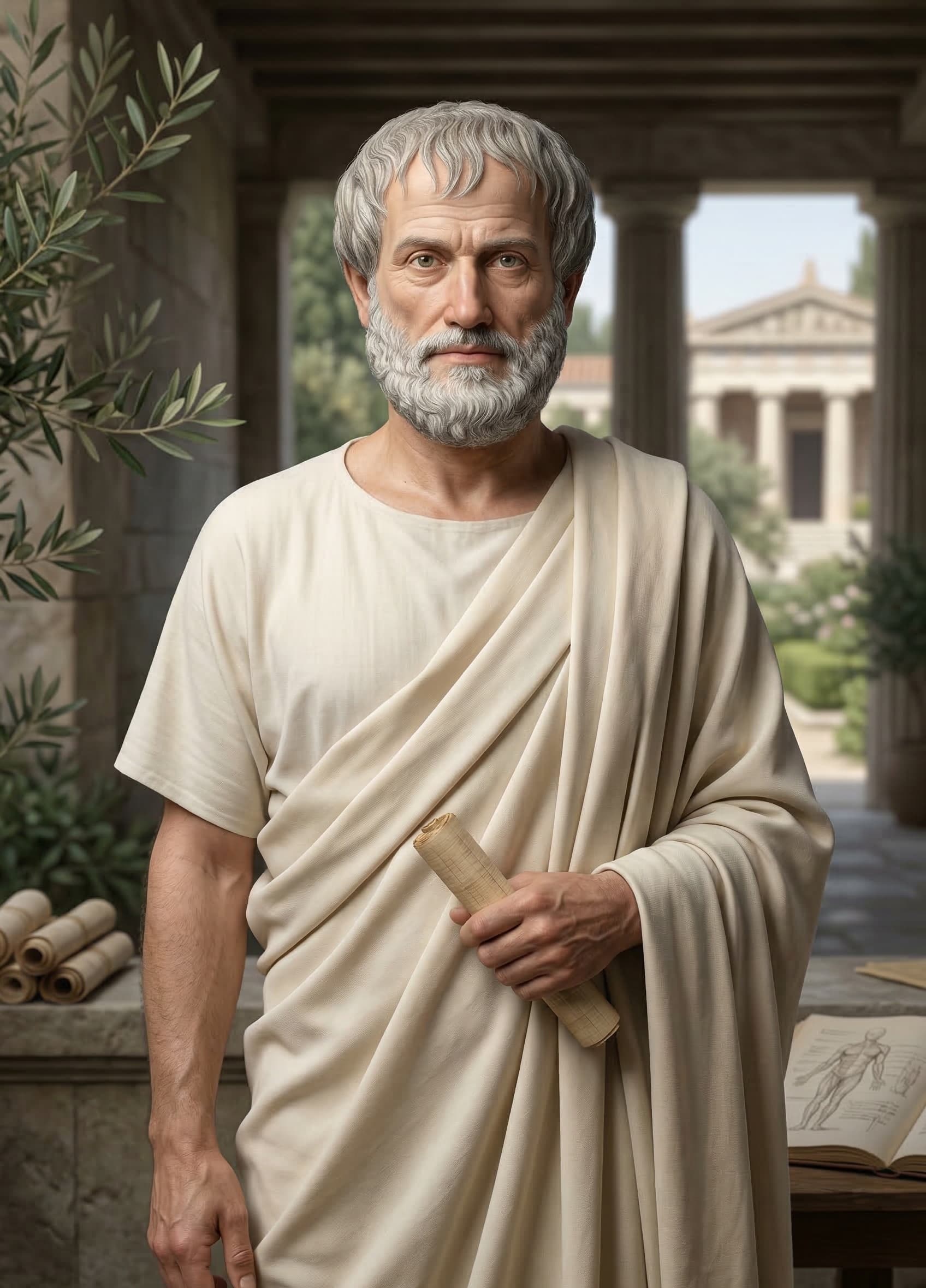
AI-assisted portrait of Aristotle
The Architecture of Reason
Aristotle did not inherit a system. He built one.
A student of Plato for twenty years, he began within an already towering philosophical structure—one oriented toward abstract forms and transcendent ideals. This was not a brief apprenticeship, but a period of profound patience and absorption.
But Aristotle did not remain within it. Where Plato sought what lies beyond reality, Aristotle turned toward what is within it.
Not to reject philosophy. But to reorganize it.
Across disciplines—logic, biology, ethics, politics, metaphysics—Aristotle does not simply contribute ideas. He structures entire domains of knowledge, defining categories, methods, and principles that would shape intellectual inquiry for centuries.
He does not chase insight. He systematizes it.
The Psychological Verdict
Aristotle is often described as methodical, comprehensive, and oriented toward understanding reality through structured observation and classification. His work reflects not scattered curiosity, but a consistent drive to organize knowledge into coherent systems.
He reads most clearly as INTJ.
Ni — Dominant
Aristotle’s thinking converges. Though grounded in observation, his aim is not to collect facts, but to understand underlying principles—causes, purposes, and structures that define how things are. His concept of the four causes, for instance, reflects a drive to unify explanation under a coherent framework.
This is Ni: moving from the many to the one. Not accumulation. Integration.
Te — Auxiliary
What distinguishes Aristotle is execution. He does not leave ideas in abstraction—he organizes them, categorizes them, and builds systems that can be taught, applied, and extended. His works are structured, deliberate, and oriented toward clarity and utility.
This is Te in service of Ni: translating insight into organized knowledge. Not just understanding. Building.
Fi — Tertiary
There is a quieter layer of internal alignment. Aristotle’s ethics, centered on virtue and the cultivation of a good life, reflect a concern with what is right—not merely in a social sense, but in relation to human flourishing. This suggests a personal, internal orientation toward value, even if it is not overtly expressed.
This reflects tertiary Fi: present, but contained.
Se — Inferior
Aristotle engages with the sensory world, but not for its own sake. Observation is a tool, not a focus. His attention to empirical detail serves a larger aim—to understand structure and causality. He is not immersed in the present moment, but uses it as input for deeper synthesis.
This reflects inferior Se: engagement with reality in service of vision.
Analysis
Why not ENTJ?
Given Aristotle’s productivity and structured output, ENTJ may seem plausible—a figure organizing systems and executing at scale. But the distinction lies in domain.
ENTJs tend to organize the external world—institutions, people, systems of power—with a focus on control and outcomes. Their orientation is outward, toward directing reality.
Aristotle’s work is not about controlling systems. It is about understanding them. His structures are intellectual, not managerial. He is not directing people or enforcing systems in the external world—he is constructing frameworks that describe reality itself.
This is not Te leading outward. It is Ni–Te building inward.
Why not ESTJ?
ESTJ may also seem plausible given Aristotle’s emphasis on classification, order, and structured knowledge. But ESTJs tend to rely on precedent—organizing based on what is known, established, and already validated (Si).
Aristotle is not preserving a system. He is redefining it. He does not simply categorize what is already accepted—he introduces new frameworks for understanding causality, logic, and nature. His orientation is not toward maintaining tradition, but toward constructing a new intellectual order.
This is not Si–Te preservation. It is Ni–Te creation.
The System That Remained
Aristotle did not simply think about the world. He structured how it would be understood.
For centuries, his frameworks shaped not just philosophy, but science, logic, and education—not because they were the only way to see reality, but because they formed a coherent way to organize it.
He did not seek endless questions. He sought stable answers.
Not the philosopher who questioned everything. But the one who built what followed.
Connected Figures
Further Reading
- Aristotle — Jonathan BarnesThe authoritative short introduction — rigorous on the logic and metaphysics without sacrificing readability.
- Nicomachean Ethics — Aristotle (trans. Terence Irwin)The central ethical text in its most scholarly translation — the clearest window into Aristotle's vision of the good life.
- Aristotle's Way — Edith HallA warm, humanizing account of how Aristotle's practical philosophy can be lived today.
- Aristotle: A Very Short Introduction — Jonathan BarnesA more accessible entry point than the full biography — good for readers new to ancient philosophy.
- The Lagoon: How Aristotle Invented Science — Armand Marie LeroiFocuses on Aristotle's biological observations, recovering him as the first genuine naturalist.
