 Historical Figure MBTI
3 min read
#189 · 3-20-26 · Ancient Athens
Pythias
The Wife — A Life of Refined Intellect
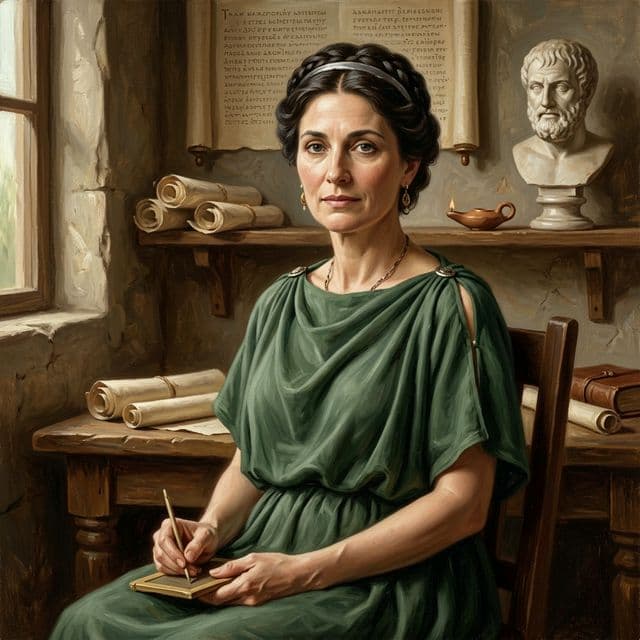
AI-assisted portrait of Pythias
The Architecture of Partnership
Pythias did not merely occupy a home; she inhabited an intellectual circle. As the niece and adoptive daughter of Hermias of Atarneus and the first wife of Aristotle, her life was defined by the intersection of high politics and deep philosophy. Her journey was one of refined depth, serving as a companion to the man who was mapping the entire universe while she navigated the precarious transitions of his early career.
She lived as a figure of quiet intellectual loyalty, using her background to support the growth of the Peripatetic project. Her personality was a bridge between the courtly structures of her youth and the academic rigor of her adult life, finding a sense of individual agency through the shared search for the Good.
Historical Context
Pythias the Elder was born in Atarneus and joined Aristotle in his travels after he left the Academy in Athens. She accompanied him to Assos and later to Mytilene, eventually settling with him in his return to Athens. Reportedly an educated woman who participated in the school’s discourse, she died relatively young. Aristotle’s will honored her memory profoundly, requesting that her bones be buried next to his—a testament to the depth of their partnership and her importance to his life's work.
The Psychological Verdict
Pythias reads most clearly as ISFJ. She was a figure of quiet, internal depth and refined loyalty (Si), guided by a desire for social and intellectual harmony (Fe) within the circle of the Academy.
The Years That Made the Philosopher
Pythias was the niece and ward of Hermias of Atarneus, given to Aristotle in marriage around 347 BCE when he left Plato’s Academy. They traveled together — to Assos, where Hermias had established a small philosophical court, to Mytilene on Lesbos where Aristotle did much of his foundational biological fieldwork, and eventually to Macedonia when Philip II hired him to tutor Alexander. Pythias died sometime around 335 BCE, before Aristotle returned to Athens to found the Lyceum. She is one of the absent figures in his intellectual biography — present during the years of formation, gone before the institution. Ancient sources suggest she participated in philosophical discussion; this is plausible but unverifiable. Aristotle’s will honored her: her bones were to be buried next to his, per his own request. She reads as ISFJ in tendency — loyal, attentive, someone who held the household together through years of political instability and itinerant academic life. The bones were buried together. That much was kept.
Connected Figures
Further Reading
- Aristotle: His Life and School — Carlo NataliTraces Pythias's marriage to Aristotle through the Assos and Mytilene years, before the founding of the Lyceum.
- The Cambridge Companion to Aristotle — Jonathan Barnes (ed.)Situates the biological fieldwork Aristotle conducted on Lesbos during the years Pythias shared with him.
- Lives of the Eminent Philosophers — Diogenes LaertiusPreserves Aristotle's will, including his request that Pythias's bones be buried beside his own.
