 Historical Figure MBTI
5 min read
#204 · 3-21-26 · The Age of Alexander
Alexander the Great
The Visionary Who Sought the Ends of the World
r. 336 – 323 BCE
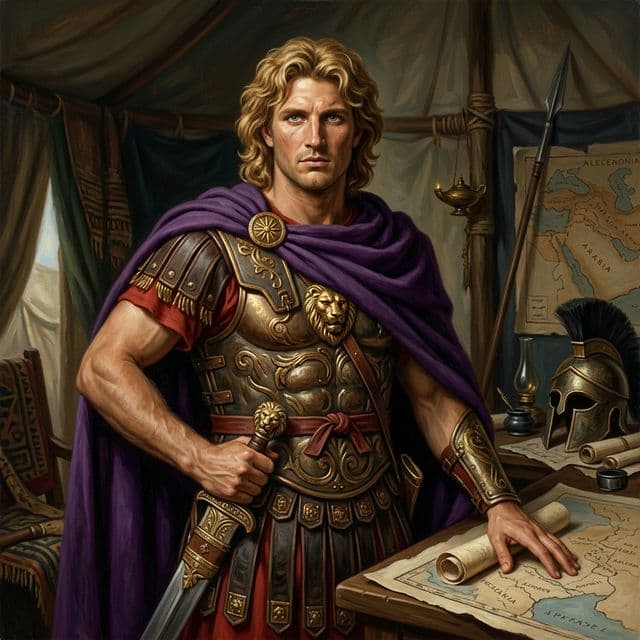
AI-assisted portrait of Alexander the Great
The Architecture of Expansion
Alexander did not just conquer territory; he envisioned a unified world. Born to two powerful ENTJ parents—the military mastermind Philip II and the fierce, mystical Olympias—he grew up in a household defined by absolute strategic will and the drive for dominion. While he inherited their command of reality, Alexander’s own temperament was oriented toward something more expansive: the integration of collective identity.
He saw possibilities where others saw borders. From Macedonia to the Indus, he moved with a conviction that the world could be reshaped not just through force, but through a shared vision of leadership that could unite disparate peoples under a single, grand identity.
Historical Context
Ascending to the throne at just twenty years old after his father's assassination, Alexander faced a world in transition. He transformed Macedon from a regional power into the center of the largest empire the world had yet seen. His campaign dismantled the Persian Empire and spread Hellenic culture across three continents, laying the foundations for the Hellenistic age. His life was a brief, intense explosion of energy that permanently shifted the course of Western and Eastern history.
The Psychological Verdict
Alexander reads most clearly as ENFJ. He was a leader driven by a powerful vision of unity and collective identity (Fe), guided by an intuitive sense of destiny (Ni) and a high degree of physical and tactical engagement (Se).
Fe — Dominant
Alexander’s leadership was profoundly relational and collective. Unlike his parents, who ruled through the cold, structural efficiency of Te, Alexander built loyalty through a shared sense of glory. He sought to integrate conquered peoples into his empire, adopting their customs and encouraging his generals to marry into their lineages. He wanted to create a global demos where everyone participated in the myth of his leadership.
Ni — Auxiliary
His strategy was guided by a singular, long-term vision. He wasn't just reacting to the next battle; he was following a path toward a conceptualized horizon—the ends of the world. This auxiliary Ni provided the "destiny" behind his drive, transforming a simple military conquest into a spiritual crusade for world unification.
Se — Tertiary
Alexander lived in the intensity of the moment. His personal bravery at the head of every charge and his appreciation for splendor, physical challenges, and the immediate impact of his presence reflect a strong connection to Se. This was the fire that fueled his Fe vision, making his abstract ideas visceral and real to his followers.
Ti — Inferior
His emotional intensity and visionary drive could sometimes override the practical, analytic caution of inferior Ti. When he pushed his men to the point of mutiny at the Hyphasis River, his "vision" (Fe-Ni) had completely detached from the cold reality of logistical and internal logic (Ti).
Analysis
Why not ENTJ?
Alexander’s drive was not purely structural or logistical. While he was a brilliant strategist, his primary mode was the creation of a shared mythos and identity. He led through inspiration and cultural integration (Fe) rather than purely through cold system-building (Te).
The Dream That Consumed the World
What separates Alexander from every conqueror before or since is not the distance he covered, but the depth of his belief that the distance mattered. Philip gave him the machine; Olympias gave him the myth. Aristotle gave him the questions. But what drove him to the edge of the known world was something none of them gave him — an internal fire that could only be satisfied by the act of reaching. Hephaestion was the one person who understood it without needing to explain it; Ptolemy was the one who survived it by watching from a careful distance. The cities Alexander left behind, strewn across Asia like embers, were not monuments to conquest — they were evidence of a man who truly believed that if he could just get far enough, something permanent would finally begin.
Not the king who ruled a nation. But the visionary who tried to end the distance between nations.
Connected Figures
Further Reading
- Alexander the Great — Robin Lane FoxThe authoritative modern biography — vivid, scholarly, and unsparing about the man behind the legend.
- Alexander the Great — Philip FreemanAccessible one-volume life grounded in the ancient sources, with clear analysis of the campaigns.
- The Campaigns of Alexander — Arrian (trans. Aubrey de Sélincourt)The closest ancient source — Arrian wrote from Ptolemy's and Aristobulus's firsthand accounts.
- Alexander of Macedon, 356–323 BC — Peter GreenA revisionist biography that takes seriously Alexander's megalomania and the cost of his vision.
