 Historical Figure MBTI
4 min read
#206 · 3-21-26 · The Age of Alexander
Olympias
The Mystical Heart of Macedon
c. 375 – 316 BCE
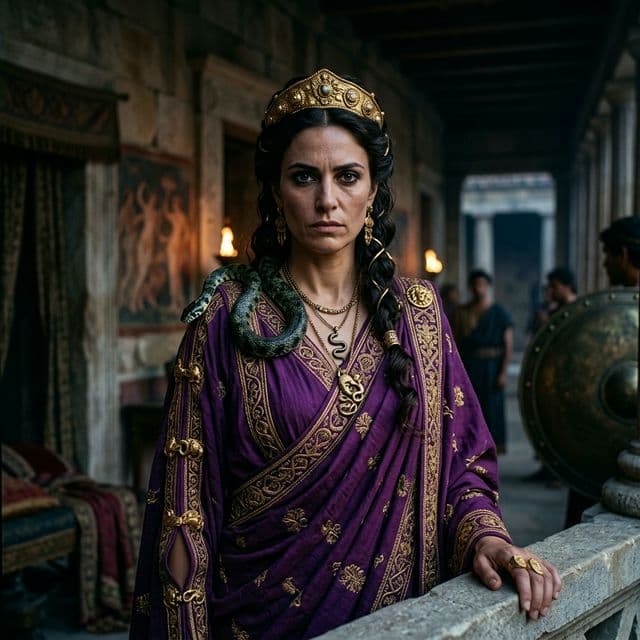
AI-assisted portrait of Olympias
The Architecture of Destiny
Olympias did not just raise a king; she cultivated a god. As the Molossian princess who married Philip II of Macedon, her life was defined by an iron-clad will and a profound connection to the mystical rites of Dionysus. While her husband built the Macedonian state through structural logic (Te), Olympias operated through a fierce, uncompromising drive to secure her son’s path to the throne. Her personality was a storm of strategic ambition and religious conviction, fueled by the certainty that Alexander was destined for more than mere mortality.
She lived as a protector and a provocateur. Her cognitive focus was entirely on the long-term goal of the Argead dynasty, using her intensity to navigate a court that was often hostile to her status as a "foreign" queen. To Olympias, power was not an end in itself, but the necessary vessel for the fulfillment of a divine vision.
Historical Context
Olympias was the primary wife of Philip II and the mother of Alexander the Great. After Philip's assassination, she was instrumental in securing Alexander's succession and remained a powerful force in Macedonian politics during his campaigns. Her final years were spent in a brutal struggle for power against Cassander, as she fought to preserve the legacy of her son and grandson. Her life remains one of the most polarizing and powerful examples of female agency in the ancient world.
The Psychological Verdict
Olympias reads most clearly as a fierce ENTJ. Her life was a relentless exercise in strategic will (Te), guided by an intuitive sense of destiny and legacy (Ni), and supported by a high-stakes engagement with the physical and religious world (Se).
Te — Dominant
Her primary mode was the application of will to the external world. She was a master of political maneuvering, understanding exactly how to consolidate power and eliminate rivals. Her actions were decisive, calculated, and oriented toward the objective outcome of securing the throne for her lineage. She did not wait for events to unfold; she forced them to align with her goals.
Ni — Auxiliary
Supporting her will was a deep, intuitive vision of the future. Olympias saw herself and her son as part of a grander, mythological narrative. This auxiliary Ni provided the "why" behind her "how," transforming political survival into a crusade for a divine legacy. She understood the symbolic power of her actions and used them to shape the destiny of Macedon.
Se — Tertiary
Her participation in the Bacchic rites and her reported handling of serpents reflect an intense, almost visceral connection to the physical world. This tertiary Se manifests in her bravery and her willingness to engage in the bloody realities of power. She was not a distant strategist; she was a present, formidable force who inhabited her role with total sensory commitment.
Fi — Inferior
Her intense focus on external power and the fulfillment of her vision often came at the cost of personal, subjective vulnerability. Her inferior Fi could manifest as an uncompromising, almost vengeful attachment to her own values and loyalties, leading to a "with us or against us" mentality that made her both a powerful ally and a terrifying enemy.
The Flame Behind the Throne
Olympias did not survive the wars of the Diadochi — but she shaped every one of them. When Philip was murdered, she was suspected. When Alexander conquered the world, she was the one who had convinced him he was destined to. When Roxana was trying to secure her son’s claim to the throne, it was Olympias who crossed from Epirus with an army to enforce it. Cassander had her executed in 316 BCE — not in battle, but by a vote of the Macedonian assembly, because even her enemies recognized she was too dangerous to face directly. She is the figure that the Hellenistic age both required and refused to accommodate: a woman of absolute conviction operating at the center of a world that ran on male authority. She made it work anyway, until the day it didn’t.
Connected Figures
Further Reading
- Olympias, Mother of Alexander the Great — Elizabeth Donnelly CarneyThe definitive modern biography, tracing her political career and posthumous reputation.
- Alexander the Great — Robin Lane FoxPlaces Olympias's influence in the full arc of Alexander's life and campaigns.
- Women and Monarchy in Macedonia — Elizabeth Donnelly CarneyExamines the structural role of royal women in Macedonian court politics.
- The Wars of Alexander's Successors 323–281 BC — Bob Bennett & Mike RobertsCovers the Diadochi conflicts in which Olympias fought her final, fatal campaign.
