 Historical Figure MBTI
5 min read
#210 · 3-21-26 · The Age of Alexander
Hephaestion
The One for Whom the King Wept
c. 356 – 324 BCE
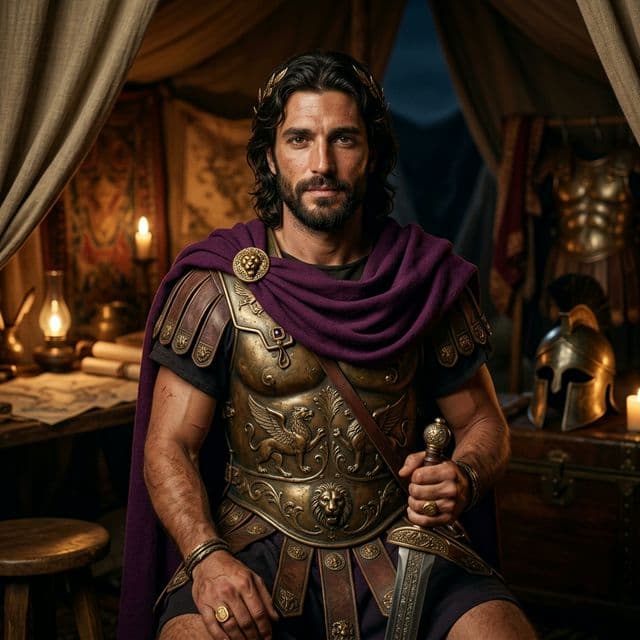
AI-assisted portrait of Hephaestion
The Architecture of Devotion
Hephaestion did not just follow a king; he inhabited a soul. As the closest companion of Alexander the Great from their youth at Pella, their relationship was the emotional and intellectual anchor of the Macedonian expansion. While the other generals focused on the structural logistics of conquest (Te) or the political integration of peoples (Fe), Hephaestion’s core mode was an intense, internal loyalty to the person of Alexander (Fi). He was the guardian of the king’s private self, providing a quiet, unwavering mirror to Alexander’s own titanic vision.
He lived as a figure of singular dedication. His cognitive focus was entirely on the internal consistency of his relationship with Alexander, using his auxiliary Ne to mirror and facilitate the king’s most expansive conceptual projects. For Hephaestion, the world was secondary to the shared identity he built with the most powerful man in history.
Historical Context
Hephaestion was a Macedonian nobleman, a general, and the Chiliarch (second-in-command) of Alexander the Great's empire. Beyond his military roles, he was Alexander’s most intimate confidant, famously described as "Patroclus to Alexander's Achilles." Their partnership was so profound that upon Hephaestion's sudden death in Ecbatana in 324 BCE, Alexander’s grief reached mythical proportions, leading to the establishment of heroic cults in his memory. His death is often seen as the beginning of the end for Alexander himself, who followed him into the dark less than a year later.
The Psychological Verdict
Hephaestion reads most clearly as an INFP. He was a figure defined by his deep, internal loyalty and personal values (Fi), guided by a broad, imaginative mirroring of Alexander’s vision (Ne), and supported by a fierce connection to the shared history of their youth (Si).
Fi — Dominant
Her primary mode was the cultivation of a singular, internal value. Hephaestion’s life was not about his own ambition, but about the integrity of his bond with Alexander. His Fi manifested in a quiet, uncompromising loyalty that stood apart from the court’s political maneuvering. He was the one who could tell Alexander the truth because his loyalty was to the man, not the crown. He was the emotional heartbeat of the campaign.
Ne — Auxiliary
Supporting his internal values was an expansive, intuitive openness. Hephaestion was often the one who best understood and facilitated Alexander’s most radical plans, including his desire for cultural fusion. His auxiliary Ne allowed him to see the future Alexander was building and to inhabit it alongside him. He wasn't just a soldier; he was a participant in a grand, conceptual project for a unified world.
Si — Tertiary
Beneath his participation in the new empire lay a bedrock of shared memory. His tertiary Si manifested in his constant reference to their shared youth and the heroic templates of the Iliad. This function provided the stability to his relationship with Alexander, anchoring the king’s mercurial nature in the tangible, reliable truths of their lifelong friendship.
Te — Inferior
What stayed in the background was a relative detachment from the desire for autonomous, structural power. While Hephaestion was a competent commander, his administrative and military success was always a function of his role as Alexander’s Chiliarch. His inferior Te manifested in his lack of independent political ambition; for him, the organizational reality was merely the stage upon which his singular devotion was played out.
The Other Half of the Conqueror
There is a passage in Plutarch where Alexander, standing at the tomb of Achilles, says he envied the hero for having a friend like Patroclus — and then turned to Hephaestion. That moment encapsulates everything. Hephaestion was not Alexander’s general, though he served as one. He was not his administrator, though he held the title of Chiliarch. He was the person Alexander allowed to see the inside of the dream. When Hephaestion died in Ecbatana in 324 BCE, Alexander’s grief was operatic and total — he refused food, ordered the manes of all horses cropped, tore down the battlements of the surrounding city, and sent to the oracle at Siwa to ask if Hephaestion could be worshipped as a god. Ptolemy would later write of it with careful understatement. Perdiccas helped carry the body. The world had seen conquerors before. It had not often seen a conqueror who fell apart like this.
Connected Figures
Further Reading
- Alexander the Great — Robin Lane FoxThe most vivid narrative biography of Alexander; gives sustained attention to Hephaestion as the king's closest companion throughout the campaigns.
- The Nature of Alexander — Mary RenaultA luminous historical study that takes Hephaestion's relationship with Alexander seriously as an emotional and political fact.
- Alexander of Macedon, 356–323 B.C.: A Historical Biography — Peter GreenA rigorous scholarly account that places Hephaestion's role within the full political and military context of the Macedonian empire.
- Hephaestion Amyntoros: Epimeletes of Alexander the Great — Waldemar HeckelThe most focused scholarly treatment of Hephaestion's administrative role and historical significance within the conquests.
