 Historical Figure MBTI
5 min read
#216 · 3-21-26 · The Age of Alexander
Perdiccas
The Guardian of the Seal
c. 355 – 320 BCE
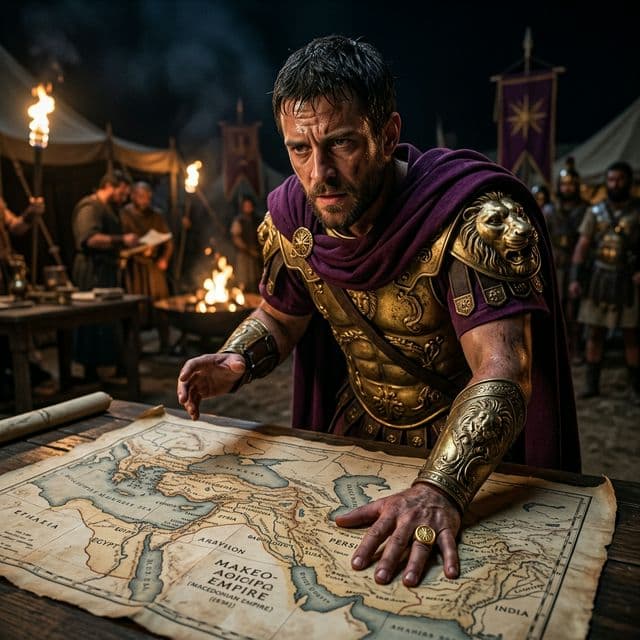
AI-assisted portrait of Perdiccas
The Architecture of Authority
Perdiccas did not just receive a ring; he assumed a burden. When Alexander the Great handed him the royal signet seal on his deathbed in 323 BCE, Perdiccas was thrust into the role of the regent of a collapsing world. While others like Ptolemy immediately sought the stability of separate parts (Te-Si), Perdiccas’s genius was profoundly oriented toward the structural maintenance of the whole (Te-Ni). He was the only general who fought to keep the universal empire together, applying a rigid, authoritative logic to a situation that was rapidly spiraling into chaos.
He was the master of the imperial frame and the hard command. From the Partition of Babylon to his final, ill-fated march on Egypt, Perdiccas’s cognitive mode was focused on the objective preservation of the Argead system. He was a leader who valued hierarchy, structural continuity, and the absolute authority of the throne.
Historical Context
Perdiccas was a Macedonian general and a primary companion of Alexander the Great. After Alexander's death, he was appointed Supreme Regent of the Empire, acting on behalf of the cognitively disabled Philip III Arrhidaeus and the infant Alexander IV. His attempts to centralize power and his intended marriage to Alexander's sister Cleopatra led to a coalition of the other Diadochi against him. He was assassinated by his own officers—including Seleucus—during a failed invasion of Egypt in 321/320 BCE. His death marked the effective end of the attempt to maintain a unified Macedonian empire.
The Psychological Verdict
Perdiccas is a definitive ENTJ. He was a leader defined by his relentless focus on external organization and authoritative command (Te), guided by a clear, if ultimately overreaching, strategic vision for the empire (Ni), and supported by a pragmatic engagement with the physical reality of power (Se).
Te — Dominant
His primary mode was the application of logic to the structure of the state. Perdiccas saw the empire as a single machine that required a unified command. His decisions at Babylon were designed to preserve the hierarchy and prevent the fragmentation of the military. He was a leader who spoke in the language of objective rights and structural necessity, attempting to force a fractured reality back into a coherent frame.
Ni — Auxiliary
Supporting his will was a deep, intuitive vision of a unified Argead world. Perdiccas truly believed in the "King's Peace" and the necessity of a single sovereign. This auxiliary Ni allowed him to look past the immediate grievances of the other generals to see the systemic disaster that fragmentation would cause. He was a man who planned for a global future that his contemporaries were already abandoning in favor of regional survival.
Se — Tertiary
Perdiccas was a formidable soldier who had proven himself in the most intense battles of Alexander’s campaign. His tertiary Se gave him the tactical presence to command the phalanx and the physical bravery to face his rivals. However, this same Se could lead to an overestimation of his own physical power, as seen in his stubborn, disastrous attempt to force a crossing of the Nile against the elements and the enemy.
Fi — Inferior
His narrow focus on structural power and the preservation of the empire often left him blind to the personal, subjective motivations of his subordinates. His inferior Fi manifested in his inability to build genuine, relational trust with his fellow generals, leading him to rely on authority and fear rather than shared loyalty. This isolation eventually led to his betrayal by those he trusted most to execute his orders.
The Regent Who Reached Too Far
Perdiccas held the ring and the empire when Alexander died — literally, as Alexander reportedly handed him his signet ring in his final hours. He inherited the impossible: a world-state with no clear heir, surrounded by ambitious men who had spent a decade earning the right to their own kingdoms. His attempts to assert central authority drove Ptolemy, Antipater, Antigonus, and Cassander into alliance against him. His campaign against Ptolemy in Egypt ended in disaster at the Nile — the currents and the crocodiles did as much damage as the enemy — and his own officers murdered him in his tent in 320 BCE rather than continue. He lasted three years as regent. Eumenes of Cardia, who had fought for him, outlasted him by nearly a decade. The empire they both tried to preserve was never reunified. But Perdiccas got closest, and was destroyed for it precisely because he got closest.
Connected Figures
Further Reading
- Alexander the Great — Robin Lane FoxThe definitive narrative of Alexander's campaigns and the world Perdiccas inherited.
- The Wars of Alexander's Successors 323–281 BC, Vol. 1: Commanders and Campaigns — Bob Bennett & Mike RobertsA detailed military account of the Diadochi wars in which Perdiccas played the opening role.
- Dividing the Spoils: The War for Alexander the Great's Empire — Robin WaterfieldFocuses on the Successor period and Perdiccas's central, doomed effort to hold the empire together.
- The Successors of Alexander the Great — Johann Gustav DroysenThe foundational 19th-century history of the Diadochi era that established the scholarly framework.
