 Historical Figure MBTI
5 min read
#221 · 3-21-26 · The Age of Alexander
Antigonus I Monophthalmus
The One-Eyed Titan
c. 382 – 301 BCE
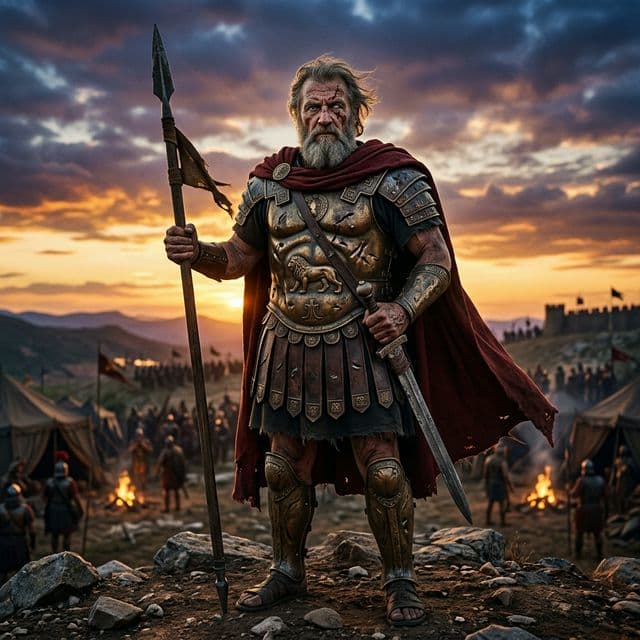
AI-assisted portrait of Antigonus I Monophthalmus
The Architecture of Unity
Antigonus I Monophthalmus did not just want a crown; he wanted the world. As the oldest and most formidable of the Diadochi, his life was defined by a profound, unwavering commitment to the structural reunification of Alexander’s vast empire (Te-Ni). While others like Ptolemy were content with separate kingdoms, Antigonus’s genius was profoundly oriented toward the maintenance of a single, universal command. He was the titan who refused to compromise, applying a rigid, authoritative logic to the mapping of a new world-state.
He was the master of the long march and the absolute command. From his initial satrapy in Phrygia to his final stand at Ipsus, Antigonus’s cognitive mode was focused on the objective consolidation of power. He was a leader who saw the map as a single problem that required an unbending, strategic will to solve.
Historical Context
Antigonus I Monophthalmus ("The One-Eyed") was a Macedonian nobleman and general under both Philip II and Alexander the Great. After Alexander's death, he emerged as the primary player in the Wars of the Diadochi, eventually becoming the first of the successors to declare himself King in 306 BCE. His attempt to reunify the entire empire under his rule forced all the other successors—Ptolemy, Seleucus, Cassander, and Lysimachus—to form a grand coalition against him. He was eventually defeated and killed at the Battle of Ipsus in 301 BCE at the age of 81. His death confirmed the permanent fragmentation of the Hellenistic world.
The Psychological Verdict
Antigonus I Monophthalmus is a definitive ENTJ. He was a leader defined by his relentless focus on external organization and authoritative command (Te), guided by a clear, inter-generational vision for a unified empire (Ni), and supported by an intense, physical command of the vast landscapes he ruled (Se).
Te — Dominant
His primary mode was the application of logic to the map. Antigonus saw the fragmentation of the empire not as a political inevitability, but as a logistical error that required an unbending command to correct. His decisions were characterized by a focus on the centralized control of resources and the efficient mobilization of massive armies over enormous distances. He ran his empire with the same rigid, objective precision that he used to command his battle lines. He was the ultimate planner of the Hellenistic world.
Ni — Auxiliary
Supporting his will was a deep, intuitive vision of a global Macedonian hegemony. Antigonus was the only one who truly believed that the universal empire of Alexander could—and should—be maintained. This auxiliary Ni allowed him to look past the immediate prestige of regional kingship to see the systemic disaster that fragmentation would cause. He was a man who planned for a legacy that his contemporaries were already abandoning in favor of survival. He was the "One-Eye" that saw the whole when others saw only parts.
Se — Tertiary
Antigonus was a man of immense physical presence. Despite his age and his single eye, he remained a formidable figure on the battlefield until his final day at Ipsus. His tertiary Se gave him the tactical presence to command the phalanx and the physical bravery to face his rivals. He understood the sensory impact of a massive army and the tactical value of the terrain. He didn't just command from a throne; he commanded from the heart of the action.
Fi — Inferior
His narrow focus on structural power and the preservation of the empire often left his internal world as a secondary consideration. His decisions were driven by the objective needs of his dynasty and his kingdom, reflecting an inferior Fi that prioritized systemic success over personal sentiment. He was a man who sacrificed his own subjectivity to the altar of the empire he sought to rebuild. His isolation at Ipsus was the ultimate result of a life lived for the objective frame rather than the relational bond.
The Last Man Who Believed in One Empire
Antigonus was 82 years old when he died at Ipsus in 301 BCE — on foot in the battle line, still fighting, waiting for his son Demetrius to return with the cavalry. Demetrius had broken the enemy cavalry but chased them too far; when he came back, his father was dead and the army had collapsed. The coalition of Ptolemy, Seleucus, Cassander, and Lysimachus — four men who agreed on almost nothing — had united specifically to stop him, which is perhaps the clearest measure of how seriously they took the threat he represented. Antigonus was the only one of the successors who genuinely tried to keep Alexander’s empire whole. His failure at Ipsus confirmed what everyone else had already accepted: the empire was over, and the Hellenistic world would be a system of competing kingdoms. The iron logic of that outcome is the shape of his legacy.
Connected Figures
Further Reading
- Antigonus the One-Eyed and the Creation of the Hellenistic State — Richard A. BillowsThe definitive scholarly biography — covers his career from Philip's general to the Wars of the Diadochi in close detail.
- The Wars of Alexander's Successors, 323–281 BC — Bob Bennett & Mike RobertsTwo-volume military history of the Diadochi conflicts; Antigonus dominates volumes 1 and 2.
- Dividing the Spoils: The War for Alexander the Great's Empire — Robin WaterfieldAccessible narrative of the succession wars, with Antigonus as the central antagonist of the whole period.
- The Hellenistic Age — Peter GreenBroad cultural and political history of the world the Diadochi built — essential background for understanding Antigonus's aims.
