 Historical Figure MBTI
5 min read
#223 · 3-21-26 · The Age of Alexander
Lysimachus
The King of Thrace
c. 360 – 281 BCE
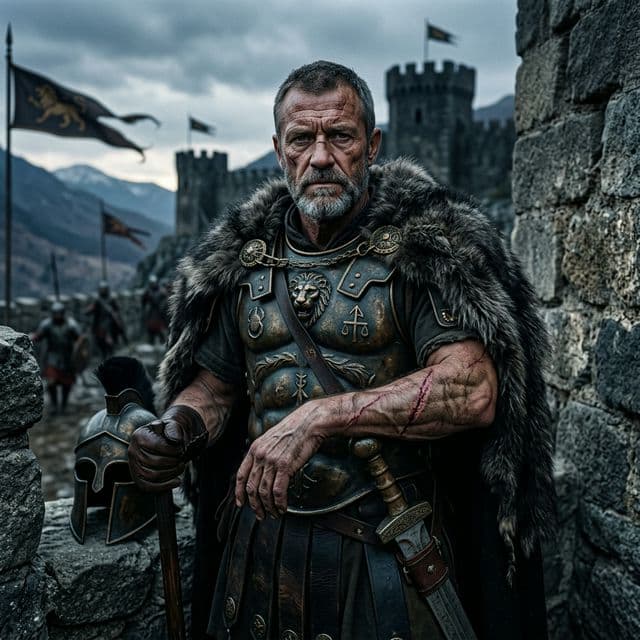
AI-assisted portrait of Lysimachus
The Architecture of Austerity
Lysimachus did not just rule a territory; he enforced a border. As one of the original Diadochi and a somatophylax (bodyguard) of Alexander, his life was defined by a profound, unwavering commitment to the structural and defensive integrity of his kingdom in Thrace. While others like Demetrius were driven by an adventurous, sensory expansion (Se), Lysimachus’s genius was profoundly rooted in the tangible, reliable reality of fortification and administrative harshness (Si). He was the guardian of the straits, the one who valued the known, the structural, and the fiscal over the infinite horizons of his rivals.
He was the master of the long vigil and the administrative truth. From his survival in the Thracian wilds to his final confrontation with Seleucus, Lysimachus’s cognitive mode was focused on the internal comparison of the present reality to the established standards of Macedonian control. For Lysimachus, power was something to be hoarded and defended through pure, objective will.
Historical Context
Lysimachus was a Macedonian general and companion of Alexander the Great. After Alexander's death, he secured the satrapy of Thrace, a difficult and often hostile region that he successfully transformed into a powerful, independent kingdom. He was a key member of the grand coalitions against Antigonus and was instrumental in the victory at Ipsus. Known for his legendary strength (famously fighting a lion with his bare hands) and his increasingly harsh and predatory tax policies, he eventually expanded his rule into Asia Minor and Macedonia. His reign ended in 281 BCE at the Battle of Corupedium, where he was killed by Seleucus, marking the end of the last of Alexander's original commanders.
The Psychological Verdict
Lysimachus is a definitive ISTJ. He was a leader defined by his relentless focus on established order and internal loyalty to tradition (Si), supported by a pragmatic, logical approach to administrative and military organization (Te) and an unwavering, if cold, internal set of standards (Fi).
Si — Dominant
His primary mode was the preservation of established reality. Lysimachus’s identity was tied to the old Macedonian school of thought; he was a man of the mountains and the phalanx. His decisions were characterized by a focus on the reliable, the repeatable, and the traditional. He distrusted the "flamboyance" of his younger rivals, famously mocking Demetrius's theatricality. For Lysimachus, the world was a set of known boundaries that required a disciplined, defensive command to maintain. He was the guardian of the literal and metaphorical gates.
Te — Auxiliary
Supporting his sense of border-security was an objective, effective application of logic. Lysimachus was a master of fiscal and military engineering. His actions were decisive, calculated, and entirely oriented toward the efficient management of his kingdom’s resources—often to the point of predatory taxation. He ran Thrace with the same precision he used to command his cavalry. He didn't seek glory (Fe); he sought the structural finality of a solvent and secure state.
Fi — Tertiary
Beneath his strategic exterior lay a deeply private and unwavering internal world. His tertiary Fi manifests in his absolute, if increasingly isolated, commitment to his own vision of sovereignty. This internal standard of duty was quiet and unobserved, but it provided the bedrock for his decades of survival. His resilience was fueled by an internal conviction that remained invisible to the world, eventually leading to a paranoia that destroyed his own family, including his son Agathocles.
Ne — Inferior
What stayed in the background was a relative discomfort with the unpredictable and the visionary. Lysimachus flourished in the known geography of defensive warfare. His inferior Ne manifested in his intense anxiety and eventual paranoia toward the shifting loyalties of his court and his sons. He was the voice of "security," unable to fully trust the infinite, often chaotic possibilities that the new Hellenistic age had unleashed, leading him to retreat into an ever-narrowing circle of control.
The Soldier Who Outlasted the Age
Lysimachus was one of Alexander’s personal bodyguards, and a story circulated that Alexander once locked him in a cage with a lion — and that Lysimachus killed the lion with his bare hands. It may be apocryphal. It may not be. He went on to hold Thrace for thirty years against pressure from Scythians, Getae, Dacians, and fellow Diadochi, building a kingdom from a land most of his contemporaries considered ungovernable. He aligned with Ptolemy, fought Antigonus at Ipsus, and eventually took Macedonia itself from Demetrius in 288 BCE. Then he had his own son Agathocles executed on the influence of his second wife, alienated half his court, and died at Corupedium in 281 BCE fighting Seleucus — the last man standing from the original generation. He had built something durable out of nothing. He pulled it apart at the end himself. A remarkable career, undone in its final chapters by the same inflexibility that had made it possible.
Connected Figures
Further Reading
- The Wars of Alexander's Successors 323–281 BC — Bob Bennett & Mike RobertsTwo-volume military history of the Diadochi wars; the most detailed modern account of the campaigns involving Lysimachus.
- Successors of Alexander the Great — Hugh BowdenAccessible overview of the Successor kingdoms and the political world Lysimachus navigated.
- The Cambridge Companion to the Age of Alexander — Edited by J. RoismanReference collection covering the political, cultural, and military context of all the major Diadochi including Lysimachus.
- After Alexander: The Time of the Diadochi — V. Heckel & L. A. Tritle (eds.)Essay collection examining individual Successors, including Lysimachus's territorial ambitions and administration of Thrace.
