 Historical Figure MBTI
5 min read
#222 · 3-21-26 · The Age of Alexander
Demetrius I Poliorcetes
The Besieger of Cities
c. 337 – 283 BCE
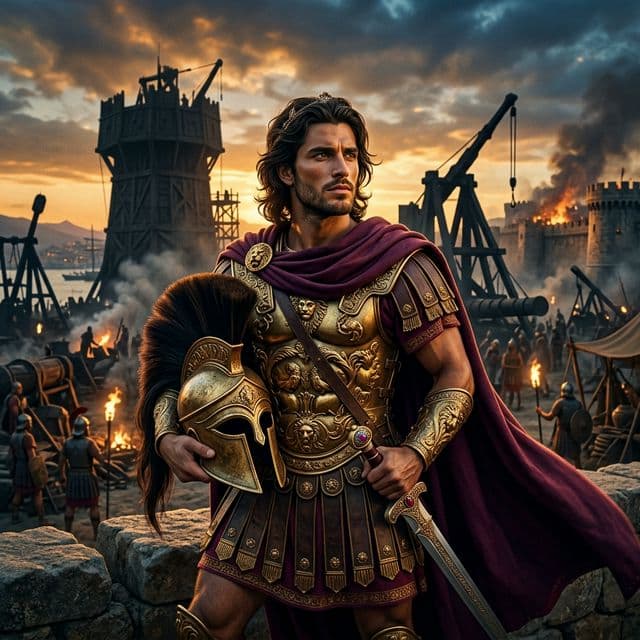
AI-assisted portrait of Demetrius I Poliorcetes
The Architecture of Adventure
Demetrius I Poliorcetes did not just attack cities; he besieged the very concept of limits. As the son of Antigonus the One-Eyed, his life was defined by the profound, external engagement with the sensory and tactical reality of the present (Se-Ti). While his father was obsessed with the structural reunification of empire (Te), Demetrius’s genius was profoundly oriented toward the immediate, mechanical challenge of the siege and the adventurous thrill of the sea. He was the figure of the living presence, the one who moved through the Hellenistic world with a mercurial, sensory intelligence that focused on the beauty and challenge of the "now."
He was the master of the massive engine and the tactical gamble. From the victory at Salamis to the epic siege of Rhodes, Demetrius’s cognitive mode was focused on the internal synthesis of mechanical and tactical systems. For Demetrius, the world was a set of physical obstacles that required a brilliant, independent skill set to overcome.
Historical Context
Demetrius I Poliorcetes ("The Besieger") was a Macedonian nobleman and king, the son of Antigonus I. Most famous for his incredible naval victories and his invention of colossal siege machinery (like the Helepolis), he was the primary military arm of the Antigonid attempt to reunify Alexander's empire. His career was a roller coaster of extreme victory and total defeat, eventually leading him to the throne of Macedonia before his final surrender to Seleucus. He was known for his legendary beauty, his erratic brilliance, and his flamboyant lifestyle, embodying the adventurous spirit of the early Hellenistic age.
The Psychological Verdict
Demetrius I Poliorcetes is a definitive ESTP. He was a leader defined by his intense engagement with the sensory and tactical present (Se), guided by a deep, internal mastery of mechanical and logical systems (Ti), and supported by an imaginative, if erratic, openness to his changing role (Fe).
Se — Dominant
His primary mode was the immersion in the immediate, physical environment. Demetrius’s legendary skill as a sailor, his love of massive machinery, and his flamboyant court life reflect a dominant Se. He was acutely aware of the sensory impact of his actions, using his beauty and his colossal engines to overwhelm his enemies. He didn't live for the abstract future; he lived for the tangible challenge and the visceral thrill of the moment.
Ti — Auxiliary
Supporting his sensory presence was a deep, internal mastery of how things work. Demetrius was not just a general; he was an engineer. His auxiliary Ti allowed him to design and build the most sophisticated military technology of his age, treating the siege as a mechanical puzzle to be solved with the highest level of individual efficiency. He approached the world as a system of physical laws that could be manipulated to achieve his immediate tactical goals.
Fe — Tertiary
Beneath his mechanical mastery lay a tertiary ability to navigate the emotional landscape of his people and his court. Demetrius was legendary for his charisma and his ability to inspire loyalty (and desire) in both his soldiers and the citizens of Athens. This function allowed him to be not just a conqueror, but a popular figure who could lead through charm and public spectacle as much as through force.
Ni — Inferior
What stayed in the background was the pursuit of a long-term, abstract strategic vision. Demetrius’s career was marked by erratic shifts and a lack of consistent focus beyond the immediate objective. His inferior Ni manifested in a relative inability to consolidate his victories into a stable, lasting state. He was a man who could win any battle but struggled to win the peace, living a life that was profoundly tied to the next great adventure rather than the structural legacy of his house.
The Siege That Never Really Ended
Demetrius was the only Diadochos who successfully besieged a city that didn’t want to be taken — and failed to hold the ones that did. His father Antigonus wanted him to be the military arm of a unified empire; what he became was the most spectacular general of a generation with no idea what to do between campaigns. He won at Salamis, built the Helepolis for the siege of Rhodes — the largest siege tower the ancient world had seen — and then accepted terms that let Rhodes maintain its independence. He seized Macedonia from Lysimachus and Pyrrhus and was expelled by his own soldiers within two years. He finally surrendered to Seleucus in 285 BCE and drank himself to death in captivity over the following two years, apparently still expecting rescue. He was 54. Ancient sources describe his final years with something between pity and fascination. Even captive and drinking, he couldn’t quite stop performing.
Connected Figures
Further Reading
- Demetrius of Macedon: Unconquered Conqueror — Pat Wheatley & Charlotte DunnThe most thorough modern scholarly biography of Demetrius, covering his campaigns, personality, and legacy.
- Plutarch's Lives, Vol. IX: Demetrius and Antony — Plutarch (trans. Bernadotte Perrin)The primary ancient source on Demetrius — Plutarch pairs him with Antony as twin studies in brilliant self-destruction.
- The Successors to Alexander the Great — Bob Bennett & Mike RobertsA readable account of the Diadochi wars that situates Demetrius within the broader struggle for Alexander's empire.
- Dividing the Spoils: The War for Alexander the Great's Empire — Robin WaterfieldContextualizes the Antigonid cause and Demetrius's campaigns within the larger collapse of Macedonian unity.
