 Historical Figure MBTI
#233 · 3-21-26 · The Age of Alexander
Pyrrhus of Epirus
King of Epirus · Tactical Genius · The Pyrrhic Victor
319 — 272 BC
9 min read
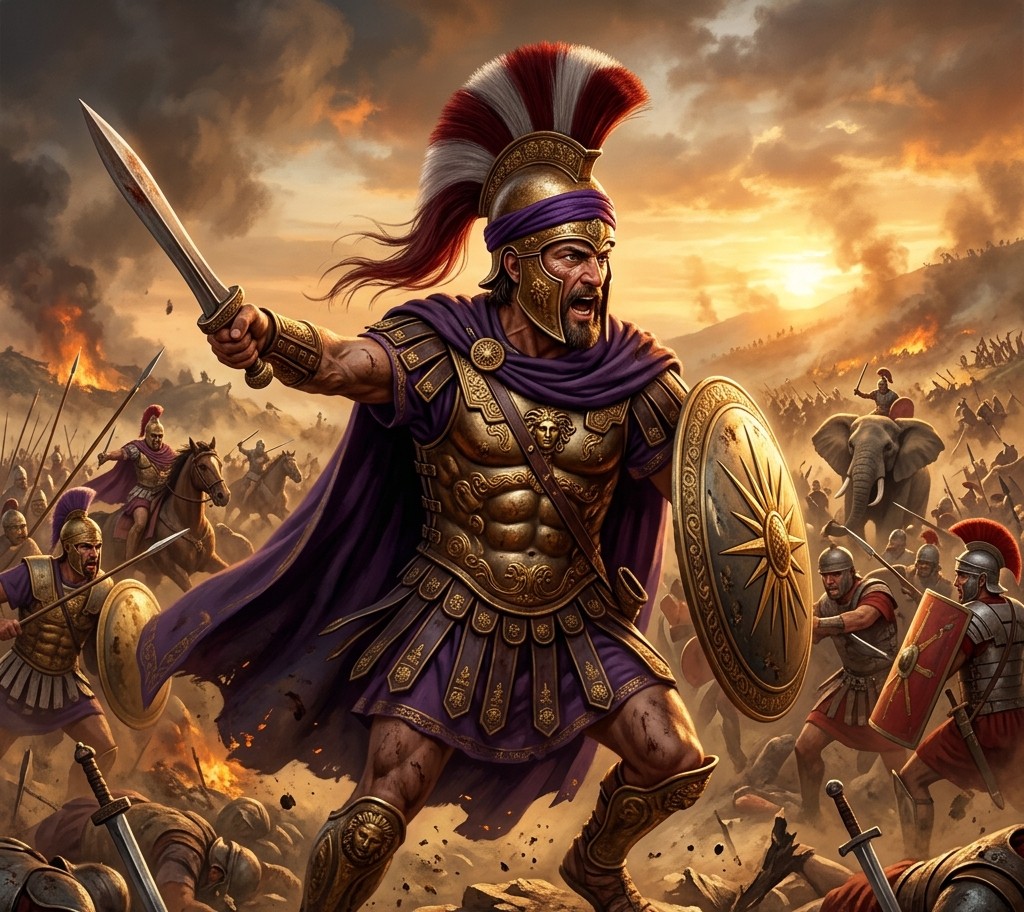
AI-assisted Portrait of Pyrrhus of Epirus
The General Who Could Win Everything Except the Peace
At Asculum in 279 BC, after two days of grinding slaughter against the Roman legions, Pyrrhus of Epirus stood among the wreckage of his own victory. He had broken the Roman line, held the field, and lost the best of his officers—men who could not be replaced from the thin manpower of a small Balkan kingdom. When a courtier congratulated him, he answered that one more such victory would finish him entirely. From that line the phrase “Pyrrhic victory” descended to us, and with it the shape of the man: a soldier of dazzling tactical gifts who could see the field in front of him with total clarity and could never quite see past it.
Pyrrhus (319–272 BC) was a second cousin of Alexander the Great through the Molossian royal line of Olympias, and he spent his life chasing Alexander's shadow without ever building his empire. Driven from the Epirote throne as a boy and raised at the court of Ptolemy I, he fought at Ipsus beside his brother-in-law Demetrius Poliorcetes, briefly seized Macedonia, invaded Italy, beat the Romans twice, crossed to Sicily to fight Carthage, came back to Italy, lost, and finally died in a street brawl at Argos in 272 BC—felled, according to Plutarch, when an old woman flung a roof-tile and stunned him long enough for an enemy soldier to cut him down.
Hannibal reportedly ranked him among the greatest generals who ever lived, and the judgment was earned in the only place Pyrrhus truly excelled: the live, sensory, unfolding present of a battle in progress. He read terrain the way a musician reads a room. But the moment a campaign required him to consolidate, to govern, to build something that would outlast the next engagement, his attention slid toward the next fight. He is the textbook ESTP: a man whose genius lived entirely in action, and whose tragedy was that action was all he knew how to want.
Pyrrhus was the ESTP as warlord—dominant Se reading the battlefield in real time and auxiliary Ti solving each tactical problem with cold precision, paired with an inferior Ni so weak that he could win every battle and never once imagine what the war was for.
The Man Who Lived in the Battle
Se — dominant
Dominant extraverted sensing is the function of total immersion in the physical present. At Heraclea in 280 BC, his first clash with Rome, the decisive shock came when he unleashed war elephants the Italian cavalry had never seen; the horses panicked, the Roman flank collapsed, and Pyrrhus exploited the chaos with the instinct of a man who reads disorder as opportunity. This is Se as a weapon: not foresight, but reaction so fast and accurate it looks like foresight.
He led from the front always. Plutarch records that at Asculum he was everywhere in the press of bodies, trading armor with a bodyguard to confuse assassins, refusing to direct a battle from any safe distance. The sensory thrill of the thing—the weight of the spear, the churn of the line, the fact of risk—was not incidental to his command; it was the point. His soldiers loved him because he shared their danger in the body, not because he promised them a destiny. An Se dominant does not inspire through vision. He inspires through presence.
But Se lives only in the now. The same hunger for vivid engagement that made Pyrrhus unbeatable in the field made him incapable of stillness between battles. When the fighting in Italy stalled into negotiation and garrison duty, he leapt at an invitation to fight Carthage in Sicily—abandoning a war he had nearly won for a fresh one that felt more alive. A kingdom is mostly the boredom of administration, and Pyrrhus would always rather be where the spears were crossing.
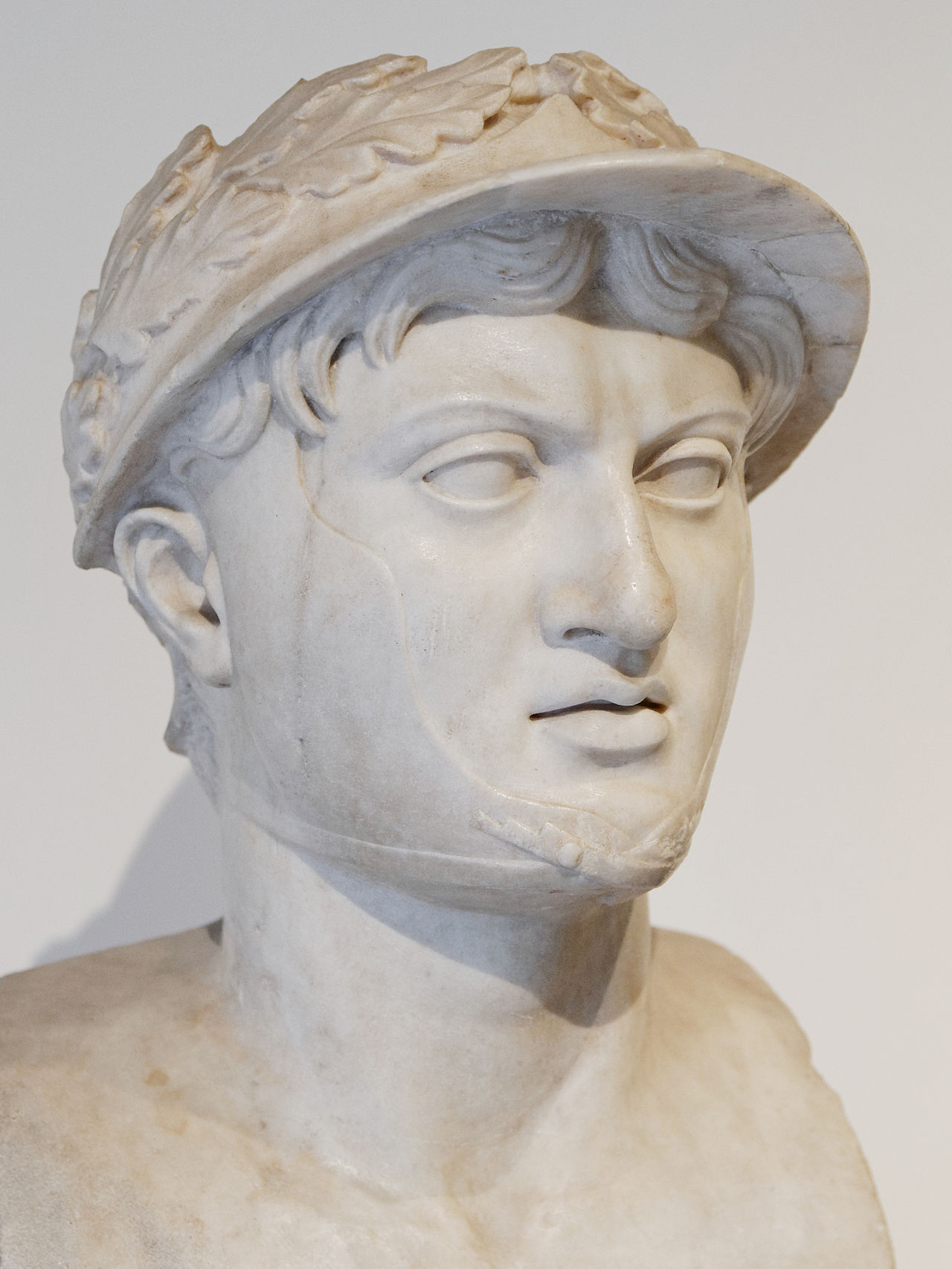
The Tactical Engine
Ti — auxiliary
If Se gave Pyrrhus the live feel of the battlefield, auxiliary introverted thinking gave him the cold machinery to solve it. He was a genuine theorist of war: he wrote treatises on tactics and generalship that later commanders studied. This is the auxiliary Ti of the ESTP—not abstract speculation, but a deep understanding of a craft's mechanics, kept sharp because it serves the dominant function's appetite for action.
At both Heraclea and Asculum he combined Macedonian phalanx, Italian infantry, cavalry, and elephants into a single integrated instrument—a tactical puzzle that defeated commanders of lesser analytical power. He understood combined arms as a system of interlocking parts and adjusted it on the fly when the Romans began adapting. The Romans learned from him: the elephant-countermeasures they developed were a tribute to how serious a problem his mind set them.
The limit of Ti paired with weak intuition is that it optimizes the problem in front of it without questioning whether that problem is worth solving. Pyrrhus could engineer the perfect battle and never ask the prior question—should this battle be fought at all, and toward what end? His analytical brilliance was always pointed at the tactical, never at the horizon.
The King His Soldiers Loved
Fe — tertiary
Tertiary extraverted feeling shows up in an ESTP as charisma—a physical ability to read the mood of a body of men and bind them to him. Pyrrhus had this in abundance. The ancient sources are unanimous that his troops adored him, that he inspired a personal devotion rare even among celebrated commanders. He knew his soldiers, fought beside them, shared their hardships, and possessed the open warmth that made men follow him into fights they had no quarrel in. This is Fe at the service of Se: charm as a tool of command, expressed through shared danger rather than quiet intimacy.
The Greeks of southern Italy and Sicily welcomed him as a liberator; for a season he was hailed in Sicily as king of the Greeks against Carthage. He governed by personal appeal, and when the appeal was fresh it worked brilliantly. But tertiary Fe is shallow-rooted. In Sicily the same charm curdled when, pressed for resources, he ruled with a heavy hand—within a couple of years the Sicilians who had welcomed him were glad to see him go. His Fe could light a room and could not sustain a relationship under strain.
The Vision He Never Had
Ni — inferior
Inferior introverted intuition is the missing organ of the ESTP, and in Pyrrhus its absence is almost the whole story of his life. Ni holds one vision across years, subordinates the present to a distant goal, knows which battles are worth winning because it can see where they lead. Pyrrhus had none of it. His career reads as a sequence of brilliant, disconnected episodes, each abandoned the moment a brighter prospect appeared: Italy for Sicily, Sicily back to Italy, Italy for Macedonia, Macedonia for a doomed adventure at Sparta and Argos. He was, in the famous ancient simile, like a gambler who throws the dice well but never knows when to leave the table.
Seleucus and Ptolemy were lesser men on a battlefield, but they founded dynasties that lasted centuries because they could choose a single territory and pour a lifetime into making it permanent. Pyrrhus had the strongest sword arm among the Diadochi's heirs and the weakest sense of purpose. He could win a throne in an afternoon and lose interest by the next season.
His death is the inferior function's final word. He died drawn, almost reflexively, into an opportunistic war—a Spartan succession dispute that was none of his business—then stumbled into a confused night assault on Argos where his own army jammed in narrow streets. There, with no grand design to die for, he was knocked senseless by a roof-tile thrown by an anonymous old woman and killed where he fell. The greatest tactician of his generation was undone not by a better general but by the absence of any reason to be in that alley at all.
Why ESTP Over ISTP
Why not ISTP?
The ISTP shares Pyrrhus's Se–Ti pairing and his mechanical mastery of craft, and on the page the two types can look nearly identical. But the ISTP leads with introverted thinking and engages the external world from a stance of self-contained detachment. Pyrrhus was the opposite: outward-driven, magnetic with crowds and armies, constitutionally unable to withdraw. His charisma was not the reluctant competence of an ISTP but the radiant, audience-needing presence of a dominant extravert. The ISTP would have happily perfected the art of war in relative solitude; Pyrrhus needed a kingdom to invade and a city to acclaim him.
The decisive marker is the restlessness itself. An ISTP's introverted dominant pulls inward, toward mastery and quiet sufficiency. Pyrrhus had no center of gravity—his was a mind flung permanently outward at the next vivid thing. That is dominant Se, not dominant Ti. The ESTP reading also explains the specific shape of his failure: his collapse was never tactical—he almost never lost a battle—but always strategic, the failure of a man whose intuition could not hold a future steady long enough to build toward it.
Connected Figures
Further Reading
- Pyrrhus of Epirus — Jeff ChampionThe most detailed modern military biography — covers all campaigns with close attention to tactical method and strategic failure.
- Life of Pyrrhus — Plutarch (tr. Robin Waterfield)The essential ancient source; vivid on the Asculum aftermath and the roof-tile death at Argos.
- The Hellenistic Age — Peter GreenPlaces Pyrrhus in the broader world of the Diadochi — the Successor kings who fought over Alexander's shattered empire.
- Rome and the Sword: How Warriors and Weapons Shaped Roman History — Simon JamesGood on the Roman adaptation to Pyrrhus's combined-arms system and the long shadow his campaigns cast on Roman military doctrine.
- The Successors of Alexander the Great — Waldemar HeckelReference-grade prosopography of the Diadochi — indispensable for placing Pyrrhus among his generation.
