 Historical Figure MBTI
5 min read
#234 · 3-23-26 · The Age of Alexander
Darius III
King · Achaemenid · Last of His Line
c. 380 — 330 BC
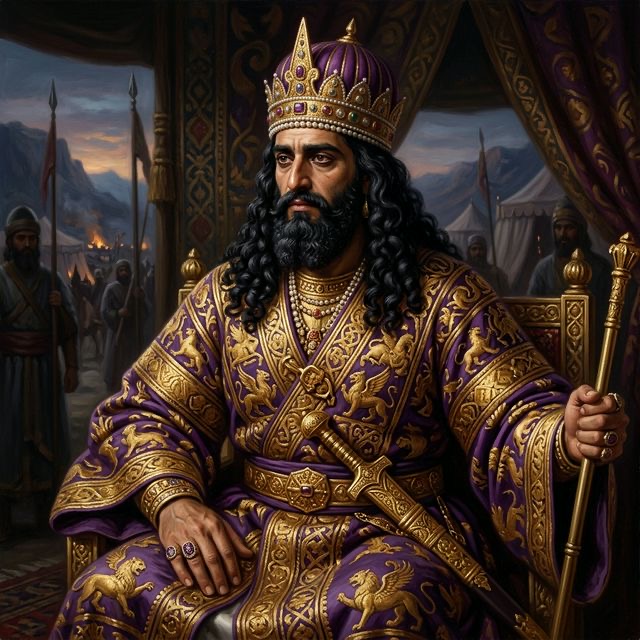
AI-assisted portrait of Darius III
The King Who Inherited the Wrong Moment
Darius III did not seek the throne. Born Artashata of the Achaemenid house, he came to power in 336 BC not through ambition but through elimination — he was the last suitable male relative standing after the eunuch minister Bagoas the Elder poisoned his way through the royal succession. He became Great King of Persia at roughly forty-four, commanding the largest empire the world had ever seen. Two years later he faced Alexander.
The record of his three major encounters with Alexander — Granicus (334 BC), Issus (333 BC), Gaugamela (331 BC) — is one of military catastrophe. At Issus, his army was routed on a narrow coastal plain that negated his numerical advantage; his mother Sisygambis, wife Stateira I, and daughters were captured. At Gaugamela, despite choosing open ground where his numbers could operate, he fled when his center collapsed. He was murdered by Bessus in 330 BC, stabbed by his own satraps as Alexander's cavalry closed in.
Darius III was an ISFJ — a steward who excelled in stable institutions, a traditionalist overwhelmed by a situation for which no Achaemenid precedent existed. His failures were not failures of courage but of cognitive architecture.
The King Formed by Precedent
Dominant Si is the function of internalized experience — of navigating the present through the map of established patterns. Darius governed a 220-year-old imperial machine designed for exactly this kind of leader: someone who held the empire together through tradition, ceremony, and a reliable hand on existing institutions. Before Alexander, he had been an effective administrator and a genuinely brave soldier — sources record that as a satrap's cavalry officer under Artaxerxes III, he fought in single combat and killed an enemy champion. He was not a coward; he was a man whose competence was configured for a world that Alexander destroyed.
The problem with Si dominance in crisis is its reliance on prior models. When Alexander used oblique cavalry charges and refused to fight on the terms that Persian doctrine expected, Darius had no internal framework for adapting. He massed infantry against opponents who avoided infantry. He chose ground that should have been decisive and watched it become irrelevant. He was not failing to try — he was trying correctly, by every precedent his experience had accumulated. The precedents were simply wrong.
The Humane Sovereign
Auxiliary Fe produced the quality for which Darius is most distinguished in the ancient sources: genuine care for his people and his family. Ancient sources — including hostile Macedonian ones — consistently note that Darius treated his subordinates with loyalty, his family with devotion, and his captive royal women with honor even in abstentia (Alexander extended the same honor on his behalf). After Issus, when he learned that his family was in Alexander's hands, he reportedly wept. His offer to Alexander before Gaugamela — half the empire, his daughter's hand, 30,000 talents of gold — was not weakness; it was Fe prioritizing people over abstract principle.
Parmenion, hearing the offer, told Alexander: "I would accept these terms if I were Alexander." Alexander replied: "So would I, if I were Parmenion." The offer was extraordinary. That it was refused tells us more about Alexander than about Darius.
Tactical Intelligence Under Pressure
Tertiary Ti in an ISFJ produces careful, methodical reasoning — but under stress, this function degrades fastest. Darius did select good battlefields and employed sensible tactics; Gaugamela's flat plain was genuinely a sound choice. But when the unexpected occurred — when Alexander personally broke through his center at Gaugamela — his Ti could not rapidly reassess. He fled. This is not cowardice in the conventional sense; it is cognitive overload in a type for whom unexpected disruptions of established patterns are genuinely destabilizing. The flight was a failure of adaptability, not nerve.
The Future He Could Not Imagine
Inferior Ne is the ISFJ's blind spot: the capacity to imagine genuinely novel possibilities. Darius could not conceive that a 22-year-old Macedonian king would in three years dismantle the greatest empire in the world. He could not imagine that the traditional responses — raise a larger army, offer more generous terms, choose better terrain — would all fail against an opponent whose entire strategy was premised on doing what had never been done. He kept trying to solve an Ne problem with Si solutions. The world had changed. He had not.
Why ISFJ Over ISTJ
Why not ISTJ?
The ISTJ shares Si dominance and would also struggle with novel disruption. But Darius's distinguishing feature is his Fe — the genuine warmth toward family and subordinates, the diplomatic instinct to offer terms rather than simply hold position, the recorded weeping over his captured family. An ISTJ's emotional life is more interior and duty-focused. Darius was relationally oriented in a way that Si-Fe produces more naturally than Si-Te.
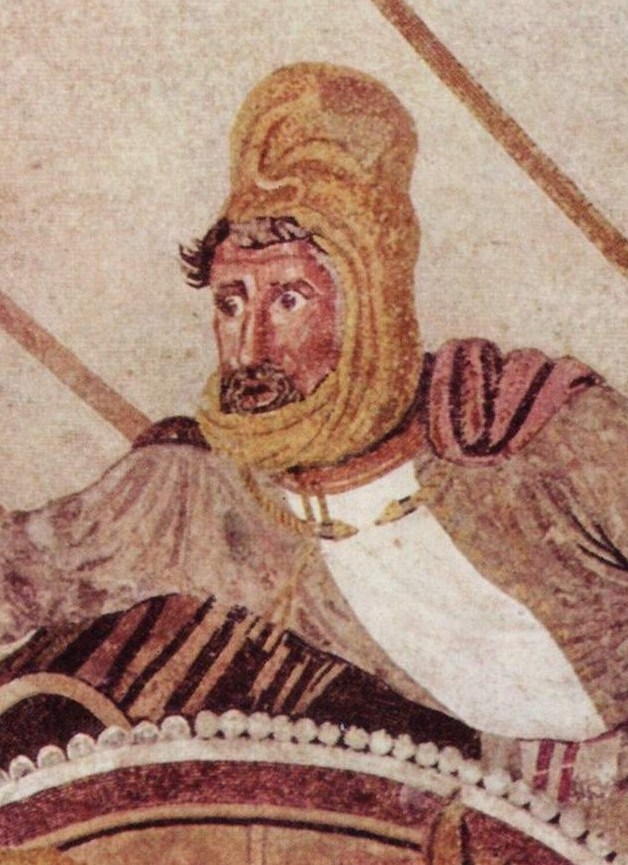
Connected Figures
Further Reading
- Alexander of Macedon, 356–323 B.C.: A Historical Biography — Peter GreenThe fullest modern account of Alexander's campaigns, with sustained attention to Darius's choices at Issus and Gaugamela.
- The Persian Empire — A. T. OlmsteadA classic study of the Achaemenid imperial system — essential context for understanding what Darius was trying to defend.
- Darius in the Shadow of Alexander — Pierre BriantA focused reappraisal of Darius III that rehabilitates him from the distortions of Macedonian-centric sources.
- The Campaigns of Alexander — Arrian (trans. Aubrey de Sélincourt)The primary ancient source — Arrian's account of the battles at Issus and Gaugamela remains the most reliable record of Darius's conduct.
