 Historical Figure MBTI
5 min read
#230 · 3-21-26 · The Age of Alexander
Alcetas
The Unyielding Sentry
c. 355 – 319 BCE
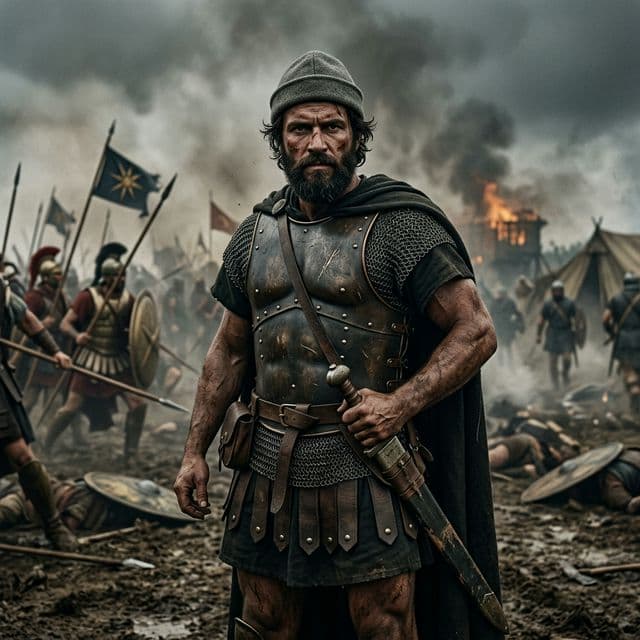
AI-assisted portrait of Alcetas
The Architecture of Force
Alcetas did not just follow a command; he enforced a reality. As the brother of the regent Perdiccas and a high-ranking officer in Alexander’s army, his life was defined by the profound, external engagement with the structural and tactical reality of the present (Te-Si). While his brother was driven by an intense, internal vision (Ni), Alcetas’s genius was profoundly oriented toward the immediate, direct application of force to maintain order. He was the figure of the blunt instrument, the one who moved through the court with a rigid, sensory intelligence that prioritized the achievement of the goal over the relational or diplomatic cost.
He was the master of the hard command and the unbending truth. From the suppression of revolt to his fatal confrontation with Cynane, Alcetas’s cognitive mode was focused on the internal comparison of his environment to the established benchmarks of Macedonian order. For Alcetas, the world was a set of physical obstacles that required a disciplined, objective command to overcome.
Historical Context
Alcetas was a Macedonian general and the brother of Perdiccas. Following Alexander's death, he served as one of his brother's most loyal and unbending commanders, often taking on the most difficult and unpopular assignments. He is most infamous for his murder of Alexander's half-sister Cynane in 323 BCE, an act he performed on his brother's orders to prevent her from merging the royal houses. The murder so outraged the Macedonian soldiers that it nearly led to the total collapse of Perdiccas’s authority. After his brother's death, Alcetas continued to fight against the coalition of the successors, eventually taking his own life in Termessus in 319 BCE rather than be captured. His life represents the most extreme extension of the "Macedonian" discipline in an age of total moral fragmentation.
The Psychological Verdict
Alcetas is a definitive ESTJ. He was a leader defined by his relentless focus on external organization and direct command (Te), guided by a deep attachment to the traditions and history of his people (Si), and supported by an imaginative, if blunt, openness to his changing role (Ne).
Te — Dominant
His primary mode was the application of logic to the external world. Alcetas thrived in the structured, hierarchical environment of the Macedonian military. His decisions were characterized by a focus on objective achievement and the direct enforcement of standard operating procedures. He spoke the language of results and duty, expecting the same blunt, effective performance from others that he gave to his brother. He was the commander who prioritized the "how" of victory over the "why" of the cost.
Si — Auxiliary
Supporting his will was a deep, sensory connection to the Macedonian past. Alcetas’s identity was rooted in the old Macedonian way of war and the shared hardships of the veterans. His auxiliary Si allowed him to see the present through the lens of established precedent, leading to his intense, if brutal, implementation of his brother’s strategic goals. He was the guardian of the memory of what Macedon was before it became an empire. For Alcetas, the past was the only reliable map for the future, even when it led to the murder of his own royal family.
Ne — Tertiary
Beneath his traditionalist exterior lay a tertiary ability to see the potential for disruption. Alcetas often foresaw the dissatisfaction among the troops and the dangers of the king’s changing temperament. However, because his Ne was tertiary, he lacked the diplomatic subtlety to communicate these possibilities effectively, instead resorting to blunt, often inflammatory warnings that eventually led to his destruction. He saw the fire coming but could only yell at the flame through the action of his sword.
Fi — Inferior
What stayed in the background was the processing of his own, internal subjective values. Alcetas’s loyalty was absolute, but it was an external, duty-bound loyalty (Te) rather than an internal, relational one (Fi). His inferior Fi manifested in his inability to navigate the complex, personal dynamics of the successors' egos, leading him to prioritize the "truth" of the system over the subjective "feelings" of those he commanded. His final end was the ultimate failure of an unyielding Te reality against a fragile Fi world.
Legacy and Conclusion
Alcetas’s legacy is a study in the power and the isolation of the unbending mind. As the ESTJ "Executive" of the late Argead guard, he proved that even the most rigorous structural logic cannot hold a world together when the vision that built it has died. He remains a symbol of the individual who refuses to bend to the will of the god-king, a soldier who died for the memory of the kingdom he saved. He wasn't just a general; he was the iron mirror of the Macedonian soul, one that Alexander broke because he could no longer bear to look at it, and one that Alcetas finally shattered himself.
Connected Figures
Further Reading
- The Marshals of Alexander's Empire — Waldemar HeckelCovers Alcetas directly among the Macedonian officers who fought and died in the Wars of the Successors.
- Dividing the Spoils: The War for Alexander the Great's Empire — Robin WaterfieldTraces the campaign that cornered Alcetas at Termessus and his final refusal to be taken alive.
- Who's Who in the Age of Alexander the Great: Prosopography of Alexander's Empire — Waldemar HeckelThe standard reference entry for Perdiccas's brother and the murder of Cynane.
