 Historical Figure MBTI
3 min read
#241 · 3-23-26 · The Age of Alexander
Bessus
Satrap · Regicide · Self-Proclaimed King
died c. 329 BC
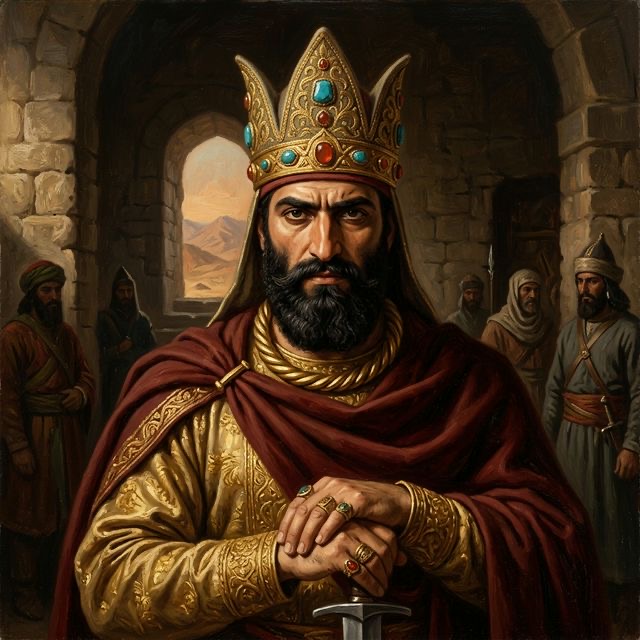
AI-assisted portrait of Bessus
The Man Who Killed His King and Called Himself Emperor
Bessus, satrap of Bactria-Sogdiana and a cousin of Darius III, commanded the left flank at Gaugamela. When the battle turned against Persia, he covered Darius's retreat — then, with Nabarzanes, arranged the king's arrest. The plan was to use Darius as a bargaining chip with Alexander. When Alexander's cavalry closed in on their column in 330 BC, Bessus made the final decision: he speared Darius and left him dying in the road, then named himself Artaxerxes V, Great King of Persia, and fled into Bactria.
Bessus was an ENTJ — a commander who moved decisively from usurpation to proclamation without hesitation. What he could not do was consolidate. He was an executor in a situation that required adaptation.
The Decisive Commander
Dominant Te is the function of decisive external action — organizing the world through command and results. Bessus did not equivocate. When Darius became a liability, he eliminated him. When a power vacuum opened, he stepped into it with a formal title and the upright tiara of a Persian king. He mobilized Bactrian and Scythian forces, allied with local rulers, and prepared a defense of the northeastern satrapies. By any Te standard, his initial moves were correct: seize the position, build the coalition, establish the claim.
The problem was that Bessus was trying to organize a resistance using Persian imperial structures against a Macedonian who was simultaneously dismantling and inheriting those structures. His Te saw the correct moves within the Persian system; it could not see that Alexander was operating outside that system entirely.
The Vision That Ran Out
Auxiliary Ni gave Bessus his strategic insight — the recognition that Darius was the wrong king for this war and that someone harder and more ruthless needed to lead the resistance. He was not wrong in principle. But his Ni vision extended to the coup and the claim, not beyond them. He imagined himself as the rightful successor and acted accordingly. What he did not project was how Alexander would respond — not with negotiation or acceptance but with the obsessive, personal hunt of a man who had murdered his rival and claimed his title.
Why ENTJ Over ENTP
Why not ENTP?
Nabarzanes was the ENTP in this partnership — the one who conspired, negotiated, hedged, and eventually surrendered to survive. Bessus took a position and held it. He raised an army, assumed a title, and died for his claim rather than capitulating. ENTJs commit to the structure they build; ENTPs exit when the structure is no longer viable. Bessus never exited. He was betrayed and handed over by his own allies — but he did not surrender.
Connected Figures
Further Reading
- The History of Alexander — Quintus Curtius RufusThe most detailed ancient narrative of Bessus's arrest of Darius, the murder, and his brief reign as self-proclaimed Artaxerxes V.
- The Campaigns of Alexander — ArrianFollows Alexander's pursuit of Bessus into Bactria and the deliberately Persian punishment inflicted at Persepolis.
- From Cyrus to Alexander: A History of the Persian Empire — Pierre BriantSituates Bessus's usurpation within the collapse of Achaemenid legitimacy after Gaugamela.
