 Historical Figure MBTI
5 min read
#217 · 3-21-26 · The Age of Alexander
Eumenes of Cardia
The Scholar of the Phalanx
c. 362 – 316 BCE
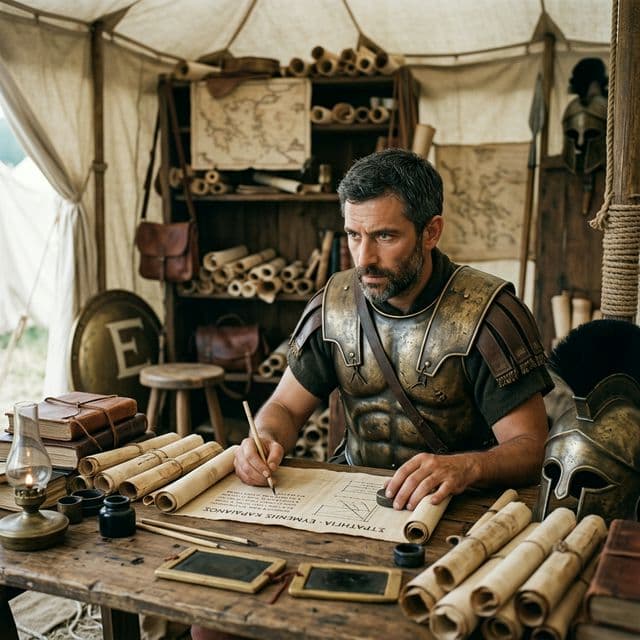
AI-assisted portrait of Eumenes of Cardia
The Architecture of Intellect
Eumenes of Cardia did not just record history; he engineered it from the archives. As the personal secretary to both Philip II and Alexander, his life was defined by a profound, internal strategic synthesis (Ni). While the other generals relied on their noble birth and physical command, Eumenes’s genius was profoundly cerebral. He saw the complex, administrative machinery of the empire as a system of information that could be mastered through pure intellect (Te). He was the scholar who proved that a mind trained in the library could outmaneuver the most battle-hardened veterans of the phalanx.
He was the master of the long game and the intellectual fallback. From his creation of the "Alexander Cult" to his brilliant tactical victories against Craterus, Eumenes’s cognitive mode was focused on the internal synthesis of shifting patterns. For Eumenes, the world was a logical puzzle that required a detached, analytical strategy to solve, even when the pieces were armies of thousands.
Historical Context
Eumenes of Cardia was a Greek statesman and general, serving as the chief secretary to Alexander the Great. After Alexander's death, he was thrust into the Wars of the Diadochi, where he emerged as one of the most brilliant and loyal defenders of the Argead royal house. Despite being a "foreigner" in a Macedonian-dominated court, he successfully commanded massive armies and defeated some of the most famous generals of the age. His career ended when his own Silver Shields betrayed him to Antigonus in 316 BCE. He remains the most sophisticated and intellectual figure of the successor era.
The Psychological Verdict
Eumenes of Cardia is a classic INTJ. He was a figure of deep, internal vision and strategic independence (Ni), supported by a pragmatic, logical approach to administrative and military organization (Te) and an unwavering, if private, internal loyalty (Fi).
Ni — Dominant
His primary mode was the internal synthesis of complex systems. Eumenes understood the psychological and political landscape of the Macedonian army better than they understood it themselves. His creation of the "Empty Throne" of Alexander—using the king's ghost to command the living—was a masterstroke of symbolic and strategic intuition. He could see the hidden leverage in any situation, using his auxiliary Ni to stay several moves ahead of his rivals.
Te — Auxiliary
Supporting his internal vision was an objective, effective application of logic to organization. Eumenes transformed himself from a secretary into a first-rate general by applying the same rigors of record-keeping and logistical planning to the battlefield. His victories were not the result of martial passion, but of the efficient coordination of resources and the precise timing of maneuvers. He was the ultimate administrative commander.
Fi — Tertiary
Beneath his strategic exterior lay a deeply private and unwavering internal loyalty. His tertiary Fi manifests in his absolute devotion to the royal family of Alexander, a commitment that remained steadfast even when it was politically suicidal. This internal standard of honor provided him with the resilience to endure decades of being an outsider, fueled by a conviction that was invisible to his enemies but bedrock to his soul.
Se — Inferior
What stayed in the background was the immediate, visceral experience of the physical world. Eumenes was always more comfortable with the plan than the sword, and his inferior Se manifested in the eventual physical exhaustion of his campaigns and his reliance on mental strategies to overcome the physical superiority of his opponents. His final capture was a direct result of being overwhelmed by the physical reality of his soldiers' betrayal.
The Greek in a Macedonian War
Eumenes was the only non-Macedonian general of the Diadochi to win major battles — and that fact was never forgiven. He served Alexander as royal secretary for years, seeing everything, recording everything. After Perdiccas was murdered by his own officers, Eumenes took up the Argead cause anyway, fighting Antigonus across Asia for years with increasingly desperate resources. His most remarkable gambit was claiming that Alexander’s spirit still led the army — he set up an empty throne with the dead king’s diadem and scepter, and his officers accepted it. He was eventually betrayed by the very Silver Shields he’d been fighting alongside, men who handed him to Antigonus in exchange for their baggage train. Antigonus kept him alive for months before executing him — an odd delay that suggests he couldn’t quite bring himself to eliminate someone he found genuinely impressive. The Greek who almost won the Macedonian wars remains history’s most complete proof that competence alone is not enough when everyone else controls who gets to count.
Connected Figures
Further Reading
- Eumenes of Cardia: A Greek Among Macedonians — Edward M. AnsonThe dedicated study of the only non-Macedonian Successor general, from royal secretary to executed rebel.
- Dividing the Spoils: The War for Alexander the Great's Empire — Robin WaterfieldFollows Eumenes's Empty Throne gambit and his eventual betrayal by the Silver Shields to Antigonus.
- Antigonos the One-Eyed and the Creation of the Hellenistic State — Richard A. BillowsTells the same pursuit and execution from the perspective of Antigonus, Eumenes's captor and reluctant admirer.
