 Historical Figure MBTI
5 min read
#218 · 3-21-26 · The Age of Alexander
Cleitus the Black
The Loyal Critic
c. 375 – 328 BCE
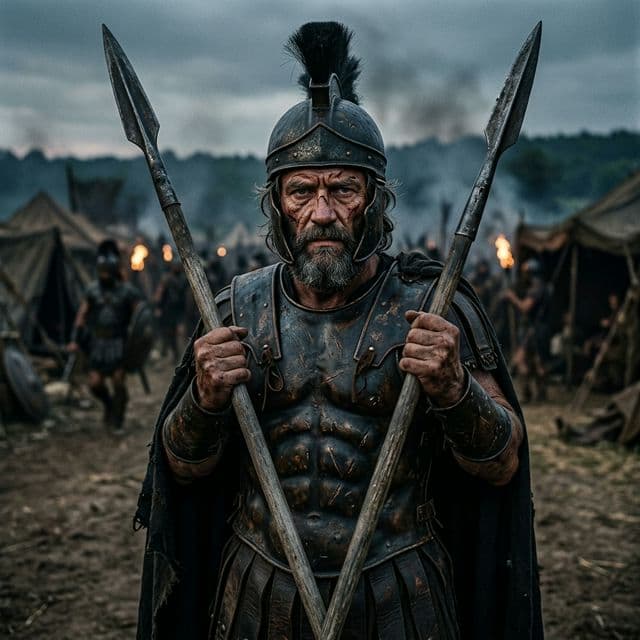
AI-assisted portrait of Cleitus the Black
The Architecture of Tradition
Cleitus the Black did not just follow a king; he protected a standard. As the veteran commander of the Companion Cavalry and the man who saved Alexander’s life at the Battle of the Granicus, his life was defined by a profound, unwavering commitment to the traditional values of the Macedonian military elite. While Alexander was driven by a mercurial, visionary expansion (Ni), Cleitus’s genius was profoundly rooted in the tangible, reliable reality of the phalanx and the shared history of his people (Te-Si). He was the voice of the old guard, the one who valued the blunt truth and the structural integrity of the past over the infinite, often "foreign" horizons of the visionary.
He was the master of the direct command and the traditional truth. From his heroism in battle to his fatal confrontation with the king, Cleitus’s cognitive mode was focused on the objective enforcement of Macedonian standards. For Cleitus, loyalty was not about worship, but about the preservation of the shared reality that had built the kingdom.
Historical Context
Cleitus the Black was a Macedonian officer and a personal friend of Alexander the Great. He famously saved Alexander's life at the Granicus in 334 BCE by severing the arm of the Persian satrap Spithridates. However, as Alexander adopted more Persian customs and began to demand deification, Cleitus became one of his most vocal critics from the old guard. Their tension reached a breaking point in 328 BCE during a drunken banquet in Maracanda, where Cleitus’s blunt defense of Philip II’s legacy led Alexander to kill him in a fit of rage. His death is often seen as the moment Alexander truly lost his connection to the Macedonian spirit.
The Psychological Verdict
Cleitus the Black is a definitive ESTJ. He was a leader defined by his relentless focus on external standards and direct command (Te), guided by a deep attachment to the traditions and history of his people (Si), and supported by a pragmatic engagement with the physical world (Se).
Te — Dominant
His primary mode was the application of logic to the external world. Cleitus thrived in the structured, hierarchical environment of the Macedonian army. His decisions were characterized by a focus on objective achievement and the direct enforcement of standard operating procedures. He spoke the language of results and duty, expecting the same blunt, effective performance from his king that he gave to his men. He was the commander who prioritized the "how" of victory over the "why" of glory.
Si — Auxiliary
Supporting his will was a deep, sensory connection to the Macedonian past. Cleitus’s identity was rooted in the reforms of Philip II and the shared hardships of the veterans. His auxiliary Si allowed him to see the present through the lens of established precedent, leading to his intense skepticism of Alexander’s "oriental" innovations. He was the guardian of the memory of what Macedon was before it became an empire. For Cleitus, the past was the only reliable map for the future.
Ne — Tertiary
Beneath his traditionalist exterior lay a tertiary ability to see the potential for disruption. Cleitus often foresaw the dissatisfaction among the troops and the dangers of the king’s changing temperament. However, because his Ne was tertiary, he lacked the diplomatic subtlety to communicate these possibilities effectively, instead resorting to blunt, often inflammatory warnings that eventually led to his destruction. He saw the fire coming but could only yell at the flame.
Fi — Inferior
What stayed in the background was the processing of his own, internal subjective values. Cleitus’s loyalty was absolute, but it was an external, duty-bound loyalty (Te) rather than an internal, relational one (Fi). His inferior Fi manifested in his inability to navigate the complex, personal dynamics of Alexander’s evolving ego, leading him to prioritize the "truth" of the system over the subjective "feelings" of the person. His final outburst was the ultimate clash of an unyielding Te reality against a fragile Fi world.
The Night at Maracanda
At the battle of the Granicus in 334 BCE, Cleitus cut off the arm of a Persian cavalry officer who was about to kill Alexander from behind. He saved the campaign. Four years later, at a banquet in Maracanda, drunk and furious at Alexander’s increasing adoption of Persian customs and his dismissal of the old Macedonian guard’s contributions, Cleitus spoke too freely. He cited Philip’s veterans. He said what many thought but no one else would say. Alexander killed him with a spear. He was immediately overcome with remorse — refused food for days, lay weeping in his tent, had to be talked back from complete breakdown by his philosophers. Ptolemy and Perdiccas were reportedly present that night. The death of Cleitus is the pivot point in Alexander’s story — the moment when the campaign stopped being a Macedonian enterprise and became something that could not quite be named. He had been repaid for saving Alexander’s life, just not in the way either of them would have chosen.
Connected Figures
Further Reading
- Alexander of Macedon, 356–323 B.C.: A Historical Biography — Peter GreenThe fullest modern biography of Alexander; gives extensive context to the Maracanda episode and Cleitus's role in the old guard.
- The Generalship of Alexander the Great — J. F. C. FullerClassic military analysis that situates Cleitus within the Companion cavalry and explains why his death mattered strategically.
- Alexander the Great: The Hunt for a New Past — Paul CartledgeExamines the sources (Arrian, Plutarch, Curtius) that preserve the Cleitus story and what each account reveals about Alexander's transformation.
- The Wars of Alexander's Successors 323–281 BC, Vol. 1 — Bob Bennett & Mike RobertsCovers the world the Companions — including Cleitus's peers — inherited after Alexander's death.
