 Historical Figure MBTI
5 min read
#219 · 3-21-26 · The Age of Alexander
Bagoas
The Bloom of the East
c. 350 – 323 BCE
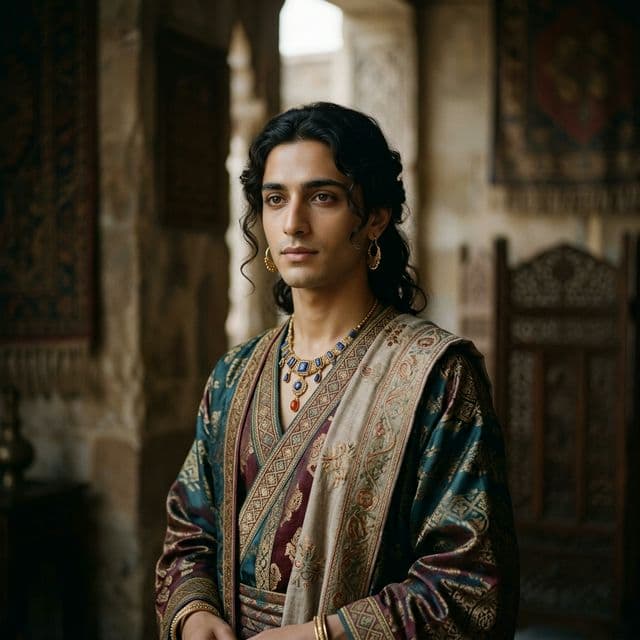
AI-assisted portrait of Bagoas
The Architecture of the Moment
Bagoas did not just enter a court; he captivated an atmosphere. As the young Persian eunuch who transitioned from the service of Darius III to the favor of Alexander the Great, his life was defined by the profound, external engagement with the sensory and emotional reality of the present (Se-Fi). While the Macedonian generals were obsessed with the structural logistics of empire (Te), Bagoas’s genius was in the immediate, relational grace that could bridge the gap between two alien cultures. He was the figure of the living presence, the one who moved through the court with a quiet, sensory intelligence that focused on the beauty and connection of the "now."
He was the master of the subtle influence and the emotional truth. From the famous public kiss in the theater at Pura to his quiet presence in the king’s private quarters, Bagoas’s cognitive mode was focused on the internal synthesis of his relationships. For Bagoas, the world was a series of immediate, sensory encounters that required an authentic, personal touch to navigate.
Historical Context
Bagoas was a Persian eunuch of noble birth who became a favorite and Eromenos (beloved) of Alexander the Great after the fall of the Achaemenid Empire. Beyond his role as a courtier, he was a key figure in Alexander’s policy of "Persianization," symbolizing the king's deep personal and cultural integration with the conquered East. He is famously remembered in the accounts of Plutarch and Curtius Rufus for his beauty, his grace as a dancer, and his significant influence on Alexander's personal decisions. His life represents the intimate, human side of the collision between Greece and Persia.
The Psychological Verdict
Bagoas is a definitive ESFP. He was a figure defined by his intense engagement with the sensory and emotional present (Se), guided by a deep, internal set of personal values and loyalties (Fi), and supported by a broad, imaginative openness to his changing role (Te).
Se — Dominant
His primary mode was the immersion in the immediate environment. Bagoas’s legendary skill as a dancer and his ability to navigate the complex social and sensory world of the Persian and Macedonian courts reflect a dominant Se. He was acutely aware of the "vibe" of any room, using his grace and physical presence to bridge cultural divides. He didn't live for the abstract future; he lived for the tangible beauty and connection of the present moment.
Fi — Auxiliary
Supporting his sensory presence was a deep, internal set of loyalties. Bagoas’s transition from Darius to Alexander was not a mere political calculation, but a personal alignment of his devotion. His auxiliary Fi manifested in his quiet, singular loyalty to Alexander, a bond that was reportedly devoid of public ambition but rich in personal meaning. He was the one who could provide Alexander with an authentic, private emotional sanctuary in the midst of a world of generals.
Te — Tertiary
Beneath his relational grace lay a tertiary ability to navigate the objective structures of the court. Bagoas understood the hierarchy and the "rules" of the game perfectly, using his influence to remove rivals like Orxines when he saw them as a threat to his or Alexander’s well-being. This function allowed him to be not just a favorite, but a survivor who could exert a subtle, effective power over the external environment when necessary.
Ni — Inferior
What stayed in the background was the pursuit of a long-term, abstract strategic vision. Bagoas’s world was one of immediate experience rather than inter-generational planning. His inferior Ni manifested in a relative lack of independent political ambition; he sought to be the heart of the present rather than the architect of the future. His story ends with Alexander's death, reflecting a life that was profoundly tied to the presence of his king.
The East That Stayed with the Conqueror
Bagoas is the figure through whom Alexander’s "Persianization" policy becomes personal rather than political. He had been a favorite of Darius III before Alexander; his transition to Alexander’s court symbolized exactly the kind of cultural continuity Alexander was trying to project — and actually, apparently, felt. The famous scene at Pura, where the Macedonian army cheered Bagoas to kiss Alexander after he won a dancing competition, is one of the few moments in the ancient sources where Alexander appears genuinely, publicly affectionate in a way that isn’t mediated through military achievement or divine framing. Hephaestion died in 324 BCE; Bagoas was still present at Alexander’s death in 323 BCE. What happened to him afterward is unknown — the sources stop caring once Alexander is gone, which is itself a comment on how completely his existence was defined by proximity to the king. He represented something the Macedonian generals never quite understood: that the empire of Alexander was also, in some fundamental way, Persian.
Connected Figures
Further Reading
- Alexander of Macedon, 356–323 B.C.: A Historical Biography — Peter GreenThe most comprehensive scholarly biography in English; treats Bagoas's role in Alexander's Persianization policy with nuance.
- The Campaigns of Alexander — Arrian (trans. Aubrey de Sélincourt)Primary ancient source; the essential starting point for any account of Alexander's court and its Persian inhabitants.
- Who's Who in the Age of Alexander the Great: Prosopography of Alexander's Empire — Waldemar HeckelStandard reference for identifying and cross-checking historical persons in Alexander's orbit, including Bagoas.
