 Historical Figure MBTI
#535 · 4-23-26 · The Hundred Years' War
Gilles de Rais
Marshal of France · Joan's Comrade Turned Monster
1405 — 1440
8 min read
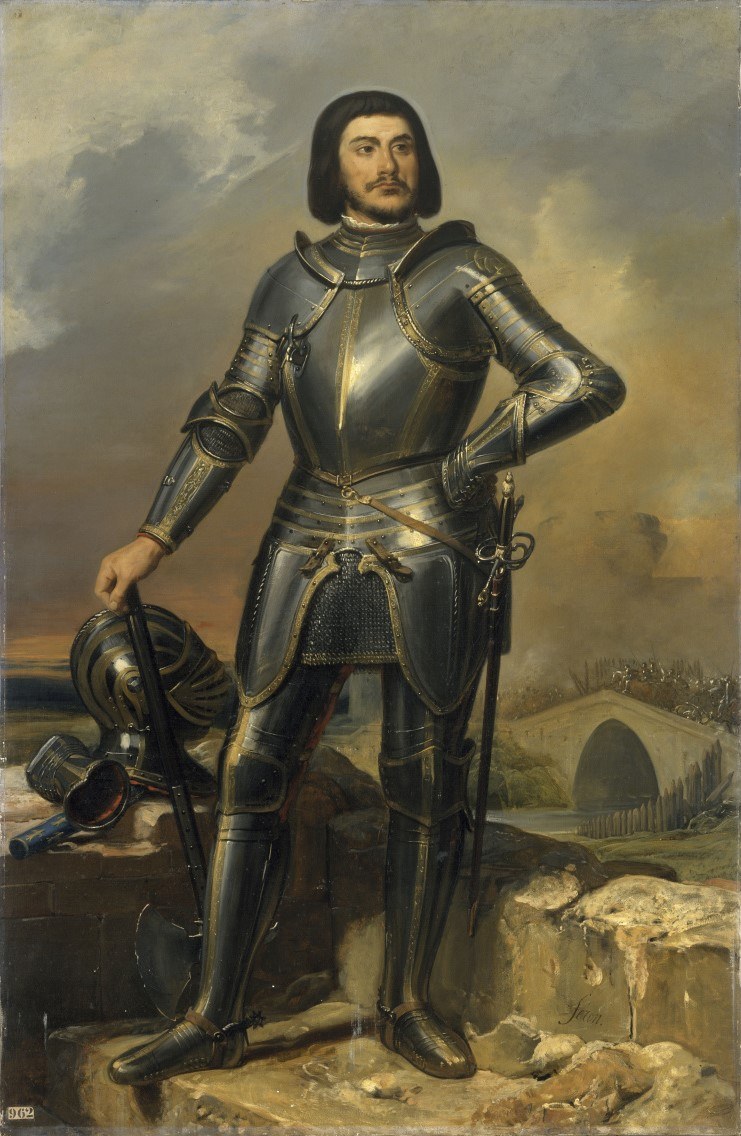
AI-assisted Portrait of Gilles de Rais
The Marshal Who Became a Monster
In 1429 Gilles de Rais rode beside Joan of Arc at the relief of Orléans, one of the wealthiest nobles in France and among the bravest soldiers in her company. He was made Marshal of France at twenty-five. Eleven years later he was hanged and his body burned outside Nantes, having confessed to the torture, sexual abuse, and murder of a large number of children. The recorded victims number in the dozens; some estimates run far higher. Few lives in history collapse so completely from valor into atrocity.
After Joan's capture, Gilles withdrew to his vast estates and began spending a colossal fortune at a ruinous pace — a private chapel staffed with its own choir, and a theatrical spectacle re-enacting the siege of Orléans so lavish it threatened to bankrupt him outright. As the money drained away he turned to alchemy and the occult, summoning practitioners who promised to conjure gold and restore his wealth. And in those same years, roughly 1432 to 1440, he committed the crimes for which he is remembered — crimes so monstrous they later fused, in folk memory, with the legend of Bluebeard.
Any attempt to type a man like this must be offered with a hard caveat. Pathology this extreme distorts every signal a personality reading depends on; what follows is a tentative sketch of the worldly, public figure — the marshal, the builder, the spender — and not a claim to explain the evil. There is no cognitive stack that accounts for what he did. There is only the outer shape of an ambition that curdled.
The public Gilles de Rais reads as an ENTJ — commanding Te paired with grandiose Ni, the will to dominate his world — but the crimes mark a moral void no type can describe. This is a portrait of the man the world saw, not an explanation of the man he was.
The Will to Command
Te — dominant
The first thing the records show is a man built to command. Gilles inherited one of the largest fortunes in France and treated it, his rank, and the men around him as instruments of his own will. On campaign he was a forceful, capable soldier — aggressive, decisive, effective enough that the crown made him a Marshal of France while he was still in his twenties. Dominant Te organizes the external world toward an objective and brooks little resistance, and in war that gave him real usefulness: he marshaled men and money and threw them at the English with conviction.
The same drive, turned inward on his estates, became megalomania. The private chapel with its own choir, the staff, the household run like a small court — these were not idle luxuries but assertions of dominance, a nobleman bending the resources of a region to magnify himself. The siege re-enactment at Orléans was Te at its most grandiose and least restrained: a production so enormous and so expensive it consumed estates faster than they could be sold, staged for no purpose but spectacle and self-aggrandizement. Where a disciplined Te builds toward a goal, his ran without a governor, spending and commanding for the sake of the commanding itself.
What is missing from the Te picture is any external authority he would submit to. He sold and mortgaged lands until his own family petitioned the king to forbid further sales; he ignored them. He answered to no one, and that is the hinge on which the worldly portrait turns — an executive will with neither check nor conscience to limit it.
The Reach for Transformation
Ni — auxiliary
Auxiliary Ni supplies the ENTJ with a singular vision toward which the will is bent, and in Gilles it shows in the grandiosity itself — the conviction that he was destined for something vast, that his fortune and his fate could be transformed if he reached far enough. The siege spectacle was not only Te excess; it was a man trying to fix his own legend in permanent form, to monumentalize the one moment of his life that had carried real glory.
The alchemy and the occult dealings are the clearest expression of this reach. As his wealth evaporated, he did not retrench; he sought a shortcut through the supernatural, importing practitioners who claimed they could conjure gold or summon a demon to deliver it. This is Ni in its most desperate register — the refusal to accept the obvious arithmetic of decline, the belief in a hidden transformation that would reverse fate at a stroke. A grounded man sells land and economizes; Gilles chased the alchemist's promise of transmutation, certain that the world owed him a way out.
Read charitably, this is the visionary cast of an ENTJ unmoored from any practical correction. Read honestly, it is the same grandiosity that let him believe himself beyond consequence — a belief that, in the years of the murders, proved very nearly true until the church and the crown finally moved against him.
Appetite Without Limit
Se — tertiary
Tertiary Se in an ENTJ shows as a taste for sensory spectacle and immediate gratification — the lavishness, the pageantry, the demand that the world deliver pleasure now. In its ordinary form this is the noble who builds, feasts, and stages; in Gilles it is the bottomless appetite that drove the spending. The chapel, the choir, the theatrical excess were all sensory in kind: a man who wanted experience on a scale no estate could sustain.
It is here that the worldly portrait runs out and the pathology begins, and the line must be drawn plainly. The crimes against the children of the countryside around Nantes and his other castles were not the excess of a healthy tertiary function; they were the acts of a profoundly disordered man, and no description of Se — or of any cognitive function — reaches them or explains them. To gesture at a personality trait as if it accounted for the murders would be both false and obscene. The appetite for spectacle is part of the public figure. What he did to children is something the typing exercise cannot, and should not, pretend to illuminate.
The Void Where Conscience Should Have Been
Fi — inferior
Inferior Fi is, in the ordinary ENTJ, the underdeveloped private value-compass — the last function to mature, the source of late-recognized personal feeling beneath all the outward drive. In Gilles de Rais the language of an underdeveloped function fails entirely. What the record reveals is not a weak conscience but an absent one: a catastrophic moral void where the capacity for human sympathy should have stood. The children he tortured and killed were nothing to him.
Caution is required even in naming this. To map a horror of this magnitude onto “inferior Fi” risks domesticating it — making a clinical or typological category out of something that exceeds any such frame. The honest statement is narrow: whatever ordinary inner moral life a person is meant to have, Gilles either never possessed it or had it annihilated. That absence is the central fact of his case, and it is also precisely the point at which personality typing reaches its limit and falls silent.
The one flicker the trial records preserve is his conduct at the end. Confronted with the evidence at Nantes, he confessed in appalling detail, wept, and asked the parents of his victims for forgiveness before his execution. Whether this was genuine contrition, terror of damnation, or a final performance, no one can say — and it does nothing to balance the ledger. It is mentioned only because it is part of the record, not because it redeems him.
Why ENTJ Over ENTP
Why not ENTP?
The ENTP's defining worldly mode is restless idea-play — improvising, debating, spinning possibilities. Gilles's defining drive was different: commanding, ambitious, and grandiose, executed with real force and a will to dominate his world rather than explore it. The marshal who threw men and money at the English, built a court to magnify himself, and pursued a single transformative fixation in the alchemy schemes reads as Te-Ni, not the branching Ne of an ENTP. That said, the caveat applies here above all: pathology this extreme makes the whole exercise genuinely uncertain.
The case for ENTJ rests entirely on the public, worldly man — the soldier, the builder, the spender who bent a fortune and a region to his will. It does not, and cannot, rest on the crimes, which lie outside the reach of any type. This is the appropriate place to end the exercise honestly: the typing describes the outline of an ambition without limit, and stops where the monstrousness begins. Everything past that point is not personality but pathology, and no MBTI reading should be asked to carry it.
Connected Figures
Further Reading
- The Trial of Gilles de Rais — Georges BatailleBataille's notorious study, built around the surviving secular and ecclesiastical trial records from Nantes — the closest thing to a primary source for the case.
- Joan of Arc: A History — Helen CastorThe fullest modern account of Joan's campaign and the men who rode with her, including the Marshal de Rais at Orléans and beyond.
- Gilles de Rais: The Authentic Bluebeard — Jean BenedettiA narrative biography tracing the path from war hero to condemned murderer, and the later fusion of the historical man with the Bluebeard legend.
