 Historical Figure MBTI
#530 · 4-23-26 · The Hundred Years' War
Joan of Arc
The Maid of Orléans · The Peasant Girl Who Crowned a King
c. 1412 — 1431
11 min read
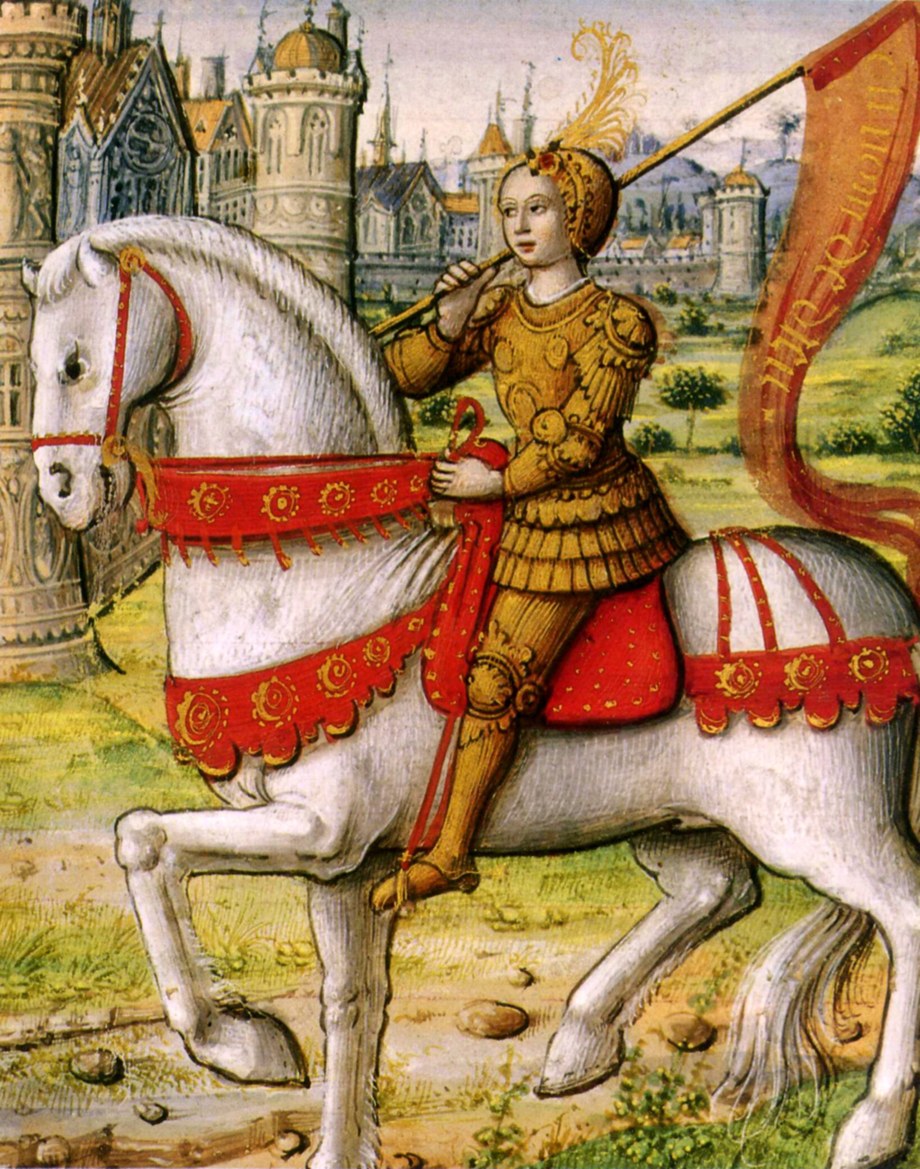
AI-assisted Portrait of Joan of Arc
The Girl Who Saw the End From the Beginning
Of all the lives the Middle Ages produced, none is stranger or more luminous than the one that began in the village of Domrémy around 1412 and ended in fire at Rouen in 1431. A peasant girl who could neither read nor write, who had never left her corner of Lorraine, announced at about seventeen that she had been sent by God to drive the English out of France and to see the disinherited Dauphin crowned at Reims — and then, against every probability the age could muster, she did it. She talked her way past a skeptical garrison captain, crossed a war-torn kingdom in disguise, picked the Dauphin out of a crowd of courtiers who had hidden him among them, satisfied a tribunal of theologians, and within months had lifted the siege of a city the English had every reason to believe would fall.
What carried her was not strategy or strength but a certainty so total it bent the people around her into belief. From the age of about thirteen she heard voices and saw visions — Saint Michael, Saint Catherine, Saint Margaret — and she did not experience them as guidance to be weighed but as commands already settled, a future she had been shown and was now obliged to bring about. She wore white armor and carried her own banner; she spoke of her death before it came; she never once, through trial, threat, or flame, doubted that she had seen the truth. She is, by near-unanimous consensus, the INFJ — the visionary whose inner certainty becomes a force in the outer world.
Joan was the INFJ in its purest and most frightening form — a dominant intuition that did not advise but command, a singular vision of the future enacted upon a whole nation by a teenager who never doubted she had already seen how it ended.
The Vision That Could Not Be Argued With
Ni — dominant
Dominant Ni does not gather evidence and reason toward a conclusion; it arrives at the conclusion first and treats everything afterward as confirmation. In Joan this took its most extreme possible form. She did not believe France could be saved — she knew it, with the flat certainty of someone reporting a thing already seen. The voices of Michael, Catherine, and Margaret were not, to her, suggestions to be tested but a future disclosed, and her task was simply to walk toward it. When the court at Chinon questioned her, when learned clergy at Poitiers probed for fraud or madness, she did not argue her case so much as describe what she had been shown, and the sheer immovability of it unsettled men trained to dismantle any claim.
The mark of Ni is the single thread running beneath apparent chaos — the one meaning that organizes everything. For Joan the whole disorder of the Hundred Years' War resolved into a sequence as clear as scripture: relieve Orléans, defeat the English in the field, march to Reims, crown the king. She announced these steps before she accomplished them, and announced too the things that frightened her allies — that she would be wounded at Orléans (she was, an arrow above the breast, which she had foretold), that her time would be short, that she would not last much beyond a year. Ni lives in the future tense, and Joan lived there so completely that the present was only the place where the foreseen was being made real.
This is what separated her from every pious visionary the age also produced. Mystics were common; what was not common was a mystic whose inner conviction translated directly into military and political action, who took a vision and turned it into a relieved city and a crowned king. The Ni dominant does not merely see — she enacts, treating the outer world as raw material to be shaped to match the inner certainty. Joan's tragedy and her glory were the same thing: she could not be talked out of what she had seen, not by captains, not by bishops, not by fire.
The Fervor That Made Hard Men Believe
Fe — auxiliary
A vision locked inside one head changes nothing. What made Joan a historical force rather than a footnote in a parish record was auxiliary Fe — the gift for reading the emotional temperature of a room and raising it, for binding strangers to a shared feeling until they would follow her into the line. The France she found was beaten and cynical, a kingdom that had lost so often it had half-accepted defeat. Joan walked into that exhaustion and ignited it. Veteran soldiers who had every reason to scorn a teenage girl in armor instead wept, confessed, swore off swearing, and fought for her with a devotion their captains could not command.
Fe works through the collective, and Joan's instrument was always the group — the army, the besieged townspeople, the demoralized court. She did not win at Orléans by tactical genius; the commanders, men like Jean de Dunois, handled the maneuvers. What she supplied was belief, the conviction that God was on this side now, and that conviction was worth more than any column of reinforcements. Her banner, her insistence that the men purify themselves, her presence in the front rank where the wound found her — all of it was Fe made visible, the moral atmosphere of an entire campaign rebuilt around one girl's certainty.
The auxiliary serves the dominant, and here it served flawlessly: Ni supplied the unbreakable vision, Fe transmitted it into the hearts of thousands until a nation that had forgotten how to win remembered. That a coronation at Reims could be made to feel inevitable — that the Dauphin Charles could be carried to the throne on a tide of restored faith — was the work of an Ni-Fe pairing operating at a pitch history has rarely seen.
The Shrewdness That Trapped the Theologians
Ti — tertiary
The transcripts of the Rouen trial are one of the most remarkable documents to survive from the medieval world, and what they reveal is tertiary Ti operating under conditions designed to break it. The court that tried her was a machine built to convict — dozens of university-trained clergy, led by Bishop Pierre Cauchon, laying logical snares for an illiterate nineteen-year-old. And again and again she stepped neatly out of them. Asked whether she knew she was in God's grace — a question with no safe answer, since to say yes was the sin of presumption and to say no was to confess damnation — she replied that if she were not, may God put her there, and if she were, may God keep her so. The judges were stunned into silence.
Tertiary Ti in an INFJ is not a system-builder; it is a sharp, occasional logical blade, drawn under pressure to defend the integrity of the dominant vision. Joan used it exactly this way. She would not let the court force her certainty into the categories they had prepared. When pressed on whether Saint Michael had appeared naked, she answered drily that she supposed God could afford to clothe him. When they tried to make her concede that her visions might be demonic, she held the line with a precision that educated men could not penetrate. She had no training and no books, yet she handled the most learned tribunal in France to something close to a draw on the points of doctrine — and they finally convicted her not on theology but on the technicality of her men's clothing.
The Sudden Mastery of Armor and Horse
Se — inferior
The inferior function is the one we least expect, the one that lies dormant until something calls it violently into use. For the INFJ that buried function is Se — the immediate, physical command of the present moment, the body in the world. And here is one of the strangest facts of Joan's life: a girl who had spent her years spinning wool and minding sheep took up armor, mounted a war horse, and moved across the field of battle as though she had been bred to it. Contemporaries who watched her ride and handle a lance remarked that she sat and managed a horse like a seasoned man-at-arms. The visionary's least-developed faculty erupted, under the pressure of her mission, into improbable competence.
Inferior Se, when it surfaces, tends to be all-or-nothing — not a steady skill but a sudden, total immersion in the sensory present. Joan in battle was exactly that: a figure of pure forward motion, planting her banner at the wall, pressing the assault when the captains hesitated, refusing to retreat from Orléans even wounded. It dazzled everyone who saw it precisely because it seemed to come from nowhere. But the inferior function is also the seat of vulnerability, and Joan's relationship to the physical world remained that of the visionary, not the tactician. At Compiègne in 1430 the rear-guard action that should have been routine became the moment she was pulled from her horse and taken — the present moment, which Ni had so long subordinated to the foreseen future, finally caught up with her. From there the road led only to Rouen.
Why INFJ Over INFP or ISFP
Why not INFP?
The INFP guards a private, deeply personal truth and resists imposing it on the world; its idealism is inward, a fidelity to its own values rather than a mission to remake the kingdom. Joan was the opposite kind of idealist. Her vision was singular and externally directed — not “this is what I believe” but “this is what will happen, and I am sent to make it happen.” She did not retreat into her conviction; she drove a whole nation toward it with prophetic certainty. That outward enactment of a foreseen future, paired with the crowd-binding charisma of Fe, is Ni-Fe, not the Fi-Ne of the INFP.
Why not ISFP?
Her sudden mastery of horse and armor, her physical fearlessness in the field, can look like the present-moment Se artistry of an ISFP. But the ISFP lives in sensory immediacy and acts on what is concretely before it; Joan's certainty was abstract, symbolic, and fixed on a future she claimed already to have seen. Her Se was the inferior function flaring under pressure — impressive but eruptive and ultimately fragile — not the steady sensory grounding that anchors an ISFP. She rode toward a vision, not into the moment for its own sake.
The decisive thing is the direction of the certainty. An INFP holds a truth; an ISFP inhabits a moment; the INFJ sees a future and bends the present to meet it. Joan never wavered, never privatized her conviction, and never lived in the now except where the now served the foreseen. She announced her wound before it came, her brief span before it ran out, the coronation before it was won — and then she made each of them real. That is dominant Ni harnessed to Fe: the prophet who does not merely believe, but builds the thing she has seen.
Connected Figures
Further Reading
- Joan of Arc: By Herself and Her Witnesses — Régine PernoudBuilds the whole story from the words of Joan and those who knew her, drawn from the two trials — the indispensable source-driven portrait.
- Joan of Arc: A History — Helen CastorReconstructs Joan inside the politics and uncertainty of her own moment, before hindsight made the legend inevitable.
- The Virgin Warrior: The Life and Death of Joan of Arc — Larissa Juliet TaylorA vivid, well-grounded modern biography attentive to Joan's charisma and military role.
- The Trial of Joan of Arc — Daniel Hobbins (trans.)A clean translation of the Rouen condemnation record — the closest we can come to hearing Joan answer her judges in her own voice.
