 Historical Figure MBTI
#508 · 4-19-26 · The Hundred Years' War
Charles VII
King of France · The Disinherited Dauphin, Crowned by Joan
1403 — 1461
8 min read
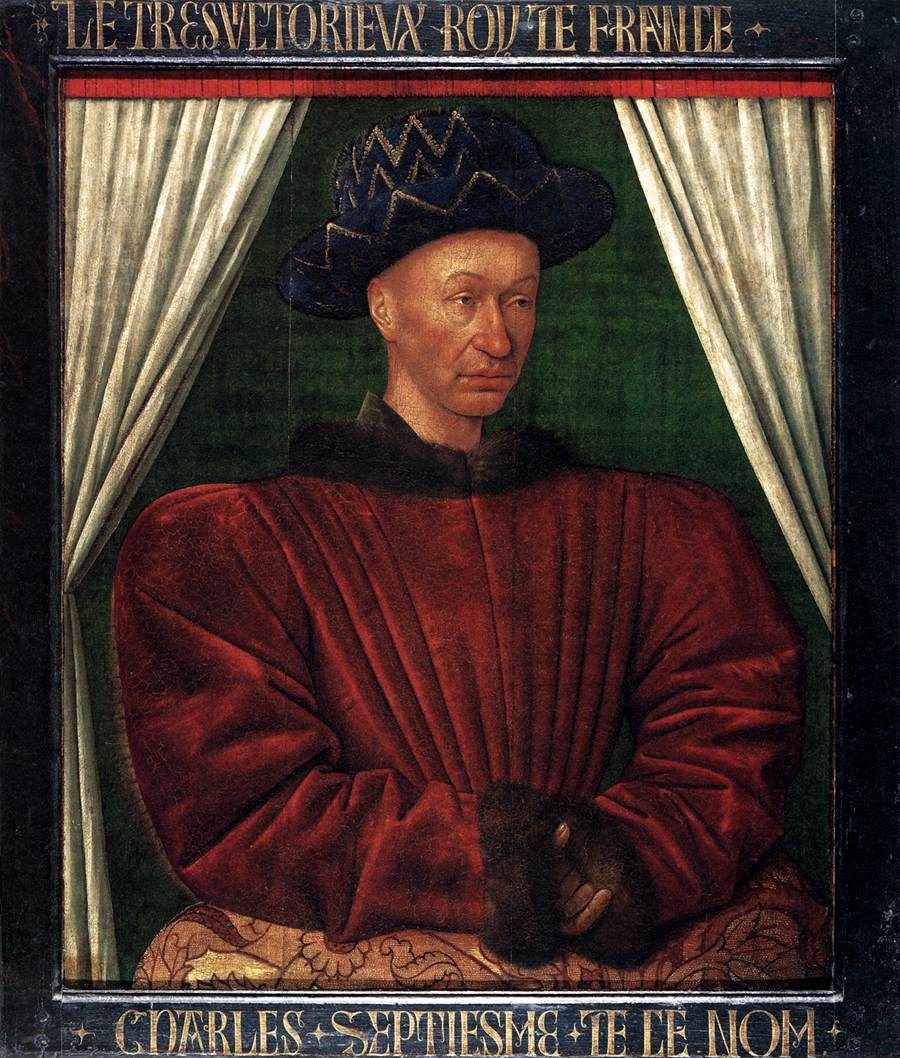
AI-assisted Portrait of Charles VII
The King Who Had to Be Told He Was King
For the first half of his life, Charles VII was the least convincing claimant to a throne in Christendom — a withdrawn, melancholic young man holding the center and the south of a France that had largely written him off. The Treaty of Troyes, signed in 1420 by his own mad father Charles VI and his mother, had formally disinherited him and handed the French crown to the English king Henry V. When Charles VI died in 1422, the seventeen-year-old Dauphin proclaimed himself king but could not be crowned at Reims, the traditional sacring place, because Reims lay in enemy hands. Mocked as the “King of Bourges” after the provincial town that held his rump court, he was hemmed in by the English regent John, Duke of Bedford and his Burgundian allies, and tormented by rumors that he was a bastard with no true right to anything at all.
And yet this hesitant, self-doubting man would die almost forty years later as Charles the Victorious, the king who reformed the French army into the first permanent standing force in Europe, embraced gunpowder artillery, and drove the English out of France almost entirely — ending the Hundred Years' War that had consumed five reigns. The arc from “King of Bourges” to “the Victorious” is one of the great late-blooming transformations in European history. What is striking is how little of it Charles drove himself, at least at first. He was carried — by belief, and by the people who believed in him when he could not believe in himself.
Charles VII is the INFP who came good at last: a king ruled by private feeling and a fragile sense of his own legitimacy, unlocked not by ambition but by faith — the faith of Joan of Arc, who swore he was the true king, and of the advisers who built a kingdom around a man who needed to be told he was its sovereign.
The Inward King
Fi — dominant
Everything about the young Charles points to a man governed from the inside. He was diffident where his rivals were brash, melancholic where the age demanded bravado, and crippled by a self-doubt that no amount of nominal authority could cure. Dominant Fi is an inner compass of feeling and conviction, but it is also fragile: it must be sure of itself before it can act, and when its sense of its own worth is shaken, it can freeze. Charles's worth was shaken at the root. The whispers that he was illegitimate — that he had no true claim to the crown he wore — cut at precisely the place an Fi-dominant lives. He did not merely doubt his strategy; he doubted his right to exist as king.
This is the man who, by tradition, asked Joan of Arc for a private sign before he would trust her — and who, the chroniclers say, was reassured only when she addressed a secret prayer he had spoken alone, a doubt he had confided to no one: whether he was truly the rightful heir. The story may be embellished, but it is psychologically exact. Charles needed his legitimacy confirmed from outside before his inner conviction could catch fire. An Fi-dominant under siege does not want a battle plan; he wants permission to believe in himself. Joan gave him that permission, and the coronation at Reims in 1429 — where she finally led him to be anointed with the holy oil — was less a political maneuver than a sacramental cure for a wound of identity.
The same inwardness has a darker face. When Joan was captured in 1430 and burned by the English in 1431, Charles lifted no finger to ransom or save her. Historians have debated his motives — political caution, the awkwardness of a king indebted to a peasant girl — but at bottom it reads as a failure of moral courage, the besetting weakness of dominant Fi. The function that can hold a private conviction with quiet fervor can also retreat into self-protective silence when acting on that conviction would cost too much. Charles let the woman who made him king die without lifting his voice.
The Openness That Saved Him
Ne — auxiliary
If Fi was the wound, auxiliary Ne was the door through which the cure arrived. Ne is an openness to possibility — to the unexpected, the unconventional, the vision that more rigid minds would dismiss out of hand. It is no small thing that a hesitant, disinherited king received an illiterate peasant girl who claimed to hear the voices of saints, listened to her, had her examined, and then staked his throne on her. A more concrete, present-bound temperament would have turned Joan away at the gate. Charles entertained the impossible because his auxiliary Ne could see, faintly, the shape of a future in which the impossible came true.
The same receptivity defined his statecraft. Charles did not generate his own grand designs — that was never his gift — but he had a remarkable ear for able people and visionary counsel, and the imagination to back them. His formidable mother-in-law, Yolande of Aragon, the “Queen of Four Kingdoms,” was the steadying intelligence behind his early court, marshaling money, marriages, and men while Charles found his feet. He surrounded himself with capable reformers and financiers and let them experiment: with a permanent army, with artillery, with new ways of taxing and supplying a war. Ne governs through possibility and through other people's ideas, and Charles's genius — such as it was — lay in his willingness to believe that things might be other than they were, and to trust the people who could make them so.
The Patience of the Slow Reconquest
Si — tertiary
The miracle year of 1429 — the relief of Orléans, the coronation at Reims — was not, in fact, followed by a lightning reconquest. Charles's victory came slowly, methodically, over a quarter-century of grinding consolidation, and that patience is where tertiary Si begins to show. Si trusts the accumulated, the gradual, the proven. Charles reconciled with the Burgundians at the Treaty of Arras in 1435, ending the ruinous civil war that had bled France for decades, and then set about the unglamorous work of building institutions that would last: regular taxation, paid troops, a standing officer corps. He was not a dazzling battlefield commander in the mold of his rival Henry V. He was a builder of durable structures, and durable structures are Si's domain.
There is also, in tertiary position, a kind of conservatism of caution. Charles learned from injury and rarely forgot it. The years as the hunted “King of Bourges” left him watchful, slow to trust, and protective of hard-won stability. Even his later reign was marked by a wariness toward those closest to him — including, in the end, his own son, the future Louis XI, who plotted against him. The man who had been disinherited never quite stopped expecting the ground to give way beneath him.
The Competence He Reached Through Others
Te — inferior
The deepest key to Charles VII is the long, painful struggle of his inferior Te. Te is the drive to organize, command, and impose order on the external world — to marshal resources toward an objective and execute without flinching. In the young Charles it was almost wholly absent. He could not command; he could barely decide. He dithered, he hesitated, he watched his cause crumble while he failed to act. The paralysis of the early reign is the paralysis of an Fi-dominant whose inferior Te has no traction — a man who feels deeply and idealizes endlessly but cannot convert feeling into the hard machinery of governance and war.
What makes his story extraordinary is that he reached that competence anyway — late, and largely through other people. Yolande of Aragon supplied the executive grip he lacked; his financiers and reformers built the standing army and the artillery train that would crush the English at Castillon in 1453. But the inferior function, grown in maturity, can become a genuine strength, and by the end Charles himself had hardened into a capable, decisive sovereign — reorganizing the realm, taxing it, arming it, and seeing the war through to victory. The man who could not command at twenty was, at fifty, the architect of the most effective royal administration France had yet seen.
His whole reign is the slow ripening of inferior Te: a feeling man who could not act, carried first by the belief of others into action, and then, late in life, growing the executive command he had spent his youth without.
Why INFP Over ISFP
Why not ISFP?
The ISFP shares the inward, gentle, feeling-led core — and Charles's diffidence might suggest one. But the ISFP's auxiliary Se anchors the type in the concrete, present, and tangible: action in the immediate world, response to what is actually in front of it. Charles was the opposite. He was paralyzed in the present and moved instead by idealized possibility — by a vision of himself as the true king, by faith in voices and signs, by belief in futures that did not yet exist. His transformation was a transformation of self-belief and identity, not a quickening of sensory engagement.
The decisive distinction is what unlocked him. An ISFP comes alive through doing, through immediate contact with the real; Charles came alive through being told he was the king he privately feared he was not. His arc ran through faith, identity, and inner permission — the Fi–Ne axis of an idealist — not through the present-focused practicality of Se. And his great failure confirms it: abandoning Joan was not the pragmatic calculation of an ISFP managing a situation, but a failure of moral courage, the characteristic collapse of an INFP who cannot make his private conviction cost him anything.
Connected Figures
Further Reading
- Charles VII — M. G. A. ValeThe standard scholarly biography in English — measured, archival, and essential on the reforms and reconquest that earned Charles his epithet.
- The Hundred Years War (Vols. IV–V) — Jonathan SumptionThe definitive narrative history; these volumes cover Charles's reign, the relief of Orléans, and the long English collapse in panoramic detail.
- Joan of Arc: Her Story — Régine Pernoud & Marie-Véronique ClinThe leading authority on Joan, illuminating the king she crowned and the court that received — and then abandoned — her.
