 Historical Figure MBTI
#509 · 4-20-26 · The Wars of the Roses
Henry VI
King of England · The Holy Fool Whose Madness Began the Wars
1421 — 1471
9 min read
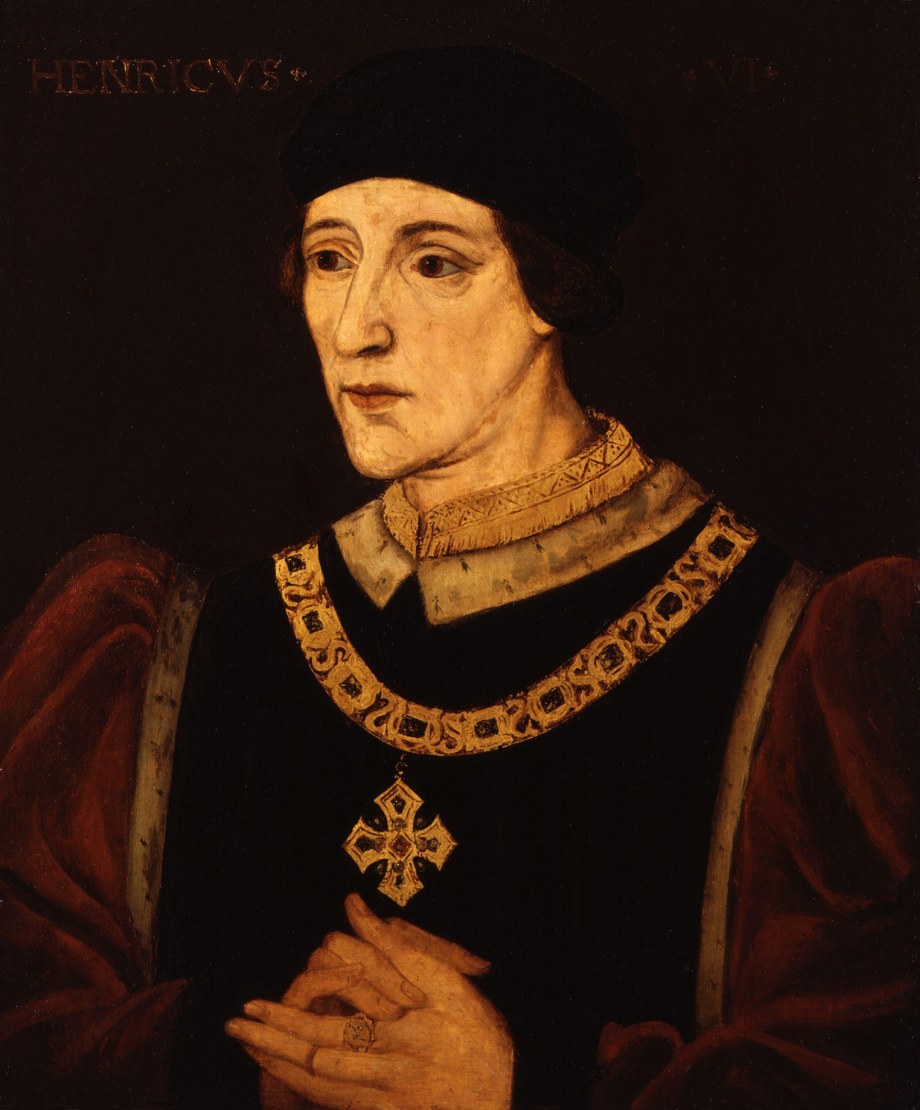
AI-assisted Portrait of Henry VI
The Saint Born to the Wrong Throne
He was the only man in history crowned king of both England and France, and he was the gentlest, most unworldly soul ever to wear either crown. Henry VI came to the English throne as a nine-month-old infant in 1422, on the death of his father Henry V — the great warrior of Agincourt, the conqueror who had brought France to its knees. The son inherited everything the father had won and was, in every dimension of temperament, his father's opposite. Where Henry V was iron, Henry VI was wax. Where the father commanded armies, the son gave away his money to the poor and recoiled from the sight of blood. He grew into a pious, bookish, peace-loving man who wanted nothing so much as to be left alone to pray and to build — and he was set down, instead, in the most violent half-century England had ever known.
His real passions were religion and learning. He founded Eton College and King's College, Cambridge, and lavished on them the attention he could never summon for statecraft. He dressed plainly, disliked finery and oaths, and was so free with the royal purse that his household was perpetually broke. He had no gift for command, no stomach for faction, no instinct for the brutal arithmetic of medieval kingship. Under his feeble hand England lost the Hundred Years' War, driven out of France by 1453, and the realm slid toward the chaos that would become the Wars of the Roses. In that same year of 1453 he collapsed into a total catatonic breakdown — unresponsive, mute, blank for more than a year — very possibly an inheritance from his maternal grandfather, the mad Charles VI of France. From that point he was less a king than a holy relic, passed back and forth between Lancaster and York until he was murdered in the Tower of London in 1471.
Henry VI was the INFP on a throne built for a conqueror — a man of deep private conscience and no public will, who could not be other than himself in a world that needed him to be ruthless, and was destroyed because he could not.
The Conscience That Would Not Bend
Fi — dominant
Dominant Fi is the rule of the inner law — a private, deeply held set of values that the self simply cannot betray, whatever the world demands. In Henry this took the form of a saintly, immovable conscience. He hated bloodshed to the point of physical revulsion; when rebels and traitors were brought before him he pleaded for mercy where a competent king would have ordered executions, and contemporaries recorded his horror at the sight of a quartered corpse displayed as a warning. His charity was compulsive and unguarded — he forgave debts, pardoned enemies, and emptied his treasury into alms and into his colleges, indifferent to the political cost. These were not policies. They were the expressions of a man who could only act from what he personally felt to be right.
What makes this Fi rather than some outward moral code is that Henry's goodness was entirely interior and personal. He did not try to legislate virtue or reform the kingdom in his image; he simply refused, again and again, to be the kind of king his age required. Asked to be cunning, he was sincere. Asked to be ruthless, he was kind. Asked to play the factions against one another, he gave himself over to whoever stood nearest. The tragedy of Fi unsupported by any executive faculty is that it can keep the soul clean while the realm burns — and Henry's did exactly that. His piety was real, his mercy was real, and both were politically suicidal in a court where mercy read as weakness and weakness invited the knife.
He could not perform a self he did not possess. Where a more worldly ruler wears conviction as a costume and sheds it when convenient, Henry was incapable of the pretence. This is the deepest mark of dominant Fi: the absolute authenticity that is also an absolute vulnerability. He was, by every account, exactly the man he appeared to be — and in the Wars of the Roses that transparency was a fatal gift.
The Otherworldly Imagination
Ne — auxiliary
Auxiliary Ne gives Fi its outward reach — an imagination that lives in possibility, in books, in visions of how things might be rather than how they grindingly are. In Henry it was poured almost entirely into religion and learning. He was bookish and contemplative, more at home in scripture and devotion than in the council chamber, and his mind ran naturally toward the eternal and the ideal rather than the practical and the immediate. The two great achievements of his reign were not victories or laws but acts of imagination given stone: Eton College and King's College, Cambridge, conceived as places where poor scholars would be educated and prayers would rise forever. He attended obsessively to their statutes and their architecture, dreaming them into being while France slipped through his fingers.
This is Ne directed away from the world rather than into it. The same faculty that in a more grounded figure might have generated political strategy or diplomatic maneuver was, in Henry, turned toward heaven and the life of the mind. He could envision an ideal community of learning down to its smallest ordinance, yet could not envision — or refused to — the concrete sequence of moves by which a king holds a fractious kingdom together. His imagination was real and even fertile, but it was an imagination without worldly traction, generating colleges and devotions while the machinery of state seized and broke around him. The colleges outlived him by five centuries. The kingdom he could not save came apart within his own lifetime.
The Habits of Devotion
Si — tertiary
Tertiary Si surfaces in Henry as a deep attachment to ritual, routine, and the steadying rhythms of religious life. He kept the daily offices with monkish regularity, observed fasts and feasts, and clung to the forms of piety the way another man might cling to a throne. In a personality otherwise untethered to the practical world, these inherited habits of devotion provided the one reliable structure: the liturgical calendar, the familiar prayers, the established usages of the Church. Where Fi supplied the conviction and Ne the longing for the ideal, Si supplied the worn, comforting groove of repetition that held a fragile man together.
But tertiary Si is a comfort, not a competence. It could organize Henry's private devotions; it could not organize a treasury, a war, or a court. The same conservatism that made him faithful to ritual made him passive before custom and precedent — he deferred, he trusted, he let things be done in his name by whoever held the established forms of authority. After his breakdown this tendency hardened into something close to pure stillness: a king reduced to the bare observances of faith, sitting through the offices while Lancaster and York fought over his crown. The devotional habits remained intact long after the kingly will had dissolved.
The King Who Could Not Command
Te — inferior
Here is the wound that destroyed him. Inferior Te is the weakest faculty of the INFP — the capacity to organize, to impose order, to command others and bend the world to a plan — and in Henry it was not merely weak but nearly absent. Kingship in the fifteenth century was, before anything else, an act of will: the king dominated his magnates, dispensed patronage to bind men to him, and crushed those who would not be bound. Henry could do none of it. He could not control his own household's finances, let alone the great lords who circled his throne. He gave lands and offices to whoever last petitioned him, often to two rivals at once, and then could not enforce his own grants. The realm under him was not governed; it drifted.
Because the king would not rule, others ruled through him. His fierce queen, Margaret of Anjou, took up the executive will her husband lacked and became the true leader of the Lancastrian cause. His court factions fought to possess him, knowing that whoever held the helpless king held the kingdom. And when his mind gave way entirely in 1453, the vacuum at the center of the state became literal: with the king catatonic and unresponsive for more than a year, a formal protectorate had to be installed under Richard, Duke of York. That protectorate was the spark of the Wars of the Roses. The inferior function, in a man whose whole office demanded it, did not merely fail him — it tore the country apart.
A king is a will before he is anything else, and Henry had none to give. The throne that demanded command from him found, in its place, only a gentle and prayerful absence — and into that absence the whole violent age came rushing.
Why INFP Over INFJ or ISFP
Why not INFJ?
The INFJ leads with Ni — a directive, strategic, almost prophetic vision of how the world ought to be remade, pursued with quiet but real determination. Henry had nothing of the kind. His goodness was not a design for the realm; it was a personal refusal to do wrong. He had no vision for England, no program, no sense of a future he meant to build — he wanted only to be left to pray and to found his colleges. The INFJ wants to shape the world; Henry wanted to withdraw from it. That is values-driven Fi, not vision-driven Ni.
Why not ISFP?
The ISFP shares Henry's dominant Fi but pairs it with Se — a grounding in the concrete, sensory, present-tense world. Henry was the opposite of sensory. His inner life was abstract, religious, and bookish, given over to scripture, devotion, and imagined institutions of learning rather than to anything immediate or physical. He disliked finery and bodily pleasure and lived among ideas and prayers. That otherworldly, possibility-haunted imagination is auxiliary Ne, which places him firmly with the INFP rather than the more earthbound ISFP.
What settles the type is the shape of the failure. Henry was not undone by a flawed vision or by misjudging the concrete facts in front of him. He was undone by the collision between an unbendable private conscience and a complete absence of executive will — pure Fi over a void where Te should have been. He could not stop being good, and he could not make anyone obey. Every other faculty was bent toward heaven and the inner life. That is the INFP carried to its furthest and most tragic extreme: the soul kept perfectly intact while the kingdom it was meant to rule falls to pieces.
Connected Figures
Further Reading
- Shadow King: The Life and Death of Henry VI — Lauren JohnsonThe most vivid and humane modern biography — sympathetic to the man without softening the catastrophe of his reign.
- Henry VI — Bertram WolffeThe influential, less forgiving scholarly portrait that argues Henry was personally responsible for his own ruin.
- Henry VI and the Politics of Kingship — John WattsA penetrating study of how a king without a will hollowed out the institution of kingship itself and brought on civil war.
- Henry VI, Parts 1–3 — William ShakespeareThe dramatic trilogy that fixed Henry in the popular imagination as the gentle, helpless saint amid the bloodshed of the Roses.
