 Historical Figure MBTI
#514 · 4-20-26 · The Wars of the Roses
Edward of Westminster
Prince of Wales · The Warlike Heir Killed at Tewkesbury
1453 — 1471
7 min read
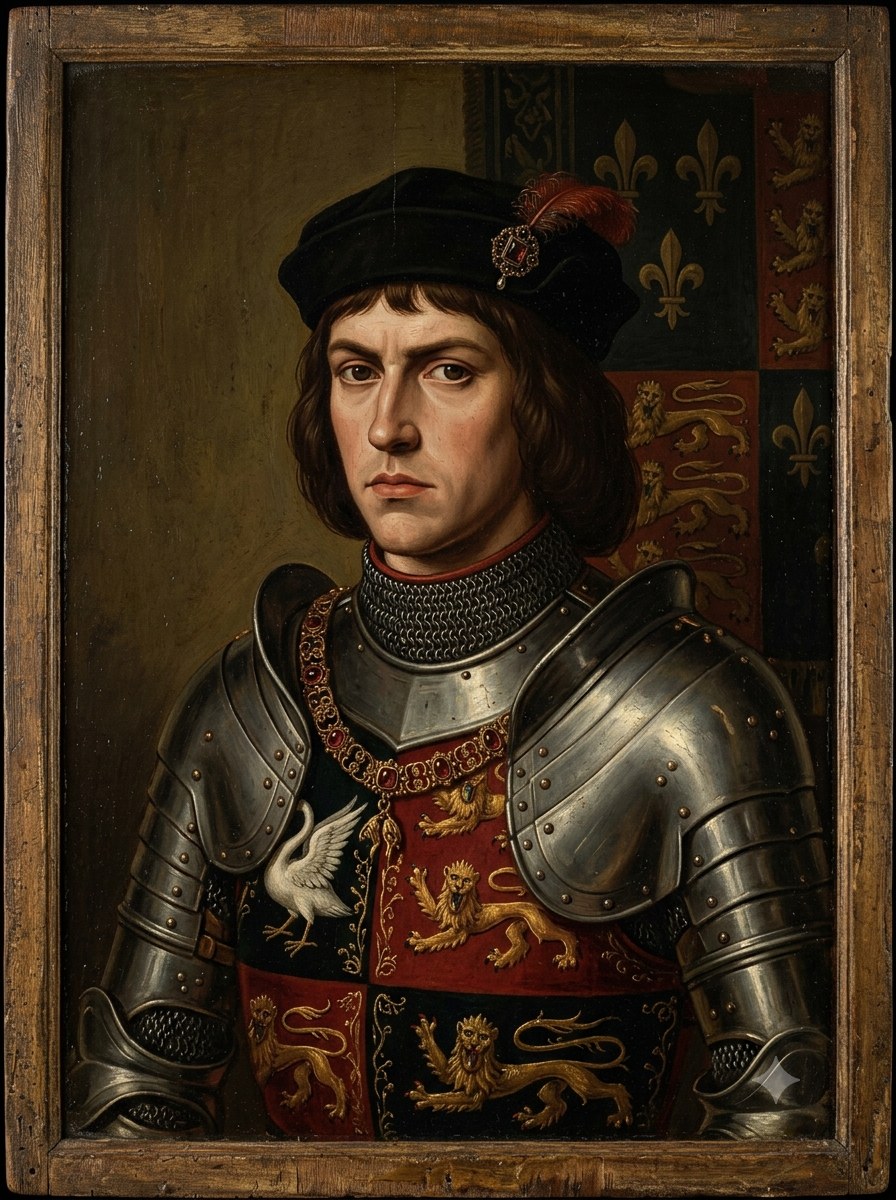
AI-assisted Portrait of Edward of Westminster
The Boy Who Talked of Nothing but War
He was born into a catastrophe and died inside one, and the seventeen years between were spent learning to be a weapon. Edward of Westminster, the only son of Henry VI and Margaret of Anjou, arrived in 1453 at the exact moment his father sank into the blank, voiceless catatonia that would shadow the rest of the reign — a coincidence so cruel that Yorkist propagandists used it for years, sneering that the gentle, shattered king could never have fathered him at all. From that opening insult onward, the boy was Lancaster's living argument: the heir who had to be real, had to be fierce, had to be worth a war.
His mother made certain of it. Margaret raised her son not in a nursery but in the saddle of a civil war, and he grew into something startling. A Milanese ambassador, watching the boy at court, reported home that he “already talks of nothing but cutting off heads or making war, as if he had everything in his hands or was the god of battle.” He was thirteen. There is no record of him discussing anything else — no statecraft, no scripture, no scheme of governance. Only the next fight, and the heads it would cost.
What little we can see of him reads as ESTP in its rawest, youngest form — pure martial Se, all edge and appetite, a fierce bold youth cut down before any of it could harden into a man.
The God of Battle
Se — dominant
Everything we know about Edward is physical, immediate, and aimed at action. He was not the heir who studied genealogies or rehearsed the duties of kingship; he was the boy raised to the horse and the sword, alive to combat the way other princes were alive to ceremony. The ambassador's phrase — talking “of nothing but cutting off heads or making war” — is the signature of dominant Se turned entirely toward violence: a hunger for the charge, the blow, the visible settling of things by force. War was not a means to a throne in his mind so much as the medium he lived in.
It is worth holding the strangeness of it. A thirteen-year-old who speaks only of battle is not a statesman in training but a fighter in training, and that is exactly what his upbringing was built to produce. Driven from England, shuttled between Scotland and France as Lancaster's exiled hope, he was shaped into the point of the spear his mother intended to drive back into the kingdom. Se does not plan from a distance; it acts on what is in front of it. By 1471 the thing in front of Edward was an English army, and he rode straight at it.
The Cool Appetite for the Mechanics of War
Ti — auxiliary
Beneath the appetite ran something colder and more precise. The boy did not merely love violence in the abstract; he talked of cutting off heads — of consequence, of who would be made to answer and how. That is auxiliary Ti feeding the dominant drive: a martial intelligence interested in the workings of force, in command and reprisal as a kind of grim logic. The same report that calls him bloodthirsty also paints a boy who fancied he “had everything in his hands,” arranging the war in his head like a problem with a clean solution.
We should not overstate it. He died before he could command anything, and the ambassador watched a child, not a general. But the texture of the few accounts is consistent: an analytical relish for the apparatus of war — chains of cause, blame, and punishment — rather than a sentimental or ideological attachment to the Lancastrian cause. The Ti is in service to the Se. It told him how the killing would work; it never told him to stop.
His Mother's Sword
Fe — tertiary
What emotional register the boy had was bound up entirely in his mother and the cause she carried. Margaret was the engine; Edward was the justification and the instrument. Tertiary Fe in a young ESTP tends to show as fierce loyalty to one's own side and a sharp performance of partisan feeling — and that is the whole emotional content of what survives of him. He belonged to Lancaster the way a blade belongs to the hand that swings it. There is no glimpse of an inner life apart from the fight, no sign of doubt about the side he was born to.
It is a bleak kind of warmth, and it makes him hard to know. He is preserved almost wholly through hostile or astonished eyes — the Milanese visitor, the Yorkist propagandists — so the gentler dimensions a tertiary function might have grown into never had time to surface. He was loyal, he was his mother's creature, and he was seventeen. That is most of what the record permits us to say.
No Glimpse of the Disaster Ahead
Ni — inferior
Inferior Ni is the blind spot — the missing instinct for where all this is going, for the single dark line running under the present moment toward its end. In Edward you can read that absence almost as fate. In the spring of 1471 the Lancastrian position was collapsing; the Earl of Warwick was already dead at Barnet. A more foresighted hope might have held back, waited, refused the open field. Edward did not. He pressed on to the Battle of Tewkesbury and met the Yorkist army head-on, all Se and forward motion, with no apparent sense of the catastrophe waiting at the bottom of the charge.
At Tewkesbury the army was destroyed and the prince was killed — the only English Prince of Wales ever to die in battle. Days later his father was murdered in the Tower, and the direct Lancastrian line ended with the two of them. We cannot know what Edward might have become; inferior Ni is the function that needs time and hard experience to mature, and time was the one thing he was never given. The boy who talked only of war got exactly the death he had been pointed toward, and never lived to see it coming.
Why ESTP Over ESTJ
Why not ESTJ?
An ESTJ would be the organized, institution-building commander — the prince who marshals supply, drills the host, and thinks in terms of structure and command. What we can actually see of Edward is none of that. He is raw martial boldness and a hunger for action: a fierce, improvising young warrior alive to the fight in front of him, not a system-builder. He was all edge and appetite, cut down before any of it could harden into structure.
The distinction matters precisely because he died so young. ESTJ is what an ESTP might grow toward as auxiliary Ti and a developing grasp of organization mature into real command. Edward never got there. The boy in the record is pure Se — immediate, aggressive, hungry for the charge — with no sign yet of the patient administrative cast an ESTJ shows early. To call him an ESTP is to read him honestly as what he was: a sketch, not a finished portrait. A warrior in the making, killed before the making was done.
Connected Figures
Further Reading
- Shadow King: The Life and Death of Henry VI — Lauren JohnsonThe fullest modern account of the reign that produced Edward — vivid on the queen, the war, and the family caught inside it.
- Margaret of Anjou: Queenship and Power in Late Medieval England — Helen MaurerThe scholarly study of the mother who shaped him, and the clearest window onto the cause he was raised to carry.
- The Wars of the Roses — Various (e.g. Dan Jones, Anthony Goodman)General histories of the dynastic conflict that frame Tewkesbury and the destruction of the Lancastrian line.
