 Historical Figure MBTI
#513 · 4-20-26 · The Wars of the Roses
Edmund Beaufort, Duke of Somerset
Lancastrian Court Leader · York's Great Rival
1406 — 1455
8 min read
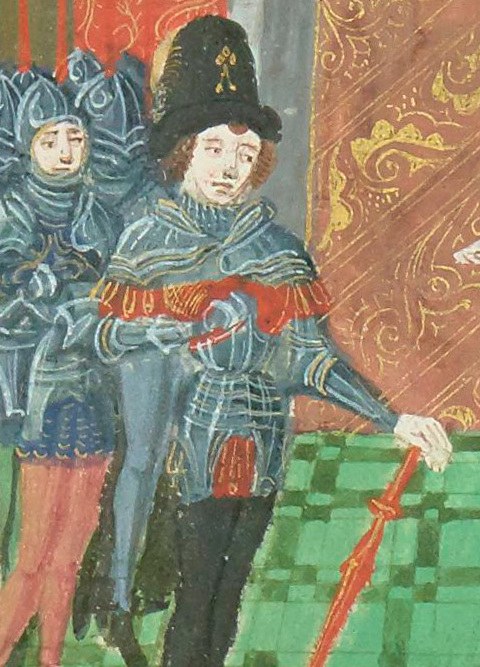
AI-assisted Portrait of Edmund Beaufort, Duke of Somerset
The Man Who Held the King's Ear
For a decade Edmund Beaufort stood at the center of English government not because he governed it well but because he owned the one thing that mattered: the favor of Henry VI. A Beaufort by blood—the legitimized line descended from John of Gaunt—he was a prince of the royal house, and he carried himself like one. He commanded English armies in France during the final, ruinous years of the Hundred Years' War, he monopolized the patronage of a weak and pliable king, and he made himself the immovable obstacle in the path of the one magnate who believed the realm needed saving from men exactly like him.
That magnate was Richard, Duke of York, and the feud between them was not a clash of policy so much as a collision of position. Somerset held the offices, the lands, and the king's confidence; York wanted them, believed himself entitled to them, and was kept from them at every turn. When Normandy was lost—the last great English foothold in France gone on Somerset's watch—it was York who pointed the finger and Somerset who absorbed the blame. The quarrel hardened into faction, and faction hardened into war. He was the ESTJ court magnate in his purest, most dangerous form: a man defending a place rather than pursuing a vision.
Somerset was the ESTJ as guardian of his own position—Te commanding the offices and the patronage, Si fortifying the rank and the order that gave him standing. He did not want to remake England. He wanted to keep what he held, and he would burn the kingdom rather than yield it.
The Commander of Office and Faction
Te — dominant
Dominant Te organizes the external world into chains of command, and Somerset spent his career building and defending one. As lieutenant-general in France he held the machinery of war—garrisons, finance, the appointment of captains—and as the king's favorite at home he held the machinery of patronage: who got which office, which wardship, which grant of land. Te does not theorize about power; it administers it, controls access to it, and rewards loyalty with it. Somerset understood that a court runs on who decides, and he made sure the deciding ran through him.
His grip on Henry VI was the masterwork of this instinct. A king incapable of governing was, to a Te magnate, not a tragedy but an opportunity: the empty throne could be filled by the man who stood closest to it. Somerset converted royal favor into hard, transferable advantage—titles, revenues, and the authority to exclude rivals from the same. When York demanded a council seat and a hearing, Somerset's answer was institutional: control the appointments, control the agenda, control who reaches the king at all, and the rival is neutralized without a blow being struck.
But Te that exists only to entrench itself curdles into something the realm cannot survive. Somerset managed faction brilliantly and managed France disastrously—because the first served his position and the second merely served the kingdom. He was a superb operator of the court and an indifferent custodian of the state, and the gap between those two facts is the whole story of his ruin.
The Guardian of Rank and Order
Si — auxiliary
Auxiliary Si gives the ESTJ its conservatism—its reverence for established order, inherited rank, and the way things have always been done. Somerset was, to his bones, an establishment man. He defended not an idea of England but the existing structure of it: the king's prerogative, the precedence of the great lords, the place of the Beauforts near the apex of the royal house. His descent from John of Gaunt was not a biographical footnote to him; it was the foundation of his standing, and he guarded it with the tenacity of a man defending sacred ground.
This is what makes his feud with York more than personal ambition. York represented, to Somerset, a threat to the settled order—a challenge to who properly stood where. To yield to York's demands was not merely to lose a turf war; it was to admit that the established hierarchy could be renegotiated by anyone with grievance enough to press it. Si recoils from that. It wants the order fixed, the precedence clear, the rank secure. Somerset would rather have the realm convulse than concede the principle that a king's favorite could be pulled down by a rival's complaint.
The Narrowing Field of Vision
Ne — tertiary
Tertiary Ne in the ESTJ is the faculty most easily starved—the capacity to imagine outcomes other than the one in front of you, to see how a present advantage might curdle into a future disaster. Somerset, fixed on holding his ground in the immediate quarrel, seems never to have grasped where the quarrel was heading. He treated each confrontation with York as a discrete contest to be won, not as one move in a deteriorating game that could end in open war. The man who excelled at administering the present could not picture the catastrophe the present was building toward.
When Ne does flicker in such a man, it tends to arrive as suspicion rather than vision—a sense that enemies are everywhere, that every concession invites the next demand. Somerset had real enemies, so the suspicion was not baseless. But it foreclosed the one imaginative leap that might have saved him: the possibility that sharing power with York, rather than hoarding it, could defuse the very crisis that finally killed him. He could not see the exit because he had spent his whole career bricking up the doors.
The Blind Spot of Private Conviction
Fi — inferior
Inferior Fi is the ESTJ's least-developed register: the inner compass of personal value, the capacity to ask whether holding a position is worth the cost to others. Somerset shows almost no sign of having asked it. His was an externalized, status-driven psychology—honor measured in office and precedence, not in conscience. The loss of Normandy cost thousands their lands and livelihoods; he experienced it chiefly as a blow to his standing and a weapon in his rival's hands, not as a wrong to be answered for.
Where inferior Fi surfaces in such a man, it tends to do so as wounded pride dressed up as principle—the conviction that one's claims are not merely advantageous but right, that to yield would be a kind of dishonor. Somerset could not separate his person from his position; an attack on his offices felt like an attack on his worth. That fusion is what made compromise impossible. A man with surer Fi might have weighed his rank against the realm's survival and found the rank wanting. Somerset never made the comparison. He died, in the end, defending it.
Why ESTJ Over ENTJ
Why not ENTJ?
The ENTJ—York's type—is the strategic visionary, the long-game player who sees the board years ahead and moves toward a goal that reorders the whole. York pursued the protectorate and, in time, the crown itself: a far-reaching design on the structure of power. Somerset had no such design. His was a turf war over place, patronage, and the king's ear—a Te-Si defense of an established position, not a Te-Ni campaign to transform one. He fought to keep what he held, not to build something new.
The distinction is the whole tragedy of the conflict. Two Te-dominant magnates faced each other across a paralyzed court, but they wanted different things. York the ENTJ wanted the realm restructured with himself at its head; Somerset the ESTJ wanted the existing order preserved with himself near its top. The visionary and the guardian could not coexist—and because Somerset would not imagine an arrangement other than total possession, and York would not stop short of total reordering, the only remaining move was the sword.
Connected Figures
Further Reading
- The Wars of the Roses — Michael HicksThe leading modern scholarly account — sharp on how court faction and the Somerset–York rivalry tipped England into civil war.
- Shadow King: The Life and Death of Henry VI — Lauren JohnsonA vivid biography of the king whose favor Somerset held, illuminating the court world in which the duke rose and fell.
- The Beauforts: The Lives and Times of a Royal Dynasty — Studies of the Beaufort familyTraces the legitimized Gaunt line — the descent and ambitions that placed Edmund Beaufort near the apex of the royal house.
