 Historical Figure MBTI
#507 · 4-19-26 · The Hundred Years' War
Charles VI
King of France · 'The Mad,' Wrecked by Delusion
1368 — 1422
8 min read
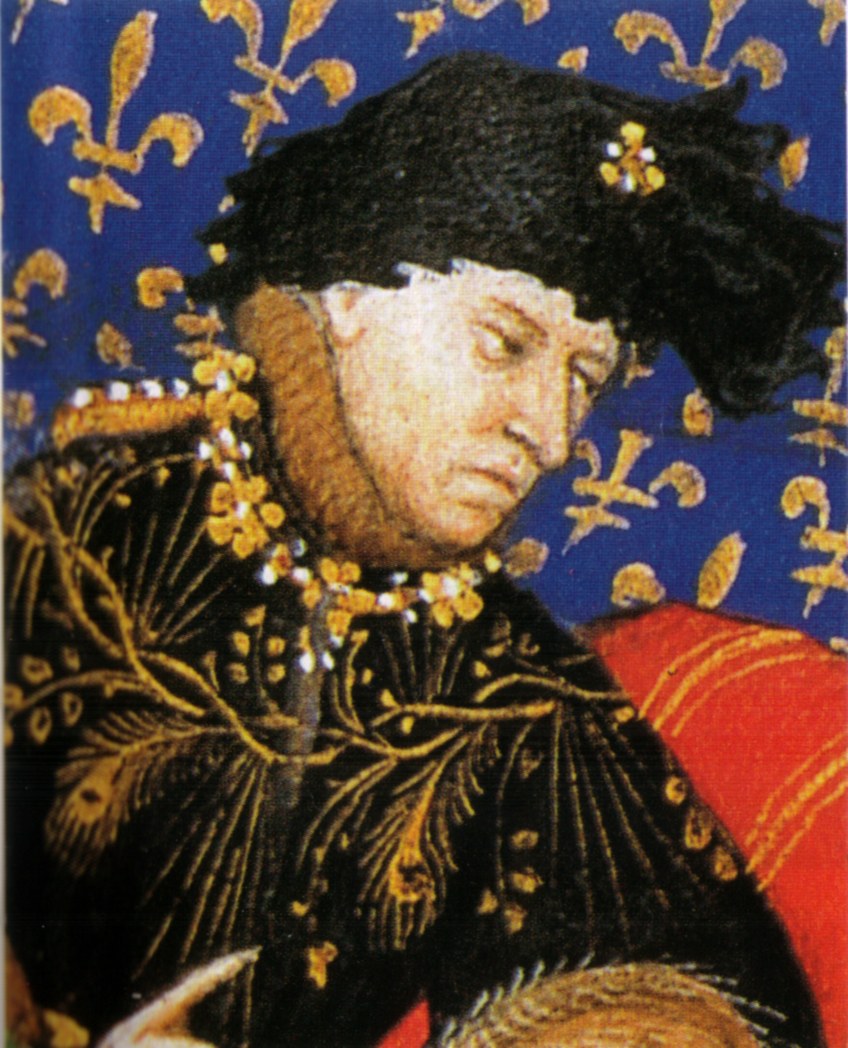
AI-assisted Portrait of Charles VI
The Gentle King the Glass Took
He came to the throne in 1380, an eleven-year-old boy, son of the wise and steady Charles V. For a while he was everything France could have hoped for — mild, warm, generous, easy to love. They called him Charles the Beloved. Then, in the summer of 1392, riding through a forest near Le Mans, he drew his sword on his own companions in a fit of terror and killed several of them before he could be subdued. He was twenty-three. For the next thirty years the madness came and went, and the man the French had loved was, more and more, simply gone.
The episodes were harrowing. He failed to recognize his wife and children; he ran screaming through the corridors of his palace; he went filthy and unfed for weeks at a time. And in his strangest delusion he became convinced that his body was made of glass — that a careless touch would shatter him — and had iron rods sewn into his clothing so that no one could break him by accident. The “glass delusion” is the image history has kept of him, and it is a cruel one, because what it preserves is the illness rather than the person.
It is worth being careful here. The madness was not a personality; it was a catastrophe that fell on one. The temperament it interrupted — the man visible in his lucid years and in the kindly boy he had been — reads, gently and without certainty, as an ISFP: a soft, personal, feeling-led nature, more sensitive than commanding.
Type the man beneath the illness, not the illness itself. What survives in the lucid intervals is an ISFP signature — dominant Fi paired with a warm, present Se: a gentle king who felt the world rather than ruled it.
The Beloved
Fi — dominant
The epithet his people gave him — le Bien-Aimé, the Beloved — was not propaganda but description. In his good years Charles was gentle and personable in a way medieval kingship rarely rewarded. He was kind to those around him, easily moved, more inclined to please than to dominate. Dominant Fi is an inner compass of feeling rather than a public code of duty, and what it produced in Charles was a softness of disposition, a king who governed from the heart and was loved for it before he could be feared.
That same tenderness made him terribly exposed. A harder man might have held the court together by force of will; Charles had no such hardness, and as the illness hollowed out his capacity to act, the gentleness that had charmed everyone became a vacancy at the center of the realm. His was a temperament built for intimacy and warmth, not for the ruthless arbitration a fracturing France demanded. The Fi that made him beloved gave him nothing to wield when the wolves closed in.
It is the saddest version of the dominant feeler's vulnerability: a man whose whole nature was personal and inward, set in a role that asked for the opposite, and then robbed even of the lucidity to try.
Before the Forest
Se — auxiliary
The young Charles loved the pleasures of the body and the moment. He delighted in festivities and pageantry, in the hunt, in the press and warmth of company — the simple, sensory enjoyments of a life lived in the present. It was on a hunt, in fact, that the first seizure took him. Auxiliary Se in an ISFP is this kind of grounded aliveness to the here and now: a pleasure in tournaments and dances and the good company of friends, an appetite for experience rather than for abstraction or scheme.
There was nothing calculating in it. He was not a strategist enjoying the chase for its advantages; he was a young man who liked to be among people and in motion, and whose court mirrored that ease in its early years. The famous costumed entertainment of his reign — a masque that ended in catastrophe when dancers' pitch-soaked costumes caught fire — belongs to this same world of revel and spectacle that he loved before the darkness narrowed his life to its terrors.
The illness eventually severed him from all of it. But the Se warmth is part of the portrait we should keep: not a glass figure in iron rods, but, first, a king who liked to dance.
The Body Made of Glass
Ni — tertiary
One must tread carefully here, because the glass delusion belongs to the illness and not to the temperament, and it would be a falsification to read a fixed idea of disease as though it were ordinary cognition. But in the healthy ISFP, tertiary Ni is a quiet undercurrent — a capacity for a single fixed inner image or conviction to take hold and settle, usually faint, occasionally insistent. It is the least developed of the conscious functions, and in a mind otherwise grounded in the present it tends to arrive as a private symbol rather than a worked-out vision.
In Charles, whatever inwardness he had ran toward the personal and the immediate, not toward grand designs for the realm. He left no political vision, no architecture of rule; he was not a man of long horizons even before he lost the capacity for any horizon at all. The tragedy is that the realm needed precisely the steadying long view that was never his to give, and that the one fixed image posterity attaches to his inner life is a delusion of fragility — a man certain he would shatter.
A Kingdom He Could Not Hold
Te — inferior
Inferior Te is the weakest hand the ISFP plays: the cool machinery of organization, command, and impersonal control sits furthest from a nature led by private feeling. In an ordinary life this shows up as a discomfort with hard logistics and a reluctance to impose order on others. In a king of France it was a catastrophe waiting to be triggered, and the illness pulled the trigger.
With the throne empty in all but name, the princes of the blood — the dukes of Burgundy and of Orléans foremost — fell on one another for control of the regency, and the realm tore itself apart in the Armagnac–Burgundian civil war. Charles could not arbitrate; he could barely be relied upon to know who his ministers were. The administrative grip a sovereign was supposed to keep simply was not in him, and there was no lucid stretch long enough to recover it. The kingdom fractured in the exact dimension — cold executive control — where its king was constitutionally and then medically least able to act.
It was into that vacuum that England walked. When Charles, no longer master of himself, was made to set his hand to the Treaty of Troyes in 1420 — disinheriting his own son and naming a foreign king his heir — the inferior function reached its bleakest expression: a man signing away the very realm he had never been able to govern.
Why ISFP Over ISFJ
Why not ISFJ?
An ISFJ reading would make Charles a dutiful institutional guardian — a king defined by steady service to the crown and its traditions. But beneath the tragedy he reads as a gentle, personal, feeling man rather than a keeper of office: warm and inward (Fi) where the ISFJ is conscientious and outward-facing (Si–Fe). And in any case his reign is defined not by the patient service an ISFJ profile would imply but by the catastrophe of his mind — there was no long stretch of dutiful rule to read either way.
This is a humane sketch of a temperament, offered with care and not as a diagnosis. The point of the ISFP reading is narrow and gentle: the man the French loved before 1392 was soft, kind, and personally feeling rather than commanding or institutional — and it was precisely that gentle nature, and not any failure of duty, that the illness left defenseless when his kingdom needed a harder king.
Connected Figures
Further Reading
- Royal Intrigue: Crisis at the Court of Charles VI, 1392–1420 — R. C. FamigliettiThe definitive study of the court politics that filled the vacuum left by the king's illness.
- La folie de Charles VI, roi bien-aimé — Bernard GuenéeA humane and scholarly account of the madness itself and how it was understood at the time.
- Armagnacs and Burgundians: The Hundred Years War in the Reign of Charles VI — general histories of the Armagnac–Burgundian civil warBackground on the murderous factional struggle that tore France apart in the king's absence.
