 Historical Figure MBTI
#503 · 4-19-26 · The Hundred Years' War
Catherine of Valois
Queen of England · Unwitting Mother of the Tudor Line
1401 — 1437
7 min read
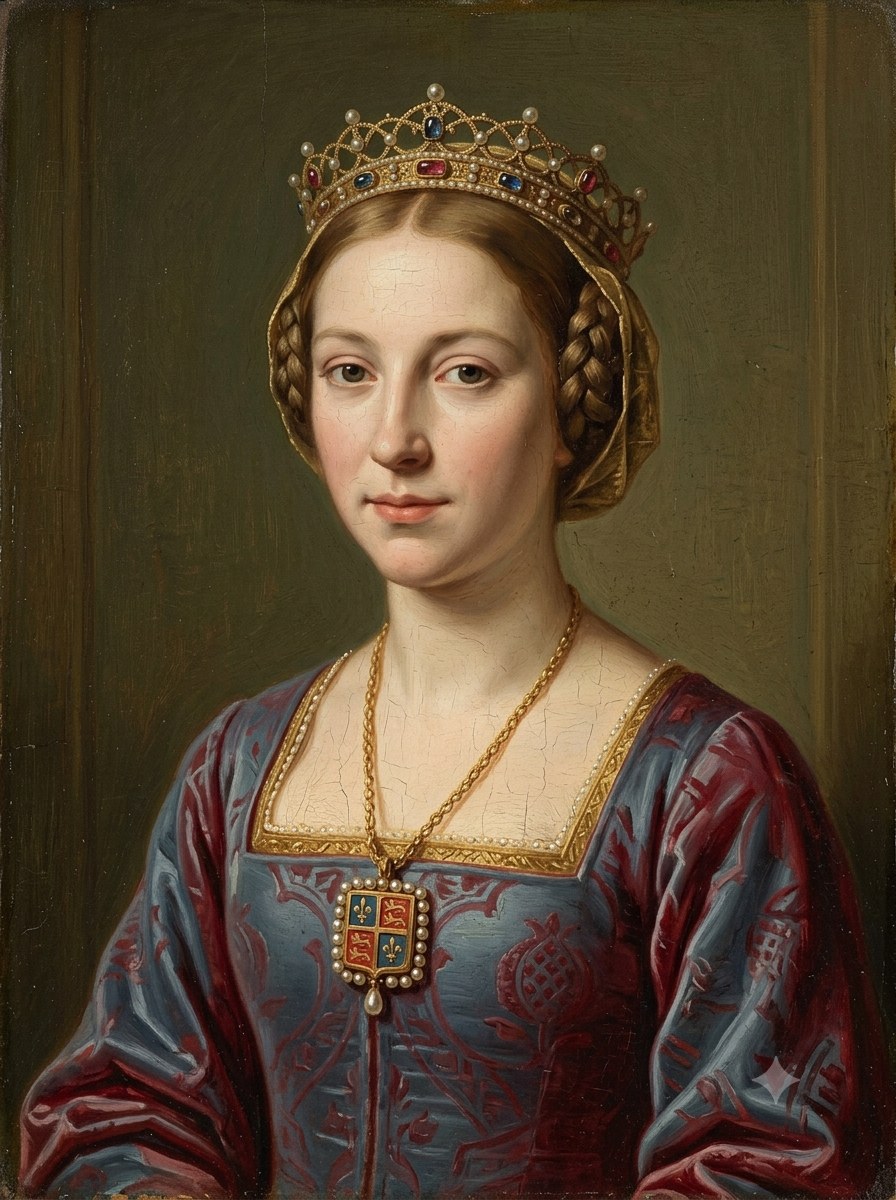
AI-assisted Portrait of Catherine of Valois
The Queen Who Followed Her Own Heart
Catherine of Valois entered history as an instrument of policy and left it as the ancestress of a dynasty. Daughter of the mad king Charles VI of France, she was given in marriage to Henry V of England in 1420 under the Treaty of Troyes — the document that disinherited her own brother and promised the crown of France to her English husband and his heirs. She was the living seal on that union, a princess handed across the Channel to bind two warring crowns. A year later she bore the son who would become Henry VI, the infant king of both kingdoms. By every measure of her age, her purpose had been fulfilled.
Then, in 1422, Henry V died of dysentery in the field, and Catherine was a dowager queen at twenty-one. What she did next was quietly extraordinary. Rather than accept the careful, supervised remarriage politics expected of a king's mother, she formed a secret attachment to — and almost certainly married — Owen Tudor, a Welsh squire of her own household, a commoner far beneath her station. She bore him children in private, in defiance of every rule that governed a queen's body and a queen's choices. It was a forbidden love-match, scandalous and dangerous, undertaken not for advantage but for feeling.
That single, stubborn act of the heart is the key to her. She is the ISFP — not the dutiful consort her birth had scripted, but a woman who, given a moment of freedom, spent it on love.
Catherine's defining choice was not the dynastic marriage arranged for her but the secret one she arranged for herself — the ISFP signature of dominant Fi: a private, immovable fidelity to one's own feeling, acted on quietly and without apology.
The Private Loyalty of the Heart
Fi — dominant
Dominant Fi is a compass that points inward. It does not ask what a situation requires or what others expect; it asks what feels true, and then it holds to that answer with a quiet, almost unbreakable stubbornness. For a princess raised to be a treaty made flesh, this was a perilous trait to possess. Everything in Catherine's upbringing pressed toward duty: she was a bargaining chip between France and England, valued for her womb and her bloodline, expected to want what the men around her wanted.
Her choice of Owen Tudor is Fi in its purest form. There was nothing strategic in it. A dowager queen who wished to advance herself would have negotiated a marriage to a great lord, or none at all; the English council had already grown nervous enough about her remarriage to legislate against it. Catherine wanted neither power nor safety. She wanted a particular man, a keeper of her wardrobe with no rank to offer, and she arranged her life so that she could have him. The secrecy was not calculation but protection — a way to guard something private from a world that had never let her keep anything private before.
This is the loyalty of feeling over form. Where a duty-bound consort measures herself against the role, Catherine measured the role against herself and found it wanting. She kept faith with her own heart even when the keeping was forbidden, and she paid the price in obscurity rather than surrender the thing she had chosen.
A Life Lived in the Present
Se — auxiliary
If Fi supplied Catherine's motive, auxiliary Se supplied its texture. Se is the function of the immediate and the tangible — the warmth of a present body, the pleasures and comforts of a real life rather than an imagined future. The second life Catherine built with Owen Tudor was not a dynastic project; it was a domestic one, lived in the here and now, in a household of children far from the cold machinery of statecraft.
There is something quietly sensory about her whole second act. She withdrew from the glare of the court into a private world of personal attachment, choosing the felt reality of one man and their growing family over the abstract dignity of a queen dowager. An intuitive in her position might have schemed toward some larger design; the Se-aided Fi user simply wanted the life in front of her, and reached for it. Her tragedy was that the present she chose could not last — she died in 1437, still young, with her second family barely begun.
The Unseen Thread of Consequence
Ni — tertiary
Tertiary Ni gives the ISFP an occasional, narrow sense of where things are tending — a private intuition that runs beneath the surface of an otherwise present-focused life. In Catherine it shows less as foresight than as a kind of quiet conviction that her choice mattered, that the bond she had formed was worth protecting against a future she could not fully see. She kept her household together, kept her secret, and held a single line through years of risk.
The irony is that she could not have grasped the true shape of what she had set in motion. Tertiary Ni is real but dim; it whispers rather than declares. Catherine acted for love, not for legacy, and had no way of knowing that the children of her forbidden marriage would seed the throne of England itself. The long thread of consequence that ran from her household to the crown was invisible to her — an intuition she lived inside but never named.
The Weakness for Worldly Power
Te — inferior
Inferior Te is the ISFP's blind spot — the cool, executive logic of leverage, negotiation, and institutional power that comes least naturally and is most easily neglected. Catherine had spent her whole life at the mercy of other people's Te: the diplomats who drafted the Treaty of Troyes, the councils that legislated over her remarriage, the lords who calculated her worth in alliances. She was the object of strategy, rarely its author.
Her response was not to master that game but to step out of it. Where a more Te-driven dowager might have weaponized her position — brokering her hand, building a faction, securing guarantees for herself and her children — Catherine simply refused to play, retreating instead into a private marriage that offered no political cover at all. It was the choice of someone for whom institutional power was foreign ground. Her unworldliness left her second family unprotected: after her death, Owen Tudor was imprisoned, and it took decades and the fortunes of war before her grandson could claim the prize her heart had unknowingly created.
Why ISFP Over ISFJ
Why not ISFJ?
The ISFJ is the consummate dutiful consort — convention-keeping, role-fulfilling, devoted to the expectations of her station. Such a queen would have honored her widowhood with decorum and accepted a remarriage shaped by the council's interests. Catherine did the opposite. Her defining act was a quiet rebellion of the heart: a marriage for personal love, far below her rank, against propriety and against the rules that governed a king's mother. That is Fi acting on its own desire, not Si upholding an inherited order.
The distinction is one of motive. An ISFJ measures herself against the role and finds meaning in fulfilling it; an ISFP measures the role against her own feeling and follows the feeling when the two diverge. Catherine's life turned on exactly that divergence. Handed the most scripted existence imaginable, she spent her one moment of freedom not on conserving her position but on claiming a private happiness no one had sanctioned. The rebellion was gentle, almost invisible — but it was unmistakably the choice of a woman loyal first to her own heart.
Connected Figures
Further Reading
- The Making of the Tudor Dynasty — R. A. Griffiths & Roger S. ThomasThe definitive account of how the Tudor line emerged from Catherine's secret marriage to Owen Tudor and rose to the throne.
- Henry V — Christopher AllmandThe authoritative biography of Catherine's first husband and the Treaty of Troyes that made her queen of England.
- Studies of Late-Medieval Queenship — VariousScholarship on the constrained roles and rare choices of medieval queens and dowagers, the world Catherine quietly defied.
