 Historical Figure MBTI
#504 · 4-19-26 · The Hundred Years' War
Owen Tudor
The Welsh Courtier Who Wed a Queen · Founder of the Tudor Line
c. 1400 — 1461
8 min read
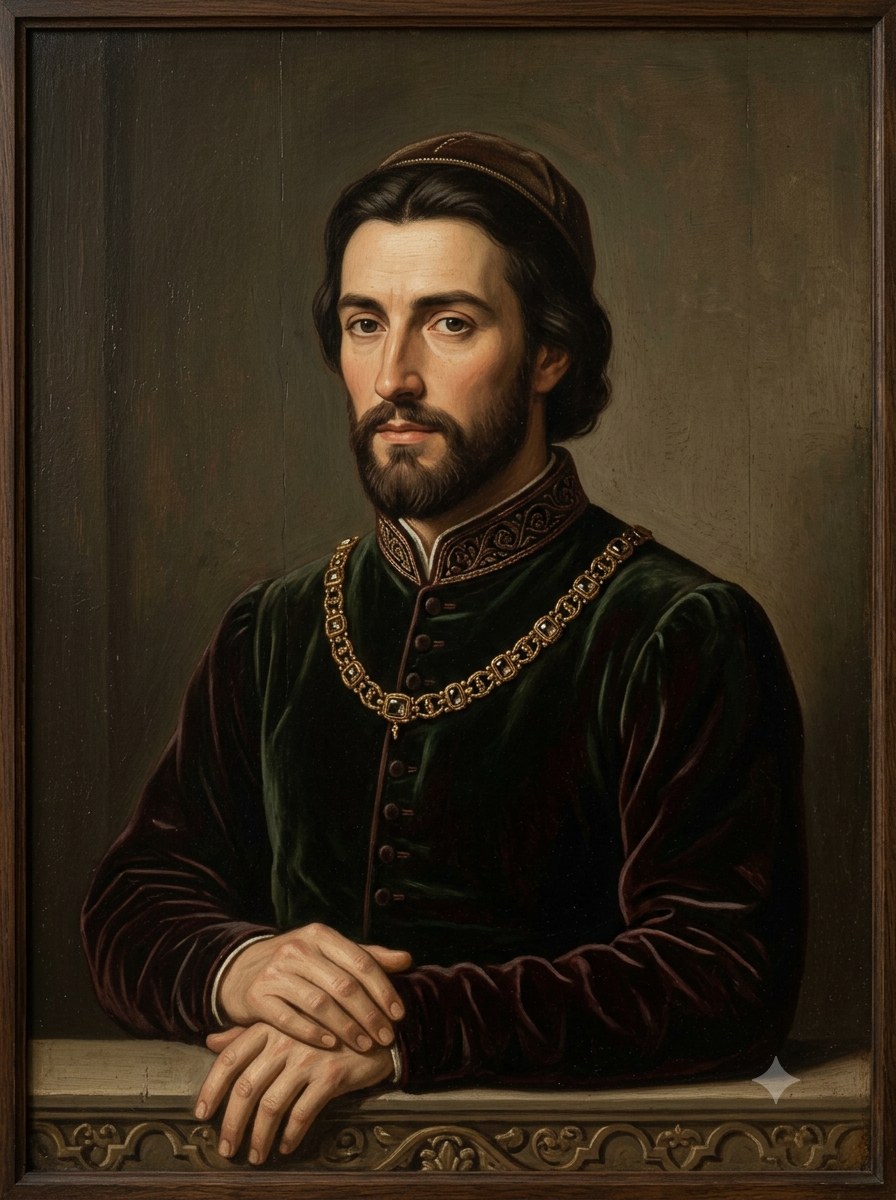
AI-assisted Portrait of Owen Tudor
The Dancer Who Fell Into a Queen's Lap
Owen Tudor began as nobody in particular—a Welsh squire of obscure birth who claimed, as such men did, descent from the old princes of Wales. He held a minor post in the household of Catherine of Valois, the young dowager queen of England, widow of the warrior-king Henry V and mother of an infant king. By the gulf of rank that separated them, the two should never have exchanged more than the orders of a mistress to a servant. Yet legend insists it was a single graceless moment that undid the distance: dancing before the queen, Owen stumbled and tumbled directly into her lap. The fall, the story goes, was the beginning of everything.
What followed was one of the most improbable love-matches in English history. Owen and Catherine married in secret—a commoner wedding a queen of England, a leap across rank so audacious it sat close to treason. They had children together, among them Edmund Tudor, who would father the future Henry VII. When the marriage was discovered, Owen was imprisoned and the union treated as a scandal of the first order. Decades later, an old man now, he took up the Lancastrian cause in the Wars of the Roses, was captured after the Battle of Mortimer's Cross in 1461, and was led to the block—baffled to the very end that the axe was meant for him. A madwoman, it was said, gathered up his severed head and set candles burning around it. He was the charming, gallant, fatally romantic Welshman whose stumble founded a dynasty.
Owen Tudor was the ESFP who lived by charm and the opening of the moment—the dancer who won a queen with warmth, fathered a dynasty without ever grasping what he had set in motion, and went to the scaffold astonished it had come to this.
The Charm of the Present Moment
Se — dominant
Everything memorable about Owen Tudor lives in the physical present. He was the dashing courtier—graceful, warm, easy in his body, the kind of man who fills a room without trying. Dominant Se reads the immediate field and moves into it: the dance floor, the queen's glance, the charged seconds when a servant might either retreat or seize a moment that will never come again. The famous tumble into Catherine's lap is the perfect Se anecdote—a man living so fully in the now that even his clumsiness becomes an opening, and an opening becomes a queen.
Se does not climb by scheme; it answers what is in front of it. Owen had no estate, no great name, no political machine—only presence, and presence was enough to win the widow of Henry V. The same instinct carried him to the end. An old man, he rode to battle for the Lancastrian cause not out of long strategy but because the cause was before him and the fighting was now. Se is the function of the gallant adventurer, and Owen was gallant to the last—a man whose whole remarkable life was a series of present moments seized with warmth and nerve.
The Heart That Crossed a Forbidden Line
Fi — auxiliary
Owen's leap makes sense only as the act of a man steered by auxiliary Fi—a private, personal compass of feeling that answers to the heart rather than to rank or advantage. Marrying a dowager queen brought no obvious gain a sane courtier would chase; it brought danger. What it brought Owen was the woman he loved. Fi does not weigh the marriage against the politics of England; it weighs it against what feels true and chooses the feeling. The secrecy of the match has the quality of a private devotion guarded from a world that had no right to it.
This is the romantic core beneath the Se charm: the warmth Owen radiated was real, not performed, and when it found its object it committed without hedging. He was no calculating fortune-hunter timing his ascent. He was a man who fell in love across an impossible gulf and acted on it, accepting imprisonment as the price of a marriage the kingdom called a scandal. The dynasty he founded was the unintended issue of a love-match—begun for the heart's own reasons, with no eye on the throne it would one day produce.
The Soldier's Practicality
Te — tertiary
Tertiary Te gave Owen the workable competence of a man who could run a household, manage an estate, and take the field when the cause demanded it. He served capably in Catherine's household before he ever caught her eye, and in his later years he handled his affairs and raised his sons to take their place in the wars of their age. Te is the function that gets concrete things done, and Owen was no idle ornament—he was a working courtier and, in the end, a fighting man.
But tertiary Te is a supporting tool, not a governing one. It executed; it did not rule. Owen could manage the task in front of him without ever stepping back to map the larger board on which his marriage and his children had placed him. He could fight a battle. He could not read the long strategic meaning of being the stepfather of one king and the grandfather of another—and that gap is where his story turns from romance to tragedy.
Blind to Where It All Led
Ni — inferior
Inferior Ni is the great blind spot of the Se-dominant—the missing organ for long consequence, for the single thread running through years toward an end no one in the moment can see. Owen's whole life is a study in this blindness. He married a queen for love and never reckoned with the political earthquake it would be, never saw imprisonment coming until it arrived. He fathered children without grasping that he was seeding a claim to the English throne—that his stumble on a dance floor would echo across half a century to a field called Bosworth and the crowning of his grandson.
The inferior function shows its hand most cruelly at the end. Captured after Mortimer's Cross, Owen seems genuinely to have believed he would be spared—astonished, the chroniclers say, when he understood the axe was meant for him. He had spent his life answering the present and trusting it would carry him, and he never developed the dark foresight that might have warned him where a Lancastrian standard-bearer's road must end. He died as he had lived: fully in the moment, and utterly surprised by the future.
Why ESFP Over ESTP
Why not ESTP?
Both types share dominant Se, and the dashing, physically present Owen could pass for an ESTP at a glance. But the ESTP pairs Se with Ti and Fe—a bold, calculating tactical operator who reads angles and works the room toward advantage. Owen was not that. His gift was personal warmth and gallantry, not daring schemes; he won a queen by being lovable, not by maneuvering. His marriage gained him peril, not power, which is the opposite of an ESTP's instinct for the main chance. The heart-led, romantic, people-pleasing core of him is Se-Fi, not Se-Ti.
The decisive evidence is what Owen did with his great opening. An ESTP who tumbled into a queen's lap would have seen the leverage and played it. Owen saw the woman and fell in love. He married for feeling against every prudent calculation, accepted the consequences, and never once treated the union as a ladder. That is auxiliary Fi steering dominant Se—the charming romantic, not the cool tactician. He was the gallant who loved, not the gambler who seized.
Connected Figures
Further Reading
- The Making of the Tudor Dynasty — R. A. Griffiths & Roger S. ThomasThe standard account of the Tudor rise from Welsh obscurity — the essential study of Owen, his marriage to Catherine, and the line that descended from it.
- Owen Tudor and the Welsh Gentry — Scholarly studies of fifteenth-century WalesSituates Owen within the Welsh gentry and squirearchy from which he emerged, and weighs his claimed descent from the old princes against the record.
- The Wars of the Roses — General histories of the dynastic conflictProvides the wider frame for Owen's later years — the Lancastrian cause, the Battle of Mortimer's Cross, and the executions that followed.
