 Historical Figure MBTI
#531 · 4-23-26 · The Hundred Years' War
Yolande of Aragon
'Queen of Four Kingdoms' · The Power Behind Charles VII
1381 — 1442
8 min read
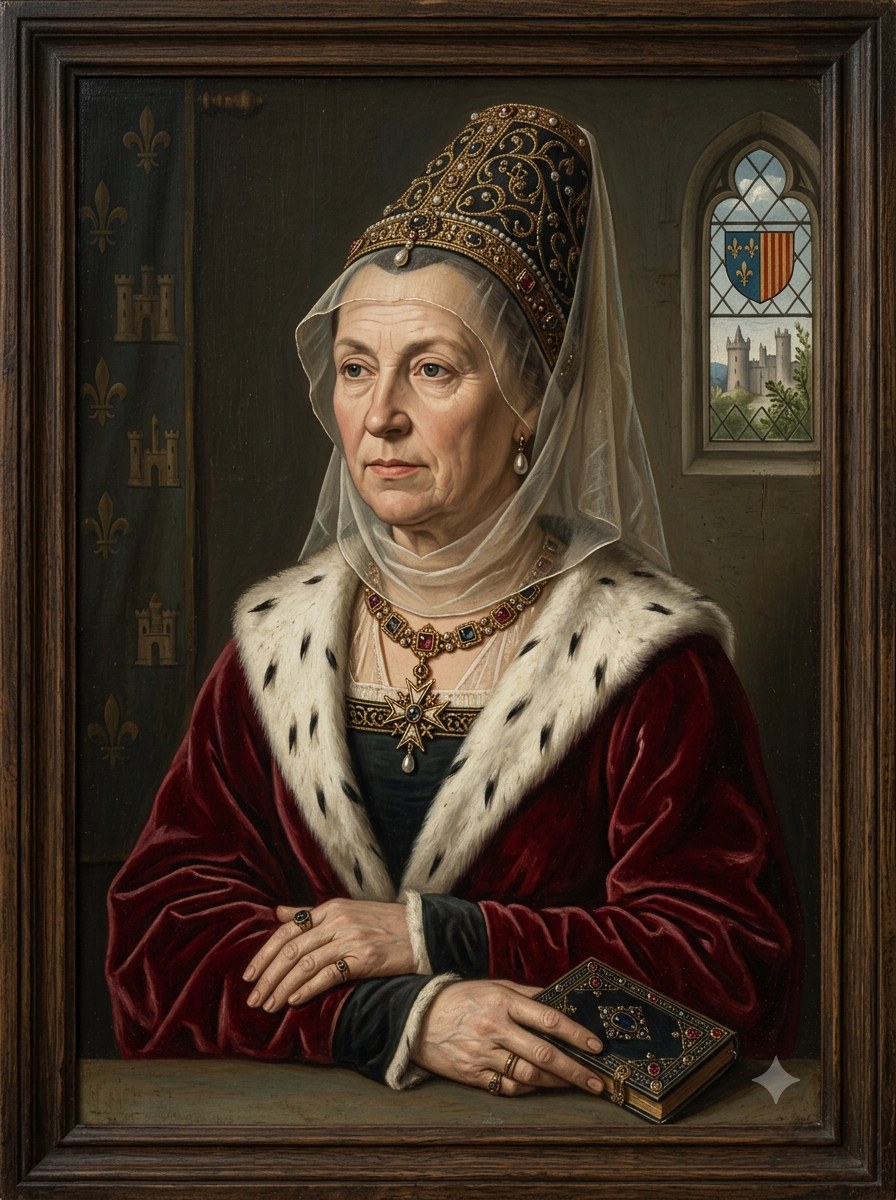
AI-assisted Portrait of Yolande of Aragon
The Hand Nobody Saw
Contemporaries called her the “Queen of Four Kingdoms” — a title that gestured at Sicily, Naples, Jerusalem, and Aragon, crowns her House of Anjou claimed but seldom held. The irony is that her real dominion never appeared on any map. Yolande of Aragon ruled the inside of a war. For two decades, while France tore itself apart between the English, the Burgundians, and a frightened young claimant who could not decide whether he was a king, she was the steadiest mind in the country — and almost no one watching the chronicles of the day would have guessed it.
She was Duchess of Anjou, mother-in-law to the Dauphin, and one of the shrewdest political operators of the fifteenth century. When her daughter Marie of Anjou was betrothed to the boy who would become Charles VII, Yolande took the weak, self-doubting prince into her own household and effectively raised him. She managed his court, steadied his finances, worked patiently to pry the duke of Burgundy loose from the English alliance, and — most famously — backed and bankrolled a teenage peasant girl named Joan, vouching for her, arranging her examination, and funding the army that broke the siege of Orléans. She never once sought the spotlight. She did not need it.
That refusal of the spotlight is not modesty. It is method. Yolande is the INTJ as matriarch-strategist: a long-range vision held with inhuman patience, executed through money, marriage, and other people's hands.
Yolande of Aragon is the INTJ stripped of every theatrical instinct — pure Ni-Te design with no appetite for the throne room. She read the war ten moves ahead and won it from a room no chronicle bothered to describe.
The Decades-Long Design
Ni — dominant
Dominant Ni works in one currency: the long game. It fixes on a single distant outcome and then bends every nearer event toward it, indifferent to how slow or circuitous the path becomes. Yolande's distant outcome was fixed early and never wavered — a Valois king, legitimate and crowned, on a French throne cleared of English and Burgundian claims. Everything she did for thirty years was a move toward that horizon, and she was content to wait out reversals that would have broken a shorter-sighted mind.
Consider the patience the design required. She secured the marriage of her daughter to the Dauphin while he was still a minor and his prospects looked hopeless — disinherited at Troyes, mocked as the “King of Bourges,” controlled by factions. A reactive operator would have hedged. Yolande instead deepened her investment in the losing side, because she was not reading the present board; she was reading the position the board would reach if she kept feeding it. She steered him through assassinations at court, through his own paralysis, through the long humiliation of a kingdom in pieces, holding the through-line when he could not see past his own fear.
The Joan of Arc gambit is the purest expression of the function. To stake the French cause on an illiterate farm girl claiming visions was, on its face, absurd. But Ni does not ask whether a thing looks plausible; it asks whether it serves the design. Yolande grasped what a more literal mind would have missed — that a war this broken would not be won by another marginal military adjustment, but by a symbol potent enough to convince a doubting prince he was God's chosen and an exhausted army it could win. She saw the strategic shape of the Maid before anyone else did, and she moved.
The Machinery of Power
Te — auxiliary
If Ni supplied the destination, auxiliary Te built the road. Vision without execution is daydream; what made Yolande dangerous was that she could operate the levers of a medieval state with a quartermaster's precision. She managed Charles's court and household, kept a grip on his perennially insolvent finances, and ran the patronage and marriage networks that decided who had access to him. Where Ni saw the shape of the war, Te assembled the men, money, and alliances to change it.
Her long campaign against Burgundy is Te diplomacy at its most methodical. The English-Burgundian alliance was the structural fact that kept France divided, and Yolande treated it as an engineering problem rather than a moral one. She worked it patiently from every angle — pressure, incentive, marriage, money — over years, loosening the joint piece by piece until Burgundy could be peeled away. The process culminated, after her lifetime of groundwork, in the Treaty of Arras that finally reconciled the duke with the crown. She did not win it with a speech; she won it with logistics.
Even the Maid was, in Te's hands, an instrument. Yolande did not merely believe in Joan; she operationalized her. She arranged the examination at Poitiers that gave the girl an official imprimatur, and she financed and equipped the relief army that marched on Orléans. A visionary peasant was, to her organizing intelligence, a strategic asset to be vetted, certified, armed, and deployed — the inspiring instrument through which the design would be made real.
The Private Loyalty
Fi — tertiary
Beneath the cold machinery ran a current of fierce, private conviction. Tertiary Fi in an INTJ is not warmth on display; it is a deeply held internal loyalty — to a family, a dynasty, a cause — that gives the strategy its emotional spine. Yolande's loyalty was to her House of Anjou and to the Valois legitimacy she had married her daughter into, and she held it with a tenacity that no setback could dislodge. The fight to make Charles a king was not, for her, a neutral chess problem. It was a thing she believed in.
That conviction shows most clearly in how she treated the Dauphin himself. She did not merely use the frightened young man; she sheltered him, raised him, and stood by him through years when abandoning him would have been the safer bet. There is a maternal, protective quality to her statecraft that pure ambition does not explain — the sense of a woman who had decided, privately and permanently, that this was her boy and this was her kingdom, and who arranged the world accordingly.
Power Without a Stage
Se — inferior
Inferior Se is the function the INTJ trusts least, and Yolande's whole career is a study in working around it. She had no taste for the immediate, sensory theater of power — the battlefield command, the dramatic court entrance, the public seizure of a moment. Where an extraverted-sensing type would have ridden out front and seized the present scene, Yolande stayed off the stage entirely. Her instrument was never her own visible presence; it was the army she financed, the alliance she brokered, the king she had quietly built.
The contrast with Joan is the whole point. Joan was Se made incandescent — the girl in armor in front of the army, embodying the cause in the immediate, physical moment. Yolande was her exact complement: the unseen mind that conceived, certified, and funded that image, and then let someone else carry it into the light. The far-sighted strategist supplied the vision and the money; the inferior function's work — the visible, sensory, present-tense act of inspiration — she delegated to a figure built for it. It was, in the end, the most efficient possible division of labor.
Why INTJ Over ENTJ
Why not ENTJ?
The ENTJ and the INTJ share the Ni-Te strategic engine, so the analysis can read identically — both are far-sighted planners who marshal resources toward a goal. The tell is the orientation of the power. The ENTJ leads from the front: it takes the visible command, occupies the throne room, drives events through its own commanding presence. Yolande did the opposite at every turn. She held no title that ran the kingdom, gave no famous speeches, fought no battles. Her power was invisible influence, exercised through a son-in-law, a duke, and a peasant girl — the hidden string-puller, never the figure on the dais.
That preference for the shadows is the signature of Ni-dominance, not Te-dominance. The ENTJ extends itself outward into the world and wants the world to register its command; the INTJ keeps the vision internal and treats visible authority as a tool to be handed to whoever can wield it best. Yolande never confused being seen with being effective. She understood that the most durable power is the kind no one thinks to resist because no one notices it's there — and she spent a lifetime proving it, holding the French cause together from a room history forgot to record.
Connected Figures
Further Reading
- Yolande of Aragon (1381–1442), Family and Power — Zita Eva RohrThe definitive modern scholarly study — reconstructs the hidden political career of one of the era's most underrated power-brokers.
- Joan of Arc: A History — Helen CastorPlaces Joan within the factional politics of the French court, where Yolande's backing and financing are essential context.
- The court of Charles VII and the rise of the Valois cause — Studies in fifteenth-century French historyThe wider scholarship on Charles VII's reign, in which Yolande's management of his household and finances steadily comes into focus.
