 Historical Figure MBTI
#532 · 4-23-26 · The Hundred Years' War
Pierre Cauchon
The Bishop Who Tried and Burned Joan of Arc
c. 1371 — 1442
7 min read
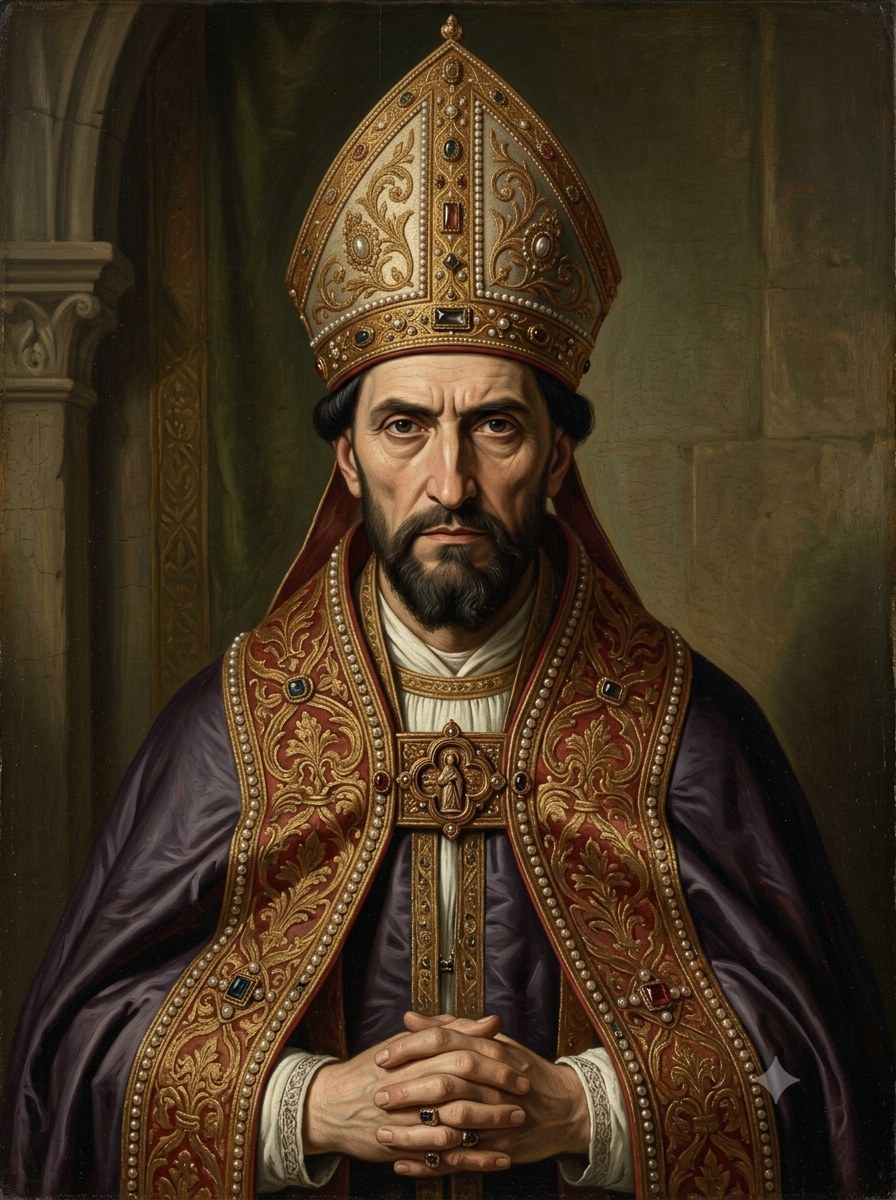
AI-assisted Portrait of Pierre Cauchon
The Man Who Ran the Machine
Pierre Cauchon was, by every conventional measure of his world, a success. He was a doctor of the University of Paris, a skilled diplomat, a bishop, and a trusted servant of the men who governed France from English-held Rouen. He had spent a career making himself useful to power. And he is remembered for exactly one thing: presiding over the heresy trial that sent Joan of Arc to the stake.
The trial of 1431 was not a search for truth. It was a prosecution with its verdict already written, and Cauchon was the man who built and operated the apparatus that delivered it. He claimed jurisdiction over a captured nineteen-year-old, assembled dozens of learned theologians to interrogate her, laid verbal traps an illiterate peasant girl could not be expected to evade, and drove the proceeding methodically toward its predetermined end. What stands out across the surviving record is not malice so much as competence—the cold efficiency of an administrator executing a commission.
He did it because it served the English and Burgundian cause that had raised him, and because destroying the Maid meant discrediting the king she had crowned—Charles VII's coronation at Reims. Cauchon expected to be rewarded with the rich archbishopric of Rouen. He never got it. He is the establishment man who did the occupier's dirtiest work and won nothing he wanted by it.
Cauchon was the ESTJ careerist at its most damning: dominant Te that organizes a process flawlessly toward a fixed outcome, anchored by an Si loyalty to the institutions that pay, with a conscience filed under inferior Fi and overruled.
The Prosecutor as Engineer
Te — dominant
Dominant Te organizes the external world to produce a result, and in Cauchon it produced a model of procedural machinery. The trial was not improvised. He secured jurisdiction, convened a body of theologians and jurists drawn largely from the University of Paris, structured the interrogations, and kept the whole apparatus moving with the steadiness of a man running an institution rather than persecuting a girl. Te does not ask whether a process is just; it asks whether it works, and Cauchon's worked with terrible efficiency.
The marshalling of force is the tell. Against one unlettered teenager he arrayed the full weight of learned authority—dozens of credentialed clerics, the prestige of the University, the formal language of canon law—and used it to manufacture legitimacy. The famous traps belong here too: the question of whether she knew herself to be in God's grace, designed so that any answer condemned her. That is Te logic applied to a human being, a problem to be closed out rather than a soul to be examined.
What makes it specifically Cauchon's is the absence of fanaticism. He was not a zealot burning with conviction; he was an operator delivering a contracted outcome. The process had to look orthodox enough to survive scrutiny, and so he built it to look orthodox—an administrator's instinct for the defensible paper trail, which is also why the record survives to indict him.
The Institution's Loyal Servant
Si — auxiliary
Auxiliary Si grounds the ESTJ in established authority—the proven order, the institution that has stood and rewards those who uphold it. Cauchon's whole career is a Si trajectory. He rose through the University of Paris, the most prestigious theological body in Christendom, and then attached himself to the established powers who held the territory: the English crown and its Burgundian allies who governed from Rouen. His loyalty ran to the institutions that conferred rank, not to an abstract France or to the king at Reims.
This is what makes him an establishment churchman rather than a partisan ideologue. He served whoever embodied legitimate, paying authority, and in occupied Normandy that was the English. When he turned the University's theologians against Joan, he was not betraying his formation—he was deploying it. The doctors who condemned her were his colleagues, the canon law his native tongue. Si supplied the orthodoxy that dressed expedience as duty.
The reward he hungered for was itself an Si object: the archbishopric of Rouen, a fixed, lucrative, prestigious station within the Church he had served all his life. He wanted his place in the order confirmed and elevated. The conscience-suppressing churchman doing the occupier's bidding believed, to the end, that he was simply serving the structure that had always been there.
The Trapper's Cunning
Ne — tertiary
Tertiary Ne in an ESTJ is not vision; it is tactical resourcefulness in service of the dominant Te plan—the ability to see the angles, anticipate a defendant's moves, and improvise the snare. Cauchon's interrogations show it. He and his assessors generated a thicket of theological hypotheticals designed to maneuver Joan into self-incrimination, reading where her plain answers might be turned and laying the next question accordingly.
But this Ne stays harnessed and small. It produced no grand strategy of its own, only clever local tactics that fed the fixed objective. When Joan, with peasant directness, slipped a trap—answering that if she were not in God's grace, may God put her there, and if she were, may God keep her—it was her unschooled wit that briefly outran his apparatus, exposing how mechanical his cleverness ultimately was. The ESTJ's Ne serves the verdict; it does not imagine a different one.
The Conscience He Overruled
Fi — inferior
Inferior Fi is the ESTJ's buried moral interior—the private sense of right and wrong that the dominant Te routinely subordinates to results and rank. In Cauchon it was not absent; it was overruled. A learned cleric knew what it meant to railroad a teenage girl to the fire under color of law. The flickers of procedural anxiety in the record—the care to make the trial appear canonically sound, the maneuvering over her relapse—read less like piety than like a conscience being managed, kept quiet with the paperwork of legitimacy.
What he could not do was let that interior govern. Advancement required the verdict, and so the moral cost was filed away as the price of service. That is the inferior function at its most damaging: not a man without a conscience, but a man who had one and consistently chose ambition over it. The retrial of 1456—the nullification that overturned the verdict and condemned the whole proceeding a quarter-century later— was history rendering the judgment Cauchon's own Fi had been silenced into refusing.
Why ESTJ Over ENTJ
Why not ENTJ?
The ENTJ is a visionary strategist—dominant Te driven by auxiliary Ni toward a long-range design of the figure's own making. Cauchon had no such design. His ambition was narrow and worldly: institutional preferment, a richer see, the favor of whoever held Rouen. He executed a rigged process for the masters who could promote him, a conventional careerist serving an order rather than a builder imposing a vision on it. The Te-Si pairing—competence wedded to the established hierarchy—fits far better than the Te-Ni reach of the strategist.
The distinction is one of motive. The ENTJ wants to reshape the world toward a future only they can see; Cauchon wanted only to climb within the world as it was. He did not dream of a new order; he served the existing one and asked it to pay him well. That is the conventional establishment operator—Te organizing, Si conforming, ambition pointed at a vacancy in the church rather than at history. He was a functionary of power, not an author of it.
Connected Figures
Further Reading
- The Trial of Joan of Arc — Daniel Hobbins (trans.)A clear modern translation of the Latin trial record — the document in which Cauchon's procedure, and its traps, can be read directly.
- Joan of Arc: By Herself and Her Witnesses — Régine PernoudReconstructs both the 1431 trial and the 1456 nullification from primary testimony, setting Cauchon's conduct against the verdict that later condemned it.
- The Trial of Jeanne d'Arc — W. P. Barrett (trans.)The classic English translation of the proceedings; invaluable for following the interrogations Cauchon directed session by session.
