 Historical Figure MBTI
#529 · 4-22-26 · The Wars of the Roses
Henry Stafford, Duke of Buckingham
Richard III's Ally Turned Rebel, Beheaded at Salisbury
1455 — 1483
6 min read
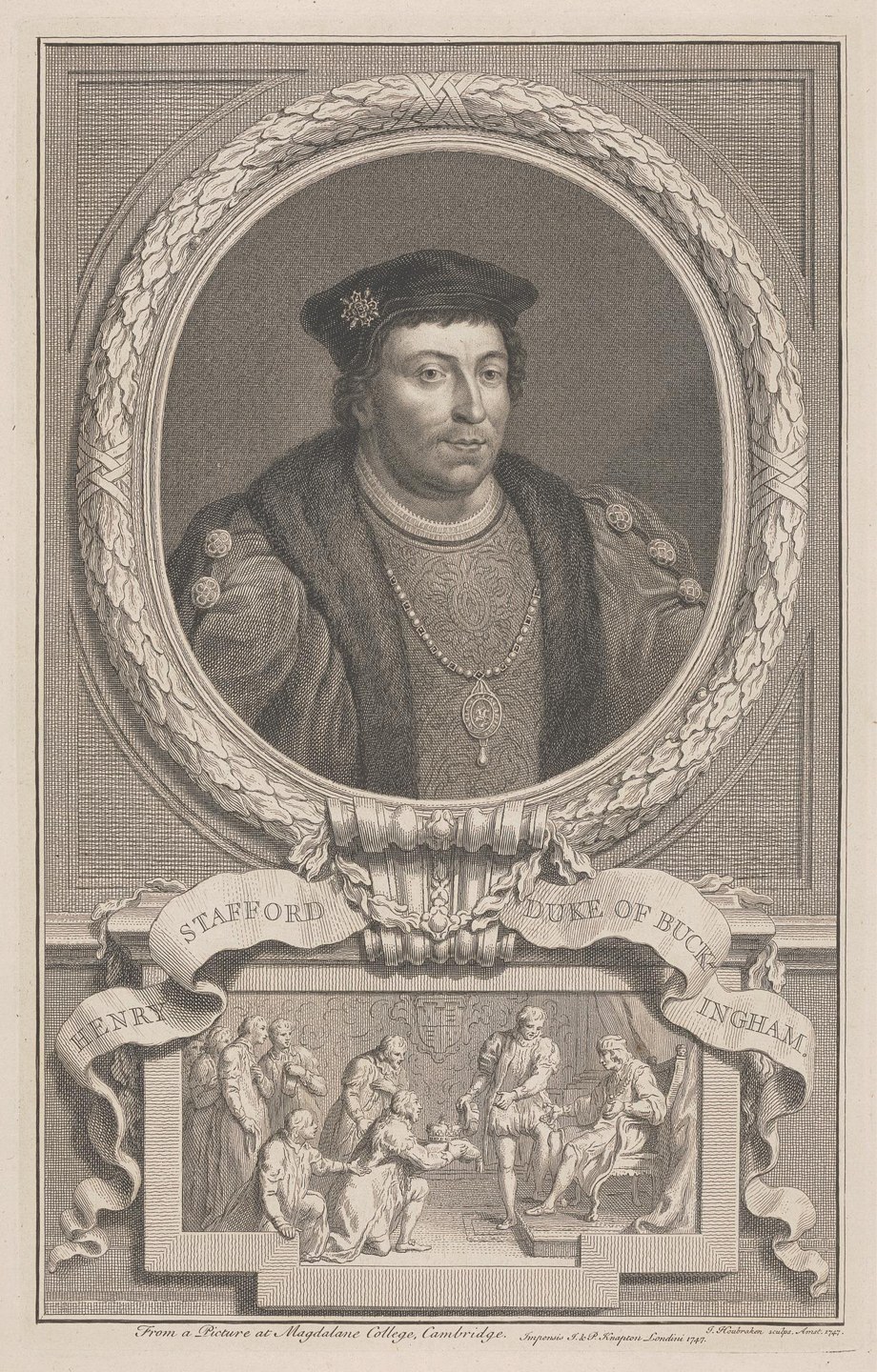
AI-assisted Portrait of Henry Stafford, Duke of Buckingham
The Kingmaker Who Could Not Stop Reaching
For a few months in 1483, Henry Stafford, Duke of Buckingham, was the most powerful subject in England. He had the highest blood short of the throne itself—a remote Plantagenet claimant in his own right—and he spent it lavishly on another man's ambition. When Edward IV died and left a boy king, it was Buckingham who supplied the muscle, the cavalcade, and the public spectacle that carried Richard III from Lord Protector to crowned king. No one rode higher in the new reign, and no one was rewarded more richly.
Then, within a single autumn, he turned. Buckingham's Rebellion—the rising that bears his name—broke against the king he had just made, and its true motive remains one of the Wars of the Roses' durable mysteries: bare ambition for the crown himself, revulsion at the fate of the Princes in the Tower, or a secret bargain to bring in Henry Tudor. The revolt collapsed in flood and miscoordination. Captured and refused even an audience, Buckingham was beheaded at Salisbury before the year was out. The arc from indispensable ally to executed traitor took barely six months.
Buckingham was the ENTJ as kingmaker—commanding Te bolted to a strategic Ni reach for the top, a man who organized a coup and then, still hungry, organized the rebellion that destroyed him.
The Magnate Who Organized a Coup
Te — dominant
Dominant Te is the drive to a commanding role and the instinct to organize people, resources, and events toward a result. Buckingham had both in abundance, sharpened by a pride in his own near-royal standing. In the chaotic weeks after Edward IV's death, while others hesitated, he acted: he rode to intercept the young king's escort, helped seize control of the boy and his protectors, and threw his name, retainers, and considerable wealth behind Richard's bid for the protectorship and then the crown.
He was the muscle and the showman of the coup—the man who marshaled the procession, managed the optics, and lent the proceedings the weight of England's premier duke. This is Te executing: not theorizing about power but assembling the machinery that delivers it. Richard understood exactly what he had in Buckingham and paid for it, heaping offices and lands on him until he was effectively viceroy of Wales and the west. When that same organizing force was turned the other way, it produced a coordinated rising across several counties at once—an ambitious man building, with characteristic Te, the apparatus of his own bid.
The Gambler's Reach
Ni — auxiliary
Auxiliary Ni gives Te its direction—a single, fixed objective glimpsed at the end of a chain of moves. Buckingham did not simply react to events; he read where they were heading and placed himself in front of the prize. Backing Richard was the first wager: he saw, before the outcome was settled, that the protectorship could be turned into a throne, and that the man who delivered it would stand second only to the king.
The rebellion was the second, riskier wager of the same faculty. Whatever its precise motive, the rising was strategic, not impulsive—a calculated reach toward a new settlement of the crown, coordinated by secret channels with Margaret Beaufort, whose son waited across the Channel. A would-be kingmaker reaching first to make Richard king and then to unmake him is Ni serving ambition: always one move ahead, always fixed on the summit. His error was not failing to plan but mistaking the moment, and that miscalculation cost him everything.
The Showman in the Saddle
Se — tertiary
Tertiary Se in an ENTJ shows up as a taste for spectacle and bold physical action—the grand gesture that makes power visible. Buckingham had a flair for the theatrical occasion. He understood that a coup is half persuasion, and he supplied the pageantry: the cavalcades, the public displays, the visible weight of England's greatest duke lending Richard's claim its legitimacy. He liked the saddle, the procession, and the eye of the crowd.
But tertiary Se is also the seat of impatience, and it betrayed him. The rebellion was launched and pressed before the pieces were truly in place, and when autumn storms swelled the rivers and washed out the bridges, his forces could not move or join. The same appetite for the bold stroke that made him a vivid ally made him a reckless rebel—he reached for the dramatic blow without the patience to secure it first.
The Conscience He Could Not Read
Fi — inferior
Inferior Fi is the ENTJ's blind quarter—a private moral register that rarely surfaces and, when it does, arrives suddenly and unintegrated. The great unanswered question of Buckingham's life lives here. One reading of his revolt is that he broke with Richard out of genuine horror at the fate of the Princes in the Tower: a buried conscience erupting into action, too late and too violently to be governed.
Whether that account is true or merely the prettier face of naked ambition, the psychological shape fits either way. If conscience moved him, it was an inferior function swamped by the dominant drive for power and then ruined by Te's and Ni's miscalculations. If ambition alone moved him, his weakness was the same: a man who could organize and strategize brilliantly but could not weigh loyalty, trust, or the moral cost of betrayal until it was upon him. The murk over his motive is exactly what an inferior Fi leaves behind—a decision no one, perhaps including the man himself, could fully explain.
Why ENTJ Over ENTP
Why not ENTP?
An ENTP reading of Buckingham would cast his sudden reversal as restless idea-play—a man who loved the gambit for its own sake and improvised his way into ruin. But that misses the shape of his drive. His defining motion was a commanding, ambitious bid for power executed with real force and a single strategic aim: a would-be kingmaker reaching for the top, not a contrarian amusing himself with possibilities. The coup he ran was organized, not improvised, and the rebellion that followed was aimed at a throne, not a debate.
The distinction is Te-Ni versus Ne. Buckingham's fault was not flightiness but the opposite—a great, fixed ambition pressed too hard and undone by one fatal miscalculation of timing and trust. The ENTP scatters; Buckingham concentrated, twice, on the crown. He was a builder of bids for power who happened to build his last one badly. That is the ENTJ failure mode, not the ENTP one.
Connected Figures
Further Reading
- Richard III — Charles RossThe standard scholarly biography — judicious on Buckingham's role in the usurpation and the motives behind his revolt.
- Buckingham's Rebellion: The 1483 Rising Against Richard III — Studies of the 1483 usurpationScholarship reconstructing the rising's coordination, collapse, and the still-debated question of why Buckingham turned.
- The Wars of the Roses — Anthony GoodmanA clear narrative of the dynastic conflict that frames Buckingham's blood claim and the stakes of 1483.
