 Historical Figure MBTI
#528 · 4-22-26 · The Wars of the Roses
Thomas Stanley
Lord Stanley · The Survivor Whose Betrayal Decided Bosworth
c. 1435 — 1504
7 min read
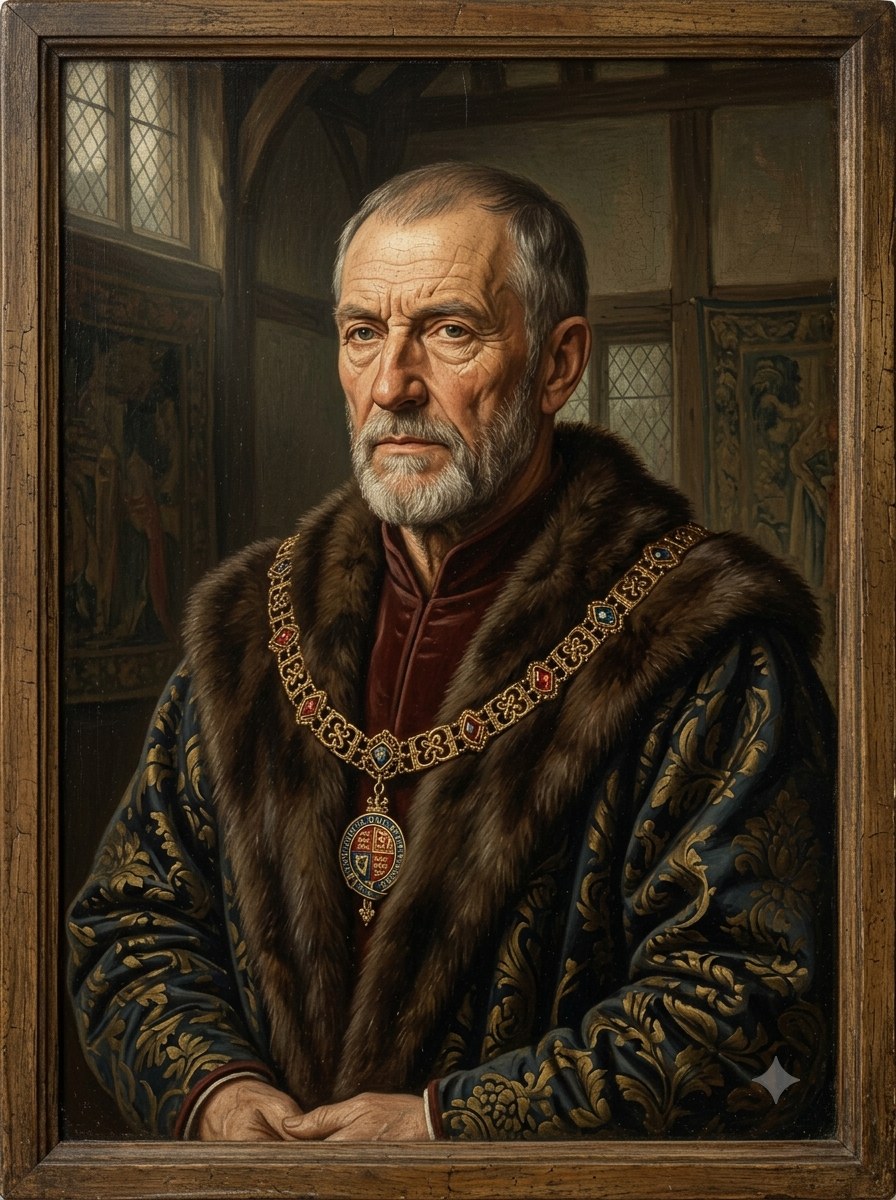
AI-assisted Portrait of Thomas Stanley
The Man Who Never Committed Until It Was Safe to Win
Across thirty years of dynastic slaughter, almost everyone who mattered in fifteenth-century England died on a battlefield, a scaffold, or in a sudden purge. Thomas Stanley did not. He served Lancaster, then York, then Richard III, then the Tudors—and he abandoned every one of them at the precise moment that loyalty stopped paying. By the time he died in his bed in 1504, an earl and a stepfather to the king, he had become the supreme survivor of the Wars of the Roses: a byword for cold, self-interested fence-sitting raised to something close to an art.
Stanley's genius was not for war or for rule but for reading a situation to the bone. He held vast estates across the northwest and could put thousands of men in the field, which made him a prize every faction courted and none could ignore. He married Margaret Beaufort as his third wife and so became, almost incidentally, stepfather to her son—the exiled claimant who would become Henry Tudor. When that obscure claimant landed in 1485, Stanley faced the calculation of his life. He answered it the way he had answered every other: by waiting.
Stanley was the ISTP stripped to its coldest logic—a detached tactician reading every crisis for risk and advantage, committing to no cause but his own survival, and striking only at the instant the outcome had already tipped.
The Ledger Behind the Eyes
Ti — dominant
Dominant Ti is a private engine of analysis that answers to no authority but its own logic. In Stanley it took the form of a perpetual, dispassionate audit of where advantage lay. He did not ask which side was righteous or which oath bound him; he asked which outcome was likeliest and which position left him standing afterward. Every shift of allegiance across his career—from Lancaster to York and back, from Richard to Henry—follows the same internal accounting: weigh the forces, price the risk, and refuse to move until the math is clear.
The cold consistency of that reasoning is what set him apart from the impulsive lords who threw themselves into doomed charges and lost their heads for it. Stanley treated each crisis as a problem to be solved rather than a banner to be followed. He kept his options open by design, never burning a bridge he might need, never closing off a path of retreat. The Ti dominant trusts its own private calculus over any external rule—and Stanley's calculus had exactly one fixed term in every equation: himself.
Waiting on the Ridge at Bosworth
Se — auxiliary
If Ti supplied the calculation, auxiliary Se supplied the timing—the predator's feel for the live moment, the instinct to watch the field and strike only when the body is already committed. Stanley's defining hour came at the Battle of Bosworth in 1485. He marched a large force to the field and then did the one thing no commander is supposed to do: nothing. He held his men coldly aloof from both armies, positioned to join whichever side the day favored, reading the tide of the fight in real time before he would spend a single soldier.
The pressure on him was as personal as it could possibly be. Richard III held Stanley's son and heir, Lord Strange, hostage, and on the morning of the battle ordered the boy beheaded if his father failed to charge for the crown—an order that, in the chaos, was never carried out. Stanley watched anyway. Only at the decisive instant, when Richard made his desperate cavalry dash and the battle tipped, did he throw his men in—for Henry Tudor, against the king who held his son. The Se read the moment perfectly: he committed not a stroke too early, when it might have cost him, and not a stroke too late, when it would have won him nothing.
He brought an army to Bosworth and then refused to be an army—watching, waiting, and spending his men only at the single instant when the outcome was no longer in doubt.
Reading Where the Wind Would Blow
Ni — tertiary
Tertiary Ni in an ISTP shows up not as grand vision but as a quiet feel for the trajectory of events—an ability to sense which way a conflict is trending and to position oneself ahead of the turn. Stanley had it. He repeatedly placed himself where the future was heading rather than where the present seemed strongest, hedging through the reign of Edward IV, surviving the convulsions of 1483, and keeping a line open to the Tudor exile even while serving Richard at court. He could smell a regime's decay before it collapsed.
It was a tertiary function, though, not a dominant one—tactical foresight in service of survival, never a coherent program for the realm. Stanley never sought to shape England's destiny; he only meant to be on the right side of it. The Ni gave him the horizon-reading instinct that told him when a cause was failing, and the Ti-Se core did the rest: calculate the odds, wait for the moment, and move.
A Son's Life on the Table
Fe — inferior
The clearest evidence for Stanley's type is what was almost entirely missing from him: the pull of loyalty, sentiment, and shared bond that a healthier Fe would supply. Inferior Fe leaves a man able to act with a chilling absence of feeling for the people around him—able to treat even the closest tie as one more variable in the calculation. Stanley had abandoned every patron he ever served without apparent anguish, and his marriages and alliances read as instruments of position rather than affection.
Bosworth is the proof carried to its limit. A father with ordinary feeling does not leave his firstborn under the headsman's axe while he weighs the odds—yet Stanley did exactly that, holding his force back even as Richard threatened to kill Lord Strange, betting coldly that the order would dissolve in the confusion of battle. The bet paid off and the boy lived, but the willingness to make it is the whole man. His only constant loyalty was to himself; everything else, including his own son's life, was negotiable.
Why ISTP Over ISTJ
Why not ISTJ?
The ISTJ is built around duty—a felt obligation to institution, oath, and crown that Stanley conspicuously lacked. An ISTJ in his position would have honored the side he had sworn to, or at least agonized over breaking faith. Stanley felt no such pull: he served and dropped every regime without visible conscience, treating allegiance as a tactical variable rather than a binding commitment. The ISTJ keeps the ledger of obligations; Stanley kept only the ledger of advantage.
The difference is motivational, and it is decisive. An ISTJ's constancy is to something outside himself—a role, a rule, a realm. Stanley's single constancy was to his own survival. He read each crisis with the detached, analytical cool of dominant Ti, struck with the opportunistic timing of Se, and committed only when the outcome was already certain. That is not the dutiful institutionalist; it is the self-interested tactician—the ISTP who serves no cause but the one that keeps him alive.
Connected Figures
Further Reading
- Bosworth 1485: Psychology of a Battle — Michael K. JonesReconstructs the battle and Stanley's fateful hesitation, arguing for a sharper account of where and how the betrayal turned the day.
- The Stanleys of Lathom and Knowsley — Barry CowardThe standard study of the family's rise to power in the northwest — essential for understanding the territorial base that made Stanley indispensable.
- The Wars of the Roses — Dan JonesA vivid narrative of the dynastic conflict that explains the shifting allegiances Stanley navigated so successfully.
- Richard III — Charles RossThe authoritative biography of the king Stanley abandoned, with a clear-eyed treatment of the Stanley problem at Bosworth.
