 Historical Figure MBTI
#1039 · 8-3-26 · The Old Kingdom
Harkhuf
The Caravan Explorer
fl. c. 2280 BCE
4 min read
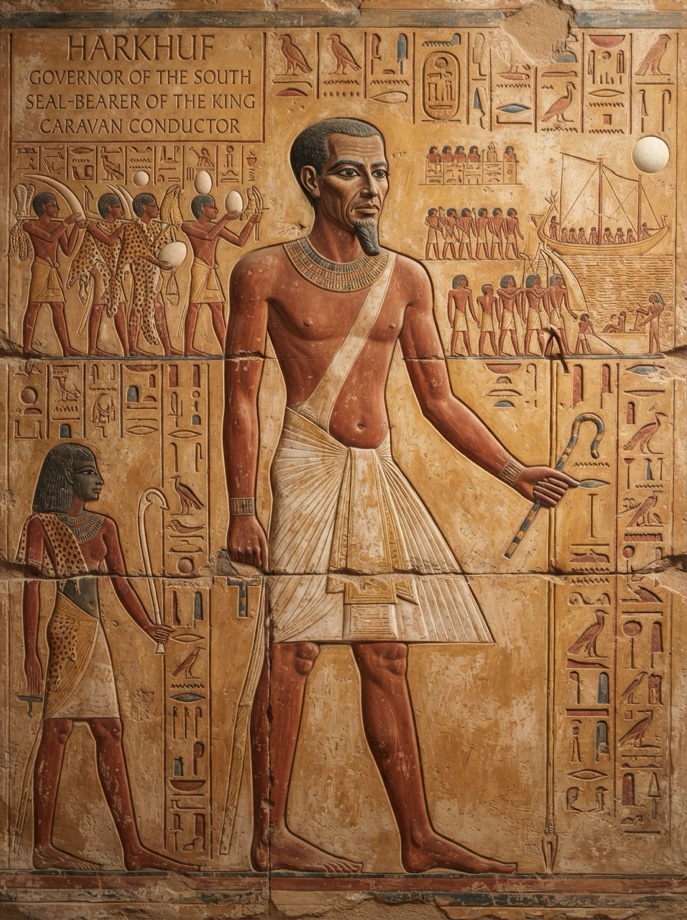
AI-assisted Portrait of Harkhuf
Four Journeys Into Yam
Harkhuf governed Elephantine, Egypt’s southern gate, at the edge of the known world — and he kept walking past it. Four times he led caravans deep into Nubia, into the land the Egyptians called Yam, trading for ebony, incense, and ivory, and once, famously, bringing home a dancing pygmy meant to delight a child-king. He returned each time with goods, and each time with a story he was determined no one would forget.
That determination is why we know him at all. Harkhuf had his own tomb inscribed not with the usual formulas of piety but with something closer to a travelogue — routes no caravan had taken before, dangers named and dismissed, a life narrated as adventure. It is one of the earliest surviving travel narratives from anywhere in the ancient world, and it reads like a man who understood, instinctively, that the story of a journey is worth as much as its cargo.
He didn’t record his life to be remembered as wise. He recorded it to be remembered as there.
Se — Reading the Trail as It Comes
Harkhuf’s expeditions were improvisational by necessity — Yam lay past the edge of any fixed itinerary, and each crossing meant reading terrain, weather, and unfamiliar peoples in real time. He boasts, tellingly, not of a plan he followed but of routes no predecessor had used; his was a confidence built on trusting his own hands and eyes over any inherited map.
Ti — A Private Logic of the Road
Beneath the showmanship sat a working method: how to provision a caravan, how to weigh a route’s risk, how to bring a pygmy across a continent alive. Harkhuf never explains this method — he simply demonstrates, four times over, that it works. That quiet, self-verified competence, shown rather than argued, is the mark of an auxiliary Ti in service of an outward-facing life.
Fe — Knowing Exactly What Would Delight a King
Harkhuf understood his audience. He knew a boy-pharaoh would care less about incense weights than a living curiosity, and he delivered one — earning a reply so excited it survives, carved whole, in his own tomb. That instinct for what would land, for the emotional currency of a gift, is Fe doing quiet diplomatic work underneath the swagger.
Ni — inferior
What Harkhuf lacks is any interest in the larger pattern — trade routes as policy, Nubia as strategy. He never reflects on what his journeys mean for Egypt’s future; he reflects on what happened to him. That narrowed, vivid, short horizon is exactly what an inferior Ni looks like in a man built for the immediate and the real.
Why ESTP Over ISTP
Why not ISTP?
Harkhuf’s inscription isn’t private tinkering — it’s a performance, aimed squarely at an audience of one very important child and everyone who would ever pass his tomb. An ISTP masters a system quietly and rarely explains himself; Harkhuf explained himself at length, in stone, precisely so the explaining would be remembered.
What ESTP captures that no other type does is the particular flavor of Harkhuf’s confidence: physical, present-tense, allergic to abstraction, always angling for the next audience. He is not remembered for foresight. He is remembered for having simply, spectacularly, gone.
Connected Figures
Further Reading
- Ancient Records of Egypt — James Henry BreastedIncludes a full translation of Harkhuf's tomb autobiography and Pepi II's letter.
- The Rise and Fall of Ancient Egypt — Toby WilkinsonSituates Old Kingdom Nubian trade within the era's wider expansion.
