 Historical Figure MBTI
#1038 · 8-3-26 · The Old Kingdom
Pepi II
Ninety-Four Years on the Throne
r. c. 2278 – 2184 BCE
4 min read
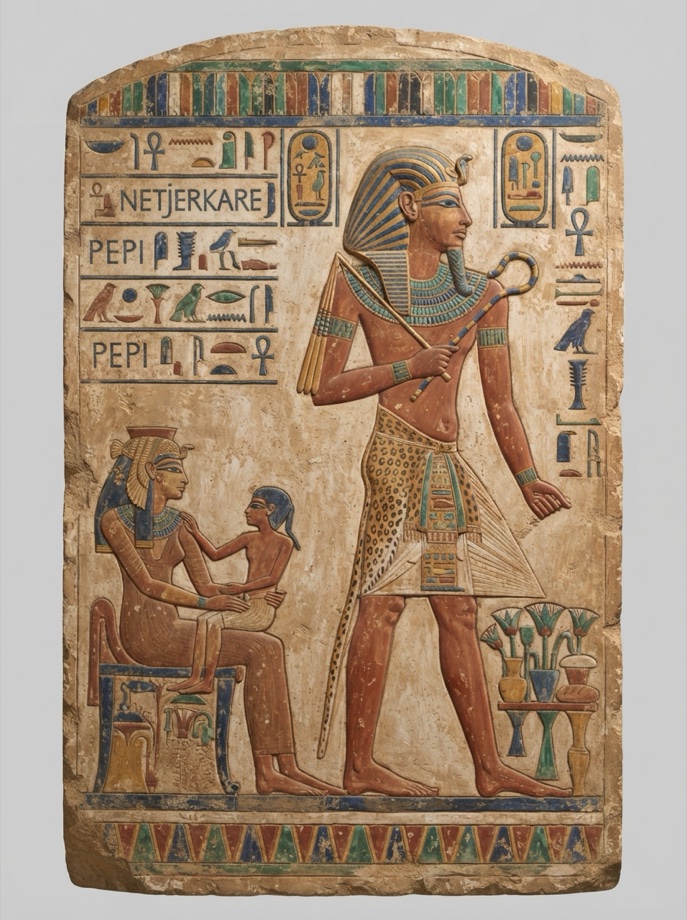
AI-assisted Portrait of Pepi II
A Boy-King and a Dancing Pygmy
Pepi II came to the throne, by ancient tradition, around the age of six, and reigned for something close to ninety-four years — quite possibly the longest reign of any monarch in recorded history. Almost nothing survives to tell us what kind of ruler that made him, with one glorious exception: a letter, inscribed in full on the tomb of the explorer Harkhuf, that the boy-king dictated on hearing that Harkhuf was bringing home a pygmy dancer from an expedition deep into Nubia and the African interior.
The letter is not measured statecraft. It is breathless. The young king orders Harkhuf to guard the dancer day and night, to check on him constantly during the journey down the Nile, to prevent him from falling into the water — and promises rewards beyond anything Harkhuf's own royal patrons had granted, purely for the joy of seeing this marvel at court. It is the most vivid, personal document to survive from the entire Old Kingdom, and it belongs to a king barely old enough to have written it himself.
Pepi II was an ESFP, dominant Se — a king whose most famous act was pure, immediate delight, not calculation.
Vivid Presence Over Measured Rule
Dominant extraverted sensing lives entirely in the immediate, the sensory, the right-now — and nothing captures that better than a child-king so overtaken by the idea of a dancing pygmy that he interrupts state correspondence to issue anxious, specific safety instructions about the man's journey. This is not a letter about diplomacy or tribute; it is a letter about wanting, urgently and directly, to see something wonderful with his own eyes.
Across ninety-four years on the throne, the historical record offers surprisingly little else in the way of decisive royal initiative — no major military campaigns remembered in his name, no sweeping legal reforms, nothing to suggest a mind occupied with abstract long-range vision. What survives instead, again and again in fragments, is a king engaged with the tangible and present: expeditions, gifts, the physical world brought to his court for him to experience directly.
Personal Reward, Personally Given
Auxiliary introverted feeling surfaces in the letter's generosity: Pepi II does not promise Harkhuf abstract state honors, he promises rewards greater than any king before him had given for a similar service, framed in intensely personal terms. The gratitude is not diplomatic boilerplate copied from a scribe's template — it reads as a genuine, individually felt appreciation, a boy's promise made because the prospect of the dancer mattered to him personally.
That same interior warmth likely explains why career officials like Weni, who served multiple Sixth Dynasty kings, describe royal favor in terms of personal trust and intimacy rather than purely institutional promotion — a court culture that, under Pepi II's extraordinarily long reign, seems to have run more on individual loyalty than on rigid bureaucratic structure.
A Machinery That Ran Without Him
Tertiary extraverted thinking is, tellingly, the function least visible in Pepi II's own surviving record — and its absence is itself the evidence. Ninety-four years is long enough for an engaged administrator to reshape a kingdom several times over; instead, Egypt's central authority spent those decades quietly leaking power to provincial governors who, by the reign's end, functioned as independent regional rulers in all but name. The state's Te-driven machinery, once robust enough to build the pyramids under his ancestors, ran increasingly on inertia rather than active royal direction.
That is not proof Pepi II lacked administrative capacity so much as evidence it was never his priority — a king absorbed in the vivid and immediate, leaving the tertiary function of organizing structural power to atrophy across a reign so long that its slow erosion became, by itself, the story of how the Old Kingdom ended.
Why ESFP Over ISFP
Why not ISFP?
An ISFP king might have felt the same private delight at the news of the dancer but would have been unlikely to dictate an urgent, outward-facing letter demanding minute logistical precautions be carried out immediately by someone else. Pepi II's excitement did not stay internal — it drove immediate, specific, externally directed action, sent down the Nile in real time. That outward discharge of enthusiasm into the tangible world is Se, not Fi, running the show.
It is worth remembering that this vivid, present-tense engagement coexisted with one of history's longest political declines — Pepi II's reign ended with royal authority dissolved into provincial hands, the Old Kingdom's central power hollowed out by decades in which a vivid, sensory-present king was simply not driving the machinery of state toward any particular future.
Connected Figures
Further Reading
- Ancient Records of Egypt — James Henry Breasted (trans.)Contains the translated text of Pepi II's letter to Harkhuf.
- The Rise and Fall of Ancient Egypt — Toby WilkinsonCovers the political decentralization that unfolded across Pepi II's long reign.
- A History of Ancient Egypt — Nicolas GrimalStandard reference on the Sixth Dynasty and the end of the Old Kingdom.
- Naguib Kanawati on Old Kingdom administration — Naguib KanawatiDetailed studies of provincial officials and the erosion of central authority.
