 Historical Figure MBTI
#1037 · 8-2-26 · The Old Kingdom
Menkaure
The Gentlest Pyramid
r. c. 2532 – 2503 BCE
4 min read
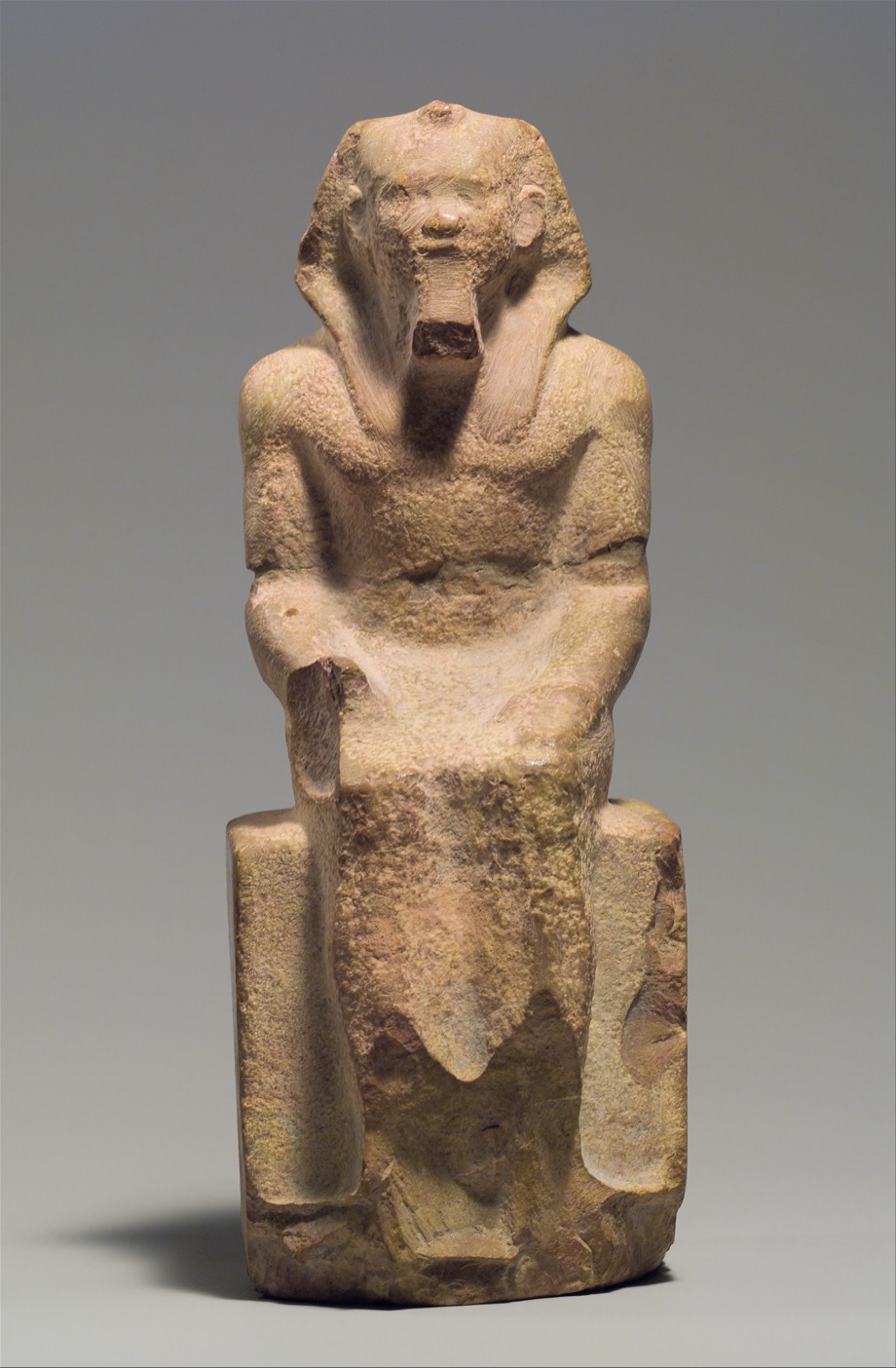
Statue of Menkaure
The Small Pyramid, the Gentle Reputation
Stand at Giza and the arithmetic tells its own story: Khufu's Great Pyramid rises 146 meters, Khafre's beside it nearly matches it, and Menkaure's — the third and last of the plateau's giants — reaches barely a third of their height. He had every resource his father and grandfather had commanded and chose, or was forced by a shortening reign, to build far smaller. What he could not shrink was his reputation. Centuries later, when Herodotus toured Egypt collecting priestly testimony, he was told that Khufu and Khafre were remembered as harsh, temple-closing tyrants — and that Menkaure, by sharp contrast, was remembered as pious, mild, and beloved.
His surviving triad statues reinforce the same impression from a different angle: where Khafre's statuary emphasizes solitary divine authority, Menkaure appears flanked by protective goddesses, gently embraced rather than enthroned alone. It is the portrait of a king who wanted to be seen in relation — sustained by inherited divine order rather than standing apart from it.
Menkaure was an ISFJ, dominant Si — a king remembered for gentleness precisely because he built to preserve, not to dominate.
Working Within an Inherited Framework
Dominant introverted sensing does not ask whether the framework it inherits should be overturned; it asks how faithfully that framework can be honored. Menkaure's pyramid is, in every structural sense, a continuation of his father's and grandfather's methods — the same core construction, the same alignment principles, the same ritual architecture — just executed at a scale his own resources and reign length could actually sustain. There is no experimentation here, no Sneferu-style trial and error; there is careful adherence to a known, working religious and architectural template.
That fidelity extended to how he presented himself to the gods. His triad statues repeat a fixed formula precisely, again and again, rather than innovating a new iconography for his own reign — a king content to occupy his place in an established order rather than reshape it around himself.
A Reign Remembered for Warmth
Auxiliary extraverted feeling is the function that explains why Menkaure's public memory diverged so sharply from his predecessors', even though his actual demands on Egyptian labor were not trivial. Herodotus reports that Menkaure, appalled by his father's and grandfather's harshness, reopened the temples they had closed and ruled with a gentler hand — testimony filtered through centuries of retelling, but consistent enough with the statuary's tone to suggest a ruler genuinely attentive to how his authority was experienced by others.
The protective goddesses flanking him in stone are themselves a statement of relational harmony: a king who wanted to be seen embraced by divine care, not merely obeyed. That is Fe expressed through royal iconography — legitimacy sought through communal warmth rather than isolated command.
A Quiet Standard of Craftsmanship
Tertiary introverted thinking shows less in grand assertion than in the unglamorous consistency of execution: Menkaure's pyramid, though far smaller than his father's and grandfather's, was built to the same exacting standards of stone-fitting and alignment his family's masons had already proven. He did not cut corners to compensate for reduced scale; the reduction itself appears to have been the plan, executed precisely within its own smaller frame.
That internal consistency — knowing exactly what standard a project must meet and holding to it regardless of how the result compares to a grander predecessor — is Ti working quietly in service of Si's larger commitment to inherited form, rather than asserting itself as an independent, questioning force.
Why ISFJ Over ESFJ
Why not ESFJ?
An ESFJ king building in reduced circumstances would more likely have compensated with visible public gestures — grand ceremony, active courting of popular favor. Menkaure's record instead shows quiet consistency with inherited form: the same statuary formula repeated rather than reinvented, a pyramid scaled down without fanfare rather than dressed up to disguise its size. That is Si's private fidelity to what already works, not Fe's outward performance of warmth as its dominant mode.
The gentleness later tradition attached to him reads, on this evidence, as a natural extension of Si-led continuity — a king sustaining rather than asserting — with Fe providing the relational warmth, not the driving ambition.
Connected Figures
Further Reading
- The Complete Pyramids — Mark LehnerCovers the Menkaure pyramid complex and its comparatively modest scale.
- The Pyramids — Miroslav VernerDiscusses the triad statues and their departure in tone from Khufu- and Khafre-era iconography.
- The Rise and Fall of Ancient Egypt — Toby WilkinsonSituates Menkaure's reign at the close of Giza's great building era.
- A History of Ancient Egypt — Nicolas GrimalStandard reference on Fourth Dynasty succession and royal ideology.
