 Historical Figure MBTI
#1034 · 8-2-26 · The Old Kingdom
Khufu
The Pyramid Builder
r. c. 2589 – 2566 BCE
10 min read
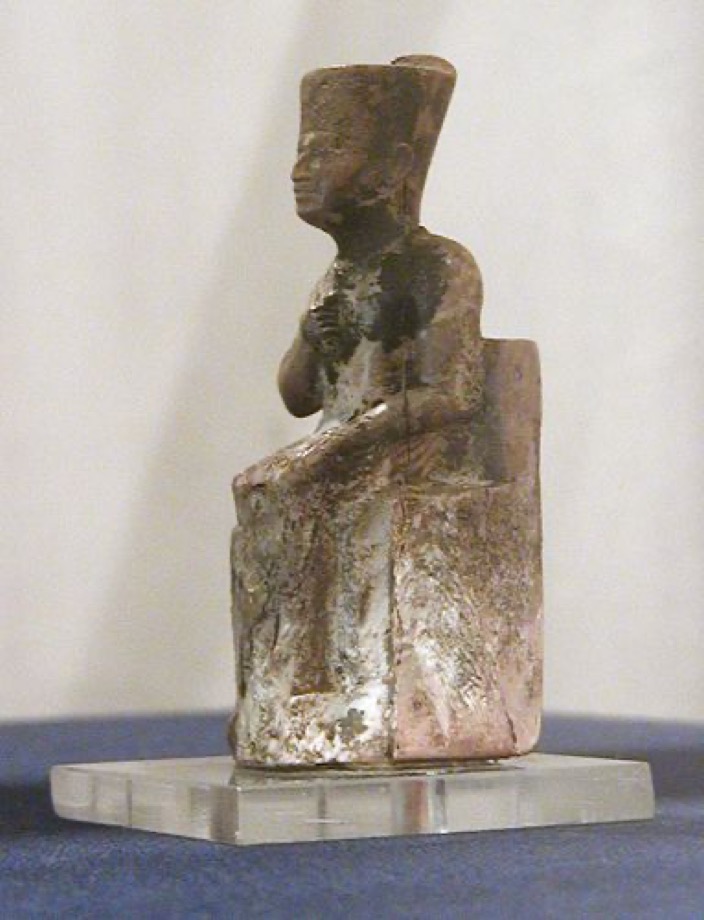
Statue of Khufu
The Man Who Left Only the Result
Of the man himself almost nothing survives. One ivory figurine three inches high, found not at Giza but at Abydos, is the only certain image of Khufu's face — a squat, thick-jawed king in the Red Crown, small enough to lose in a pocket. He built the largest object any human being had ever built, and the only portrait we have of him could be mistaken for a chess piece. That ratio is not an accident of preservation. It is the shape of the man. Khufu did not spend his reign explaining himself; he spent it producing something that would not need explaining.
The Great Pyramid contains roughly 2.3 million blocks of limestone and granite, some of the granite quarried at Aswan and floated five hundred miles downriver. Its base covers thirteen acres and is level to within about two centimetres across that span. Its sides are aligned to true north with an error of roughly three arcminutes — a twentieth of a degree, achieved without a compass, without iron tools, without the wheel in any meaningful load-bearing sense. And the whole of it was raised, finished, and sealed inside a single reign of roughly twenty-three years. That last fact is the one that matters. This was not a cathedral accumulating across generations while the theology drifted. It was one man's decision, executed on schedule.
What we know of his character comes mostly from a hostile source two thousand years his junior. Herodotus, touring Egypt in the fifth century BCE and listening to priests who had their own reasons to blacken the memory of the Old Kingdom's great builders, reported that Cheops closed the temples, forbade sacrifice, and drove the whole nation into the quarries in gangs of a hundred thousand working three-month shifts. It is bad history and excellent characterization. Modern excavation at the workers' town south of the pyramid has demolished the slave-army image — the builders ate beef and bread, lived in barracks, were organized into named crews, and were buried in their own tombs in the shadow of the thing they built. But the Greek slander preserved something real underneath the exaggeration: a memory of a king who subordinated every institution in the country, temples included, to a single objective, and who was remembered for centuries afterward as someone who did not negotiate.
Khufu is the purest ENTJ in the archive because he left nothing behind but the output: dominant Te measured not in speeches or doctrines but in 2.3 million blocks, set true north, on time.
Te — The Logistics of the Impossible
Extraverted Thinking is the function that asks what will actually work and then builds the machine that makes it work. Its evidence is never a manifesto; it is a schedule met. Khufu's schedule required, on the standard arithmetic, something like one block placed every two or three minutes of every working daylight hour for twenty years — and each of those blocks had to be quarried, dressed, hauled, sorted, and delivered to a specific course at a specific moment. The bottleneck of the Great Pyramid was never engineering. It was supply chain, and Khufu built a state to solve it.
The state he built is legible in the ground. The workers' settlement excavated by Mark Lehner and Zahi Hawass at Heit el-Ghurab includes industrial-scale bakeries, a fish-processing operation, and cattle pens — the calorie infrastructure for thousands of laborers, run as a commissary rather than a charity. Crew graffiti scrawled inside the relieving chambers above the King's Chamber name gangs like "the Friends of Khufu" and "the Drunkards of Menkaure," units subdivided into phyles and further into named divisions — an organizational chart, in red ochre, on stone nobody was ever meant to see. Te does not decorate the parts of the system the public will never inspect; it simply insists that they be indexed.
And then, in 2013, the Wadi al-Jarf papyri surfaced on the Red Sea coast: the oldest inscribed papyri ever found, and among them the logbook of an inspector named Merer, who spent his months ferrying Tura limestone across the river to Giza in a boat crew of about forty, recording each round trip. It is a timesheet. The single most spectacular monument in human history is documented for us not by a hymn but by a middle manager's delivery log, filed under the authority of Khufu's half-brother Ankhhaf. Nothing captures dominant Te more exactly: the pharaoh at the apex of a paperwork empire, where divinity is expressed as throughput.
Ni — One Shape, Chosen Before the First Stone
Khufu inherited a problem from his father. Sneferu had built three pyramids and arguably botched two of them: the collapsed or abandoned pile at Meidum, and the Bent Pyramid at Dahshur, whose angle changes partway up because the original slope was destabilizing the structure. Only the Red Pyramid, at a cautious fifty-three degrees, stood clean. A cautious heir would have copied the Red Pyramid. Khufu went to fifty-one degrees fifty minutes, raised the base to thirteen acres, and committed to a design nearly twice the volume of anything his father had managed — and then did not revise it.
Introverted Intuition, as auxiliary, is convergence: the narrowing of many possible futures into one that is then treated as already true. The Great Pyramid's internal architecture betrays that convergence under strain — the abandoned subterranean chamber, the Queen's Chamber left unfinished, the Grand Gallery corbelled upward to a King's Chamber high in the body of the monument. Scholars still argue whether these represent successive changes of plan or a single staged scheme. Either way the direction is constant: everything moves upward and inward toward one granite box. The plan adapted; the vision did not.
The orientation is the clearest signature. Aligning a thirteen-acre square to true north within three arcminutes almost certainly required observing circumpolar stars — sighting the pivot of the northern sky and holding that line across two decades of construction, since the alignment had to survive every course. That is a man setting his work against something that does not move, and then refusing to move with anything else. It is also, unavoidably, a bid on eternity: the pyramid is a machine for making a dead king permanent, and Khufu built the version that has in fact outlasted every rival claim to permanence made in the following forty-five centuries.
Se — Mass as Argument
An ENTJ's tertiary Extraverted Sensing shows up as an appetite for physical impact — for effects that land on the body before they land on the mind. Khufu could have made his case in inscription, as later pharaohs did at Karnak and Abu Simbel, covering acres of wall with victory reliefs and titulary. He barely bothered. The Great Pyramid carries essentially no exterior decorative program. Its argument is delivered entirely by mass: 5.9 million tonnes of stone, originally sheathed in polished Tura limestone that would have thrown white light across the desert for miles. You did not need to read it. You needed only to be near it.
The sensory precision is as striking as the bulk. The casing blocks were fitted with joints averaging half a millimetre, sealed with a thin gypsum mortar — tolerances that serve no structural purpose whatever and exist only so that the finished surface would read as a single unbroken plane of light. Inside, the King's Chamber is lined with granite slabs weighing fifty to eighty tonnes each, hauled from Aswan and raised some fifty metres into the body of the pyramid, in a room no living person was meant to enter twice. Se in a Te-dominant is not self-indulgence; it is a demand that the thing be right in the hand as well as on the plan.
Even the burials around it were staged for effect. The five boat pits at the pyramid's foot held disassembled cedar vessels, one of which — recovered in 1954 in 1,224 pieces and rebuilt over more than a decade — is a forty-three-metre ship of Lebanese cedar, seaworthy in principle, buried whole so the king could sail. Khufu commissioned a real ship, in real imported timber, to be put in a hole in the ground. The gesture only makes sense to a mind that regards the tangible object as the point, not the symbol of the point.
Fi — The Hidden Chamber of the Self
Inferior Introverted Feeling is the ENTJ's private room: values held so deep and so unarticulated that they surface only in things done, never in things said. Khufu said nothing. No autobiography, no boasting stela, no reported speech. What survives instead is a set of acts whose only intelligible motive is personal attachment. He buried his mother Hetepheres I in a hidden shaft on the east side of his own pyramid, a hundred feet down, packed with gilded furniture — a carrying chair, a bed canopy, silver bracelets inlaid with butterflies. The chamber was sealed and unmarked, invisible to any audience. It was not propaganda. Somebody wanted his mother close.
He also kept it in the family. The vizierate and the great works went to his own blood: Hemiunu, his nephew, held the title "overseer of all the king's works" and was buried in a mastaba in the western cemetery, his seated statue showing a heavy, sagging, unflatteringly honest man — a portrait far more revealing than anything Khufu permitted of himself. The cemeteries east and west of the Great Pyramid are laid out in rigid streets, plots assigned by rank and kinship. Khufu organized his afterlife the way he organized his quarries, and the people he trusted with the work were the people he intended to spend eternity beside.
The cost of that buried Fi is what Herodotus caught, garbled. A man who never explains himself accrues a reputation he cannot correct. The Greek tradition made Khufu a tyrant who shut the gods out of their temples and, in its ugliest version, sold his own daughter's body for building stone — pure invention, but invention of a specific flavor. It is the story people tell about a leader who was demonstrably effective and gave them no interior life to sympathize with. Inferior Fi does not make a person cruel. It makes him easy to imagine as cruel.
Why ENTJ Over ISTJ
Why not ISTJ?
The ISTJ case is tempting: a builder obsessed with tolerances, records, and inherited form looks like Si-Te on paper. But Si is continuation — it refines the precedent it was handed. Khufu did the opposite. Handed a father who had built three pyramids and failed at two, he did not iterate cautiously toward a safer version; he roughly doubled the volume, chose a steeper angle than the one Sneferu had retreated to, and staked a single twenty-three-year reign on a design with no proven precedent at that scale. ISTJs do not bet the whole state on an unrepeated experiment. And the precision at Giza is not the Si precision of doing it the way it has always been done — it is Te precision, an externally verifiable specification imposed on thousands of people because the specification is what makes the result true. The logbooks, the crew names, the commissary bakeries: those are systems invented to hit a target, not habits maintained because they are familiar.
The tell is that Khufu did it once. An Si-driven builder leaves a career of successive refinements, each learning from the last — which is precisely Sneferu's profile, three pyramids and a visible learning curve. Khufu has one monument, executed at the outer limit of what his century could organize, and then he stops. That is Te-Ni: converge on the single decisive objective, mobilize the entire apparatus of the state behind it, and refuse to spend the reign on anything smaller. His son Khafre built nearly as high by cheating with higher bedrock; his grandson Menkaure built a third the size. Nobody in four thousand years matched the original. The ceiling Khufu set was not a tradition anyone could continue. It was a command that happened to be obeyed by geology.
Connected Figures
Further Reading
- The Complete Pyramids — Mark LehnerThe standard illustrated survey — construction methods, the Giza workers' town, and the logistics behind the Fourth Dynasty.
- The Pyramids: The Mystery, Culture, and Science of Egypt's Great Monuments — Miroslav VernerExcavation-grounded account of each pyramid in sequence, strong on the Sneferu-to-Menkaure design progression.
- The Histories, Book II — HerodotusThe fifth-century BCE Greek portrait of Cheops as temple-closing tyrant — unreliable as history, invaluable as reputation.
- The Rise and Fall of Ancient Egypt — Toby WilkinsonPlaces Khufu's reign inside the political arc of the Old Kingdom state that made such a project possible.
- Giza excavation reports and popular writings — Zahi HawassDecades of fieldwork on the Giza plateau, the workers' cemeteries, and the satellite pyramids around Khufu's monument.
