 Historical Figure MBTI
#1032 · 8-1-26 · The Old Kingdom
Sneferu
The King Who Failed His Way to the Pyramid
r. c. 2613 – 2589 BCE
4 min read
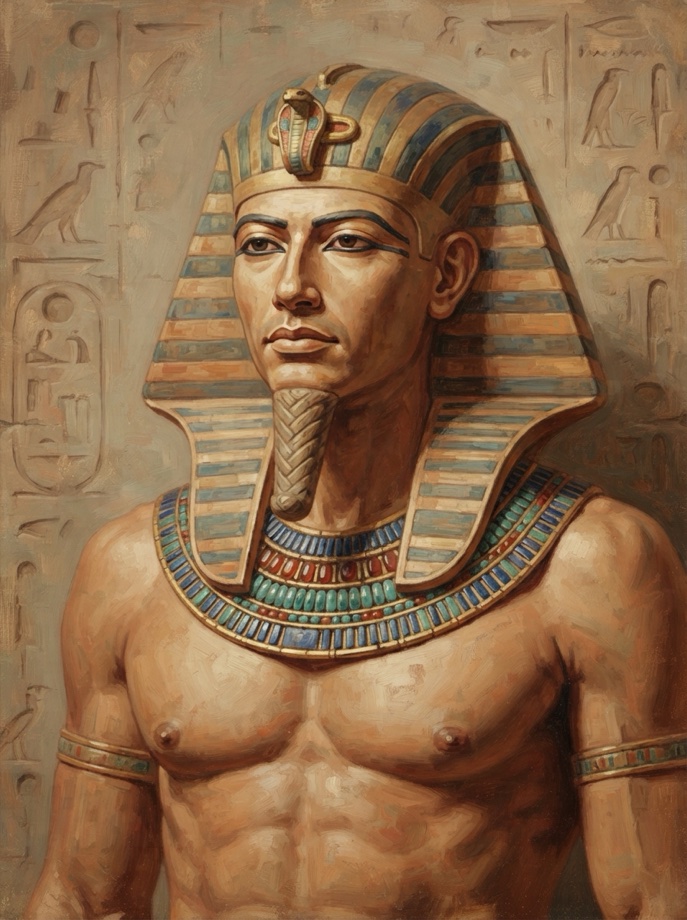
AI-assisted Portrait of Sneferu
Three Pyramids, Three Tries
No pharaoh built more pyramids than Sneferu, and no pharaoh's pyramids failed so visibly, so instructively, or so often in full public view. At Meidum, the outer casing sheared away, leaving a mountain of rubble skirting a stone core that still looks, from a distance, like a ruin mid-collapse. At Dahshur, the first attempt cracked partway up and the builders changed the angle of ascent in the middle of construction rather than tear it down, producing the strange, elbowed silhouette known ever after as the Bent Pyramid. Only the third attempt, the Red Pyramid, rose clean and stable — the first true, smooth-sided pyramid in history.
Read as failure, this is a strange record for a king remembered as one of Egypt's great builders. Read as method, it is something else entirely: a ruler who treated each collapse and correction as information rather than humiliation, who kept redeploying the state's labor and stone toward the next attempt instead of settling for the safety of repeating what had merely not yet gone wrong. Nobody before Sneferu had built at this scale twice. He built three times, and the third time he got it right.
Sneferu was an ENTP, dominant Ne — a king who treated architectural failure as a data point on the way to the next possibility.
Building to Find Out What Would Work
Dominant extraverted intuition does not plan its way to certainty before acting — it acts to generate the information certainty requires. Sneferu's building program reads exactly this way: Meidum was not a mistake he stumbled into once and then avoided, it was a hypothesis about how steep a pyramid could rise before its own mass betrayed it. When the casing failed, the response was not retreat but iteration — a second attempt at Dahshur testing a shallower angle, then a mid-build correction when even that proved too ambitious partway up.
Most rulers who watched their monument crumble would have quietly scaled down their ambitions. Sneferu instead kept generating new structural possibilities until one of them held — the signature of a mind that experiences a failed hypothesis less as a verdict than as a prompt for the next one. By the time the Red Pyramid rose clean at Dahshur, Egypt had, in a single reign, worked out the geometry that Khufu's Great Pyramid would simply scale up.
The Logic Underneath the Improvisation
What separates Sneferu's iteration from mere trial and error is the internal consistency running beneath it. The angle change partway up the Bent Pyramid was not a panicked abandonment of the plan — it was a precise recalculation, executed while the structure was still standing, that preserved the monument rather than scrapping it. That is auxiliary introverted thinking doing its quiet work: a private model of why the first design failed, refined and reapplied without needing to explain itself in public terms.
It is also why the pattern across three pyramids reads as a single coherent engineering education rather than three unrelated projects. Each structure inherited the working logic of the one before it, corrected at the exact point of prior failure — the mark of a builder testing a real internal theory of stone, mass, and angle against reality, one enormous experiment at a time.
A Reputation for Generosity, Not Just Ambition
Tertiary extraverted feeling appears in a detail that survived into later Egyptian folk memory: unlike the harsher reputations later attached to his son Khufu, Sneferu was remembered in popular tradition as approachable, even genial — a king who, in one surviving Middle Kingdom tale, is happily diverted by a small crisis among his rowing women rather than annoyed by it. Whatever the literal truth of that story, it points to a ruler whose enormous demands on his kingdom's labor did not curdle his public image into tyranny.
That is consistent with a mind more interested in the next possibility than in asserting dominance over the people executing it — Fe here reads as a genuine, if secondary, attentiveness to how the project felt to those around him, not the organizing principle of his reign, but a warmth that outlived him in story long after the pyramids themselves had gone quiet.
Why ENTP Over INTP
Why not INTP?
An INTP might have arrived at the same structural insights privately, in theory and calculation, without ever committing state resources to test them at monumental scale three times over. Sneferu's Ne was not content to reason toward the right angle in the abstract — it needed the world to answer back, which is why he kept building rather than kept calculating. That outward, generative drive toward action is extraverted, not introverted, intuition.
The distinction is the whole story of his reign: three pyramids are not the record of a man who got it wrong twice, but of a mind that needed the physical world's answer before it would settle, and had the resources of a kingdom to keep asking.
Connected Figures
Further Reading
- The Complete Pyramids — Mark LehnerCovers Meidum, the Bent Pyramid, and the Red Pyramid as one connected engineering sequence.
- The Pyramids — Miroslav VernerDetailed structural analysis of why Meidum's casing failed and the Bent Pyramid's angle changed.
- The Rise and Fall of Ancient Egypt — Toby WilkinsonSituates Sneferu's building program within Fourth Dynasty state power.
- A History of Ancient Egypt — Nicolas GrimalStandard reference on the succession from Sneferu to Khufu.
