 Historical Figure MBTI
#1033 · 8-1-26 · The Old Kingdom
Hetepheres I
The Queen in the Hidden Tomb
fl. c. 2600 BCE
5 min read
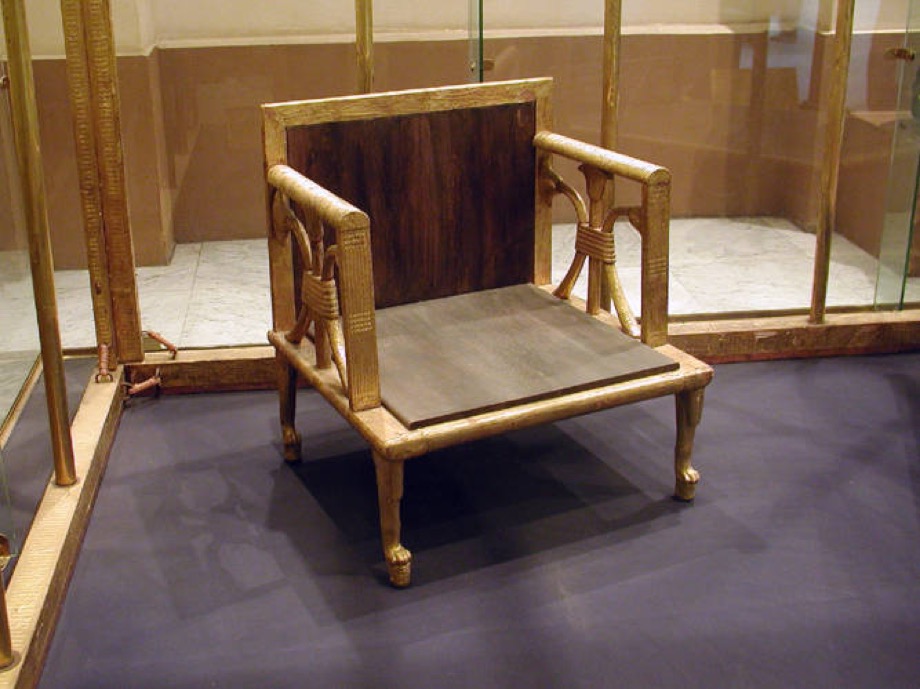
Chair of Queen Hetepheres I
A Life Recovered Through Furniture, Not Deeds
Almost nothing written survives about Hetepheres I as a person. What survives is her tomb — or rather, a hidden reburial of her belongings, discovered near Giza in 1925, sealed and untouched for over four thousand years. Her sarcophagus, when finally opened, was empty; her body had vanished, apparently lost or destroyed after her original burial was disturbed. But the furniture around that empty coffin was intact: a gilded canopy bed, an ornate carrying chair, gold-sheathed armchairs, a jewelry box still holding silver bracelets — the finest surviving domestic furnishings of the entire Old Kingdom.
The likeliest explanation, though never confirmed by inscription, is that her son Khufu — builder of the Great Pyramid — had her original tomb violated by robbers and, unable to bear the exposure, ordered a secret reburial of what could be salvaged, hidden in a shaft near his own monument. It is a story recoverable only through objects: nothing about Hetepheres survives except how carefully, and how privately, someone chose to preserve what was left of her.
Hetepheres I is an ISFJ, though the evidence for that reading is thin by necessity — what remains of her is a hoard of exquisitely preserved domestic objects, which is exactly the kind of quiet, tangible legacy dominant Si tends to leave behind.
Furniture Fine Enough to Rebury in Secret
It has to be said plainly: almost no direct evidence of Hetepheres’ personality survives, and any typing here leans heavily on inference from material remains rather than documented acts — an honesty this entry owes its reader before making any claim at all. What the tomb does show is an extraordinary, sustained investment in domestic craftsmanship: a bed frame and canopy built to travel and be reassembled, a carrying chair sized and inscribed specifically for her, furnishings meant for daily private use rather than public display.
That her family valued those specific, tangible, personal objects enough to painstakingly preserve and rebury them — rather than simply re-equip a new burial with fresh grave goods — argues for a household in which continuity and physical inheritance mattered on their own terms. Dominant Si is drawn to exactly this kind of concrete, sensory permanence: objects that hold memory in their material, not their symbolism.
The craftsmanship itself, gold leaf over wood, inlaid faience, careful joinery meant to survive travel and reassembly, speaks to a standard of domestic comfort maintained with real rigor — a queen’s household run on carefully upheld, well-established practice rather than improvisation.
A Reburial as an Act of Devotion
The strongest evidence for auxiliary Fe is not Hetepheres’ own but her family’s response to her death and its aftermath. Whoever ordered her secret reburial — most likely Khufu — treated the disturbance of her original tomb as a wound requiring careful, discreet repair, going to considerable trouble to gather and rehouse what remained of her possessions rather than simply moving on. That is Fe’s imprint by proxy: a family bond expressed through quiet, protective care after the fact.
Her title, Mother of the King, and her closeness to the throne of both her husband Sneferu and her son Khufu, suggest a woman whose position rested on relational standing within the royal household rather than an independent institutional office — again, care and continuity expressed through family connection rather than public assertion.
Precision in What Little We Can See
Tertiary Ti is the most speculative reading in this entry, but it surfaces in the exacting, almost technical precision of the furniture design attributed to her household — proportioned joinery, inscribed hieroglyphic labeling identifying pieces by function and owner, a level of specification unusual even among Old Kingdom elite burials. Someone in that household cared about getting the details structurally, not just decoratively, correct.
Whether that precision reflects Hetepheres’ own standards or simply the craftsmen she employed is impossible to know for certain from the archaeological record alone — which is exactly the honest limit of what this entry can claim.
Why ISFJ Over ESFJ
Why not ESFJ?
An ESFJ queen of this stature would likely have left behind some trace of public ceremonial role or visible court presence — an inscription, a title tied to public religious duty, some record of active social organization. What survives of Hetepheres instead is exclusively private and domestic: furniture for her own daily use, quietly and protectively reburied rather than publicly re-consecrated. That points toward an introverted, Si-led orientation rather than an extroverted, Fe-led one, even allowing for how much of her public record may simply be lost to time.
Given how little survives, this type reading is necessarily provisional — built on the character of the objects left behind rather than any documented act. That caveat is itself the honest verdict this entry can offer.
Connected Figures
Further Reading
- Excavation report on the Hetepheres tomb, Giza — George ReisnerThe primary archaeological record of the 1925 discovery of her hidden burial.
- A History of Ancient Egypt — Nicolas GrimalDynastic context for the early Fourth Dynasty and the Giza pyramid builders.
- Ancient Egyptian Literature, Vol. I — Miriam LichtheimOld Kingdom textual context surrounding royal household life.
