 Historical Figure MBTI
#1031 · 8-1-26 · The Old Kingdom
Imhotep
Architect, Vizier, God
fl. c. 2650 BCE
8 min read
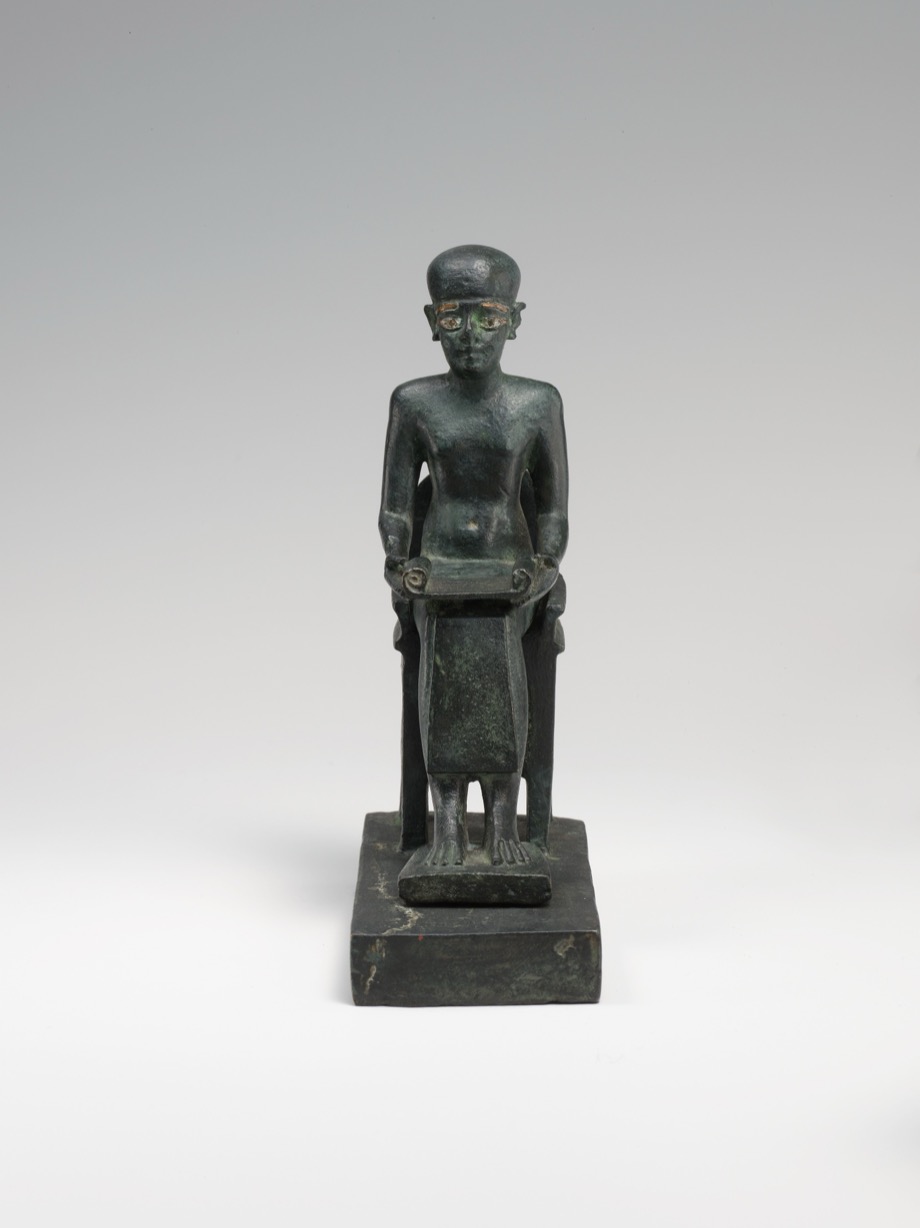
Statue of Imhotep
The Man Who Invented Stone
Every architect who has ever stacked one dressed block on another is working inside a decision somebody made once, for the first time, on a limestone plateau west of Memphis. Before Imhotep, Egyptian kings were buried under mastabas — low rectangular benches of sun-dried mud brick, impressive by the standards of mud and doomed by the standards of time. After him, they were buried under mountains of quarried stone. There is no transitional generation, no century of cautious experiment. There is one man, one reign, and a change of material and scale so abrupt that later Egyptians could only explain it by concluding he had not been entirely human.
What survives of him is thin and extraordinary. A statue base of King Djoser found at Saqqara carries his name and titles beside the king’s own — an honor so far outside protocol that it functions as evidence in itself. Chancellor of the King of Lower Egypt. First after the King of Upper Egypt. Administrator of the Great Palace. Hereditary Noble. High Priest of Heliopolis. Chief Sculptor, Chief Carpenter. The titles span cult, state, medicine, and craft, and they are held simultaneously by a commoner. Two thousand years later, Egyptians in the Late Period were still bringing offerings of mummified ibises to shrines dedicated to him as a god of healing, and the Greeks who arrived after them simply identified him with Asclepius and kept praying.
He is the only architect in Egyptian history to be deified, and he was deified for something more specific than competence. He had seen a shape that did not exist, in a material nobody had yet learned to command, and then organized an entire kingdom until the shape stood in the desert.
An INTJ whose dominant Ni did not decorate an existing tradition but replaced it — a single structural vision, in stone, in the body, and in ritual, held so hard it outlived its author by two millennia.
Ni — The Shape Before the Stone
The Step Pyramid was not designed. It was redesigned, repeatedly, and that sequence is the clearest window into how Imhotep’s mind worked. Archaeology has read the building’s own layers: it began as a square stone mastaba, was enlarged twice, was converted into a four-step tower, and was finally extended into the six-tiered mass that stands today, roughly sixty metres high. Each revision was a correction toward something the earlier version had failed to be. That is the signature of a mind working backward from an endpoint it can already see rather than forward from precedent it can already cite.
And the endpoint was not a bigger tomb. It was a coherent system. The pyramid sits inside an enclosure of some fifteen hectares, walled in white Tura limestone with fourteen gateways of which thirteen are false — doors carved as doors, opening onto nothing. Around it stand the buildings of the heb-sed jubilee court, shrines with fluted engaged columns and stone roofs cut to imitate bundled reeds and palm logs, chapels whose interiors were never meant to be entered because they were built solid. The entire complex is an eternal simulation of a ceremony, rendered in the one material that would not rot. Nobody had ever done this. Imhotep translated a whole vocabulary of perishable architecture — reed, timber, matting, brick — into permanent stone in a single unified act of imagination.
Ni is often described as foresight; it is better described as convergence. Every element at Saqqara points at one idea — the king’s ascent, staged as a stair, sealed inside a fossilized ritual landscape — and nothing is present that does not serve it. The same convergent habit shows in the tradition that attached his name to medicine. Whatever Imhotep the physician actually wrote, Egyptians credited him with reading the body the way he read the tomb: as a structure with parts that could be observed, named, and reasoned about rather than merely appeased.
Te — The Logistics of the Impossible
A vision that cannot be built is a daydream, and Imhotep’s titles are the record of a man who refused to leave that gap open. To raise the Step Pyramid he had to invent, or at least impose, an administrative machine: quarries opened and worked to consistent block sizes, gangs organized and fed, copper tools issued and resharpened, ramps built and rebuilt as the structure grew, stone hauled across the plateau on a schedule that had to survive the annual inundation. The small blocks used at Saqqara — brick-sized, manageable by a couple of men — are themselves an engineering judgment: a system designed around the workforce he actually had rather than the one a theory required.
He also gathered the authority to run it. Holding the offices of chancellor, high priest of the sun cult at Heliopolis, and chief of works at once is not ambition for its own sake; it is the collapsing of the approval chain. The man who conceived the building was also the man who commanded the treasury that paid for it and the priesthood that sanctified it. Te does not merely execute — it eliminates the interfaces where an idea can be diluted by someone who does not share it.
The proof is durability. Djoser’s complex did not merely stand; it became the specification. Within a century Sneferu was running the same method at industrial scale, failing publicly at Meidum and Dahshur and correcting toward the true pyramid, and none of that iteration would have been possible without the organizational template Imhotep left behind. He built a building and, in the process, built the institution capable of building buildings.
Fi — The Private Standard
The false doors at Saqqara are the tell. Thirteen of fourteen gateways in the enclosure wall lead nowhere; whole chapels are solid masonry with carved facades and no interior. No visitor was going to inspect them. No king was going to audit them. They were finished to full quality anyway, because the complex was built for the dead and for the gods, and Imhotep’s standard was not calibrated to an audience.
Egyptian tradition remembers him not as a courtier but as a source of wisdom — his sayings were still being quoted in the New Kingdom, and scribes poured out a drop of water to him before beginning to write. Whether or not the attributed maxims are his, the reputation is consistent: a man whose authority came from being right rather than from being placed. That is Fi in the tertiary position, quiet and unshakable, expressed as craftsmanship rather than as sentiment.
It also explains the deification. Egypt elevated kings by birthright and occasionally by conquest. Elevating a commoner required something the culture could not otherwise account for — a devotion to the work so total that it looked, from the outside, like access to the divine.
Se — Weight, Angle, Failure
Inferior Se is not absence of the physical world; it is the physical world arriving as a constraint to be mastered rather than a medium to be enjoyed. The Step Pyramid’s internal accretion layers lean inward at a deliberate incline — a stability solution reached without theory, by feel and by watching what held. Its underground galleries run more than five kilometres, including a granite-plugged burial chamber and chambers lined with thousands of blue faience tiles imitating reed matting. Somebody was thinking hard about mass, thrust, and what the desert bedrock would tolerate.
But the same inferior Se shows in the overreach. The Saqqara complex is conceptually magnificent and structurally conservative — small blocks, thick inward-leaning courses, an abundance of solid fill. It is the work of a mind that trusted its idea far more than its materials, and compensated by making everything heavier than it needed to be. The catastrophic collapse at Meidum a generation or two later is what happens when that caution is dropped before the engineering has caught up.
Nothing in the record suggests Imhotep enjoyed the world of sensation. What survives is a man who used the physical as raw material for an idea, and whose one indulgence was permanence.
Why INTJ Over ISTJ
Why not ISTJ?
The ISTJ reading is tempting: a meticulous administrator holding a stack of offices, executing a royal building program to a rigorous standard. But ISTJ perfects a known form, and Imhotep’s defining act was that there was no known form. Nobody had built at large scale in cut stone; nobody had stacked mastabas into a stair; nobody had translated reed-and-timber architecture into a permanent ritual landscape. Si works from a remembered precedent, and the precedent did not exist — he made the one that everything after him copied.
The building’s own construction history settles it. An Si-led architect asked to enlarge a royal mastaba enlarges the mastaba. Imhotep enlarged it, then changed its category — twice — abandoning each completed version because it was not yet the thing he could see. That is a mind revising reality toward an internal image, not refining reality toward an established one. Add the Te scaffolding that made the vision buildable and the pattern is unmistakable: Ni first, and the whole apparatus of the Old Kingdom state assembled behind it.
Connected Figures
Further Reading
- The Complete Pyramids — Mark LehnerThe standard illustrated account of the Step Pyramid's construction phases and the technical leap they represent.
- Abusir and Saqqara — Miroslav VernerExcavation-led treatment of the Saqqara necropolis and Djoser's enclosure by the archaeologist who worked it.
- The Rise and Fall of Ancient Egypt — Toby WilkinsonPlaces Imhotep's building program inside the political consolidation of the Third Dynasty.
- The Oxford History of Ancient Egypt — Ian Shaw (ed.)Chapter-by-chapter survey with the current scholarly consensus on Old Kingdom chronology and titles.
- The Art of Ancient Egypt — Gay RobinsBest guide to the stone translation of reed and timber forms that defines the Saqqara complex.
