 Historical Figure MBTI
#1036 · 8-2-26 · The Old Kingdom
Khafre
The Face of the Sphinx
r. c. 2558 – 2532 BCE
8 min read
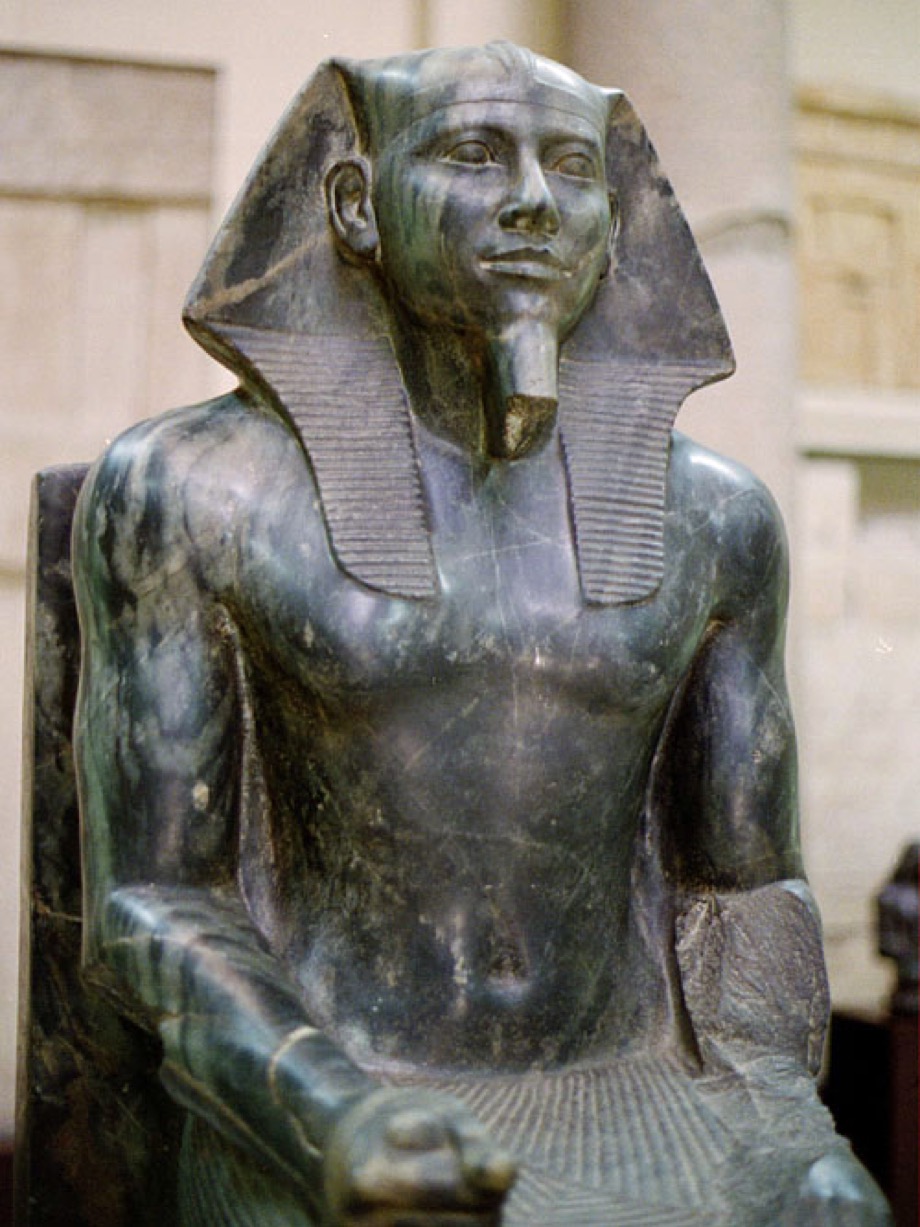
Statue of Khafre
The Coldest Face in Egypt
In a gallery of the Egyptian Museum sits a seated figure of dark, almost black-green anorthosite gneiss — a stone so hard it had to be hauled some seven hundred kilometres from a quarry in the Nubian desert, and so unforgiving that shaping it required grinding rather than carving. The king sits perfectly upright, hands on his knees, gaze level and fixed on nothing. Behind his head, a falcon has folded its wings around the back of his skull — Horus himself, not perched on the throne but pressed against the king’s neck, so that god and man share a single silhouette. Nobody in Egyptian art had made that statement before. It is not a portrait of a man who wants to be admired. It is a portrait of a man who has stopped needing to be.
Khafre came to the throne of a country still absorbing what his father had done to it. The Great Pyramid was finished; the state that built it — the quarries, the corvée rotations, the granaries, the boatyards — was intact and idle. A weaker successor would have been consumed by that inheritance. A louder one would have tried to out-build it. Khafre did neither. He built something almost the same size, positioned it so that it looks bigger, and then added a monument that had no precedent at all.
Herodotus, writing two thousand years later on Egyptian hearsay, gave Khafre the same reputation as his father: a tyrant who closed the temples and worked the country to exhaustion. The archaeology says something quieter and stranger. What survives is not cruelty but control — a plateau arranged, at enormous cost, to say exactly one thing.
An INTJ whose dominant Ni treated an entire desert plateau as a single composition — and who won the argument with his father without ever appearing to make one.
Ni — The Optical Argument
Khafre’s pyramid is roughly three metres shorter than Khufu’s. It is also built on bedrock some ten metres higher, and pitched at a steeper angle of about 53 degrees against his father’s 51. The consequence, which anyone standing on the plateau can verify, is that the second pyramid reads as the dominant one — taller against the sky, sharper in profile, and the only one still wearing a cap of its original polished Tura limestone casing. He conceded the number and took the impression. That is not modesty and it is not rivalry; it is a man solving for how the thing will look forever rather than how it will measure on the day.
The Sphinx is the same instinct at a scale no one else attempted. Carved in place from a single knoll of living limestone left over from the quarrying of the plateau — twenty metres high, seventy-three long — it fuses a royal head in the nemes headdress to the couchant body of a lion, and it faces due east into the sunrise. There is no earlier example of the form. Egyptian monumental art had kings and it had gods and it had animals; it did not have a composite creature at architectural scale guarding an entire necropolis. The attribution to Khafre’s reign rests on hard evidence — the Sphinx temple in front of it, the causeway that ties it into his valley temple, the quarrying sequence itself — and the conception fits nobody else on the plateau.
Look at the whole assembly and the Ni signature is obvious: valley temple, ramped causeway, mortuary temple, pyramid, with the Sphinx sitting at the hinge. It is not a pyramid with buildings attached. It is one continuous statement about a king dissolving into the sun, laid out across half a square kilometre, in which each element is unintelligible without the others.
Te — Inheriting the Machine and Running It Harder
Khafre’s valley temple is the most brutally efficient building of the Old Kingdom. It is built of megalithic limestone cores sheathed in polished red granite from Aswan, with monolithic granite piers holding a plain architrave and an alabaster floor — and it carries no decoration whatsoever. No reliefs, no inscriptions, no ornament of any kind. The effect is achieved entirely by mass, material, and proportion. Twenty-three statues of the king in hard stone once stood in its T-shaped hall, lit by slits cut so that light fell on them and nowhere else. Every element does work; nothing is there to be admired for itself.
Behind that austerity sits a logistics operation his father’s reign had proved out and his own extended. Granite quarried at Aswan and floated eight hundred kilometres downstream. Gneiss brought from the far Nubian desert. A permanent workforce housed and fed at the settlement south of the plateau, where excavation has turned up bakeries, breweries, and cattle bone in quantities that imply state provisioning on a standing basis rather than a seasonal levy. Te does not merely command labour; it builds the supply chain that makes command unnecessary.
And he was efficient about the site itself. The Sphinx exists partly because the knoll of poorer-quality rock it was cut from was in the way — unusable for building blocks, awkward to remove. He turned a quarrying nuisance into the most recognizable monument on earth. That is Te serving Ni: the vision decides what should exist, and the executive function finds the cheapest physical route to it.
Fi — The Falcon at the Back of the Neck
Return to the gneiss statue. Egyptian royal sculpture routinely shows the king with divine attributes, but the Horus falcon on Khafre’s throne is placed where almost nobody standing in front of the statue would see it — behind the head, wings closed around the nape. From the front you see only a still man with an unreadable expression. The god is there for the king, not for the viewer. It is one of the most private gestures in monumental art.
That privacy runs through everything he left. The undecorated valley temple; the stark simplicity of his burial chamber, cut into the bedrock with a plain granite sarcophagus sunk into the floor; the fact that no personal narrative of his reign survives at all beyond titles and building. Where his son Menkaure would commission triad statues showing warmth and relation — the king flanked by Hathor and a nome goddess, touching — Khafre commissioned himself, alone, in the hardest stone available.
Tertiary Fi in an INTJ tends to look like this: not coldness exactly, but a value system that is complete internally and feels no obligation to be legible. He knew what he was and built to that standard. Whether anyone understood it was a secondary question, and possibly not a question at all.
Se — Hard Stone, Sharp Angles
Khafre’s sensory world was one of resistance. Gneiss, granite, alabaster, schist — his workshops specialized in materials that fight back, and the surfaces they produced are ground to a polish that still catches light after four and a half thousand years. The choice is deliberate and slightly perverse: limestone was local, plentiful, and easy, and he used it for bulk while reserving the intractable stones for anything that represented him personally. Permanence over convenience, every time.
Inferior Se also shows in what he did not do. The record preserves no campaigns, no hunts, no festivals, no personal spectacle — nothing of the physical bravado that fills later royal inscriptions. His presence in the world is entirely mediated through objects and geometry. Even the steeper pitch of his pyramid, that extra two degrees, is a decision about how a mass will read at a distance rather than any pleasure taken in the thing itself.
The one place the sensory breaks through is scale, and it breaks through overwhelmingly. Standing before the Sphinx, or in the granite hall of the valley temple, the effect is bodily. He understood exactly what mass does to a person standing next to it, and he deployed that knowledge with the precision of someone who does not otherwise live there.
Why INTJ Over ISTJ
Why not ISTJ?
On the surface Khafre looks like the dutiful heir: same plateau, same form, same institutional machine, executed with discipline. But an ISTJ successor builds his father’s pyramid again, correctly. Khafre did something an Si-led mind does not do — he engineered an optical illusion at architectural scale, deliberately conceding height to gain apparent dominance, and then invented an entirely new category of monument. The Sphinx has no template. Neither does the falcon-embraced portrait. That is original symbolic composition, not faithful continuation.
The distinction matters because the two readings imply different men. The ISTJ Khafre is a careful custodian of the Fourth Dynasty program; the INTJ Khafre is a strategist who inherited a finished masterpiece and quietly reframed the whole site so that his own work sat at its centre. The plateau itself is the evidence. Khufu built the largest thing ever built. Khafre built the thing everyone photographs — and put a face on it.
Connected Figures
Further Reading
- The Complete Pyramids — Mark LehnerThe essential technical account of Khafre's complex, the Sphinx, and the plateau's quarrying sequence, by the archaeologist who mapped it.
- The Rise and Fall of Ancient Egypt — Toby WilkinsonReads the Fourth Dynasty pyramid program as an instrument of state power rather than a monument to vanity.
- The Oxford History of Ancient Egypt — Ian Shaw (ed.)Current scholarly consensus on Old Kingdom chronology and the attribution of the Sphinx.
- The Art of Ancient Egypt — Gay RobinsBest treatment of the gneiss seated statue and what its Horus falcon composition was doing that earlier royal sculpture was not.
- Abusir and Saqqara — Miroslav VernerContext for how the Giza program stood against the wider Old Kingdom necropolis tradition.
