 Historical Figure MBTI
#1035 · 8-2-26 · The Old Kingdom
Hemiunu
The Vizier Who Built Giza
fl. c. 2570 BCE
4 min read
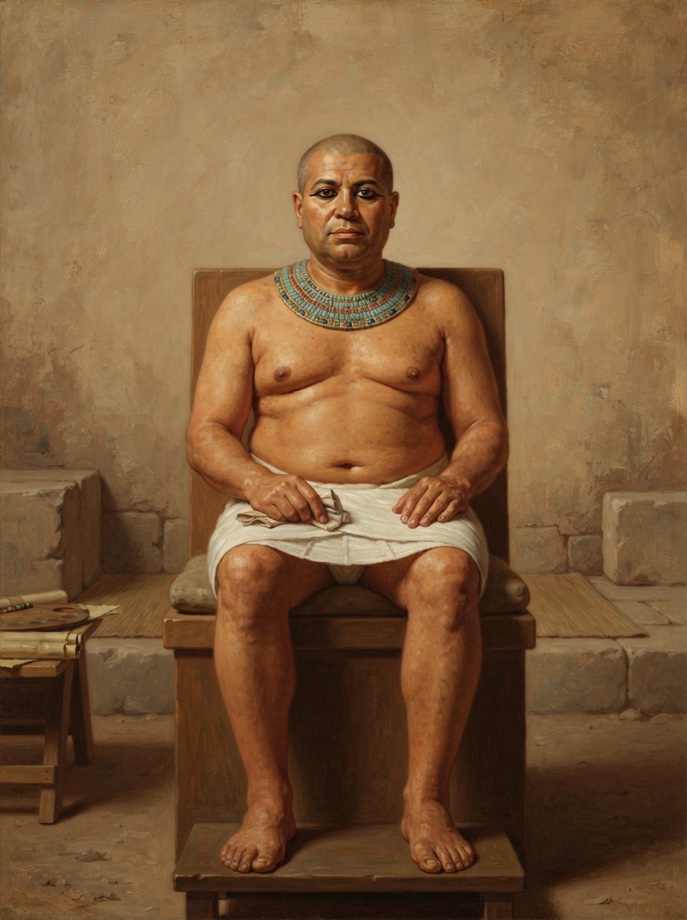
AI-assisted Portrait of Hemiunu
The Man Behind the Great Pyramid's Numbers
No inscription names Hemiunu the architect of the Great Pyramid, because no ancient Egyptian bureaucracy left behind a job title that maps neatly onto that modern word. What survives instead is a title almost as telling: Overseer of All the King's Works, held by Khufu's vizier and nephew, a man whose seated limestone statue — recovered from a mastaba built directly in the shadow of the pyramid he likely organized — shows him heavy, self-possessed, and entirely unbothered by his own bulk.
It is an unusual portrait for its era: most Old Kingdom statuary idealizes its subjects into lean, ageless authority. Hemiunu's corpulence reads instead as an assertion of comfortable institutional weight — a man who did not need to look heroic because his actual achievement was logistical, sustained, and already speaking for itself in 2.3 million blocks of quarried stone.
Hemiunu was an ISTJ, dominant Si — the procedural mind that turned Khufu's ambition into 2.3 million placed blocks.
Logistics as a Twenty-Year Discipline
Dominant introverted sensing is the function of sustained, verifiable process — and nothing in the ancient world demanded more of it than the Great Pyramid. Every one of its estimated 2.3 million blocks had to be quarried, transported, and set to a precision that still confounds modern surveyors, over roughly two decades, without a single visible interruption in the project's momentum. That kind of execution does not come from a single flash of genius; it comes from thousands of correctly repeated procedures, day after day, year after year.
Hemiunu's title as overseer of all the king's works implies exactly this kind of distributed, procedural command — quarry gangs at Tura and Aswan, a labor force organized and fed, a supply chain of ramps and sledges maintained continuously. The Great Pyramid is, before it is anything else, an monument to institutional memory held consistently across two decades, and that is Si's signature written in stone at a scale nothing else in the ancient world matches.
Precision as Command
Auxiliary extraverted thinking supplies the half of the Great Pyramid's achievement that pure procedural memory alone cannot: the base is level to within a few centimeters across more than two hundred meters, and its sides are oriented to true north with an accuracy that would not be matched again for millennia. That is not habit, it is engineering command — someone directing surveying, correcting error across a construction site the size of a small city, and holding thousands of workers to a shared external standard.
Hemiunu's statue, self-satisfied and confident, fits a man for whom this command was not personal glory but competent administration — the natural extension of a Si-driven need to see the project done correctly, expressed outward as the authority to make sure it was.
Content Without Credit
Tertiary introverted feeling shows through in what Hemiunu did not bother to claim. No inscription attributes the pyramid's design to him personally; his statue records only his titles and his family relation to the king, not any boast of singular authorship. In an era where royal monuments routinely erased the individuals who built them in favor of the king's name alone, Hemiunu's own tomb — built prominently beside the pyramid, statue and all — reads less like a demand for recognition than a private, settled satisfaction in work correctly finished.
That quiet self-possession, visible in the statue's calm, faintly amused expression, suggests a man whose sense of his own worth did not depend on public acclaim — an internal conviction stable enough that it needed no further defense once the pyramid itself stood proof of it.
Why ISTJ Over ESTJ
Why not ESTJ?
An ESTJ vizier would more plausibly have left behind inscriptions boasting of command and conquest, asserting his role in the first person. Hemiunu's record is the opposite: a modest title, a statue that communicates weight rather than triumph, and no surviving claim to have personally driven the design. That is a man content to let the finished structure speak, which points inward — to Si quietly sustaining the work — rather than outward to Se's assertive command of the moment.
Strip away the guesswork about his exact design role and what remains is consistent: a career built on procedural mastery sustained without interruption for two decades, credited by his own era with a title about oversight rather than invention.
Connected Figures
Further Reading
- The Complete Pyramids — Mark LehnerDetailed technical account of the Great Pyramid's construction logistics.
- The Pyramids — Miroslav VernerDiscusses Hemiunu's statue and his likely role as chief overseer.
- Zahi Hawass on Giza excavations — Zahi HawassExcavation reports on the workers' town and administrative structures at Giza.
- A History of Ancient Egypt — Nicolas GrimalCovers the vizierate and royal administration under Khufu.
