 Historical Figure MBTI
#421 · 4-8-26 · The Medieval Islamic World
Ibn Juzayy
Andalusi Scholar · Scribe of the Rihla
1321 — 1357
7 min read
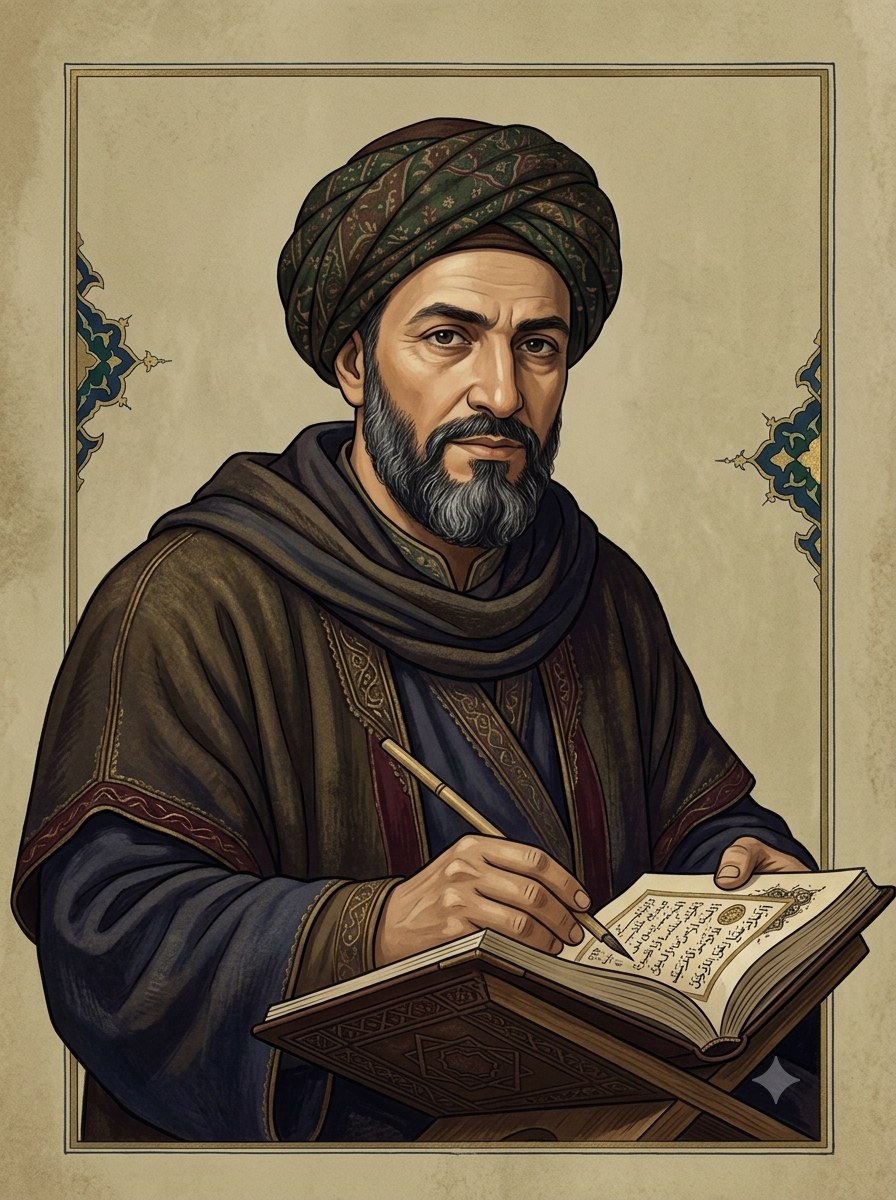
AI-assisted Portrait of Ibn Juzayy
The Hand That Held the Pen
The most famous travel book of the medieval world was not written by the man who traveled. After nearly thirty years on the road — across North Africa, Arabia, East Africa, India, the Maldives, and beyond — Ibn Battuta returned to Morocco with a head full of marvels and no manuscript. The Marinid sultan, wanting the adventure preserved, assigned him a scribe: a young Andalusi scholar named Muhammad ibn Juzayy al-Kalbi, born in Granada in 1321. What survives as the Rihla — the book that carried Ibn Battuta's name across six centuries — is in a real sense Ibn Juzayy's composition. He took the traveler's rough spoken account and shaped it into the elegant literary Arabic that made it endure.
He was a poet and a secretary by trade, a man of the chancery and the library rather than the caravan. Across 1355 and into 1356 he sat with Ibn Battuta, listened, and wrote — smoothing the prose, threading in verses, and, where the spoken memory ran thin, quietly reaching for the words of earlier travel writers, above all Ibn Jubayr, to fill out a set-piece description of a city or a shrine. He died in 1357, the year after the book was finished, barely thirty-six. The work he polished into permanence outlived him almost immediately.
Ibn Juzayy was the INFP in the scriptorium — a Fi sensibility for the right word and the apt cadence, married to an Ne imagination that could weave another man's raw memories into something lasting and beautiful.
The Poet's Inner Ear
Fi — dominant
Dominant Fi is a private compass — an inner sense of what is true and fitting that answers to no audience. In a poet and stylist, it shows up as taste: the refusal to let a clumsy line stand, the conviction that a description deserves a particular music. Ibn Juzayy was not a chronicler aiming for the bare fact. He was a craftsman who could not leave a sentence ungraceful, who heard the difference between adequate Arabic and beautiful Arabic the way a musician hears a sour note.
That sensibility is why the sultan chose him over a plainer clerk. Andalusi court culture prized the cultivated man of letters — the secretary who was also a poet, whose prose carried its own dignity — and Ibn Juzayy was its product. When he set down Ibn Battuta's words, he was not transcribing; he was, by his own lights, redeeming rough speech into literature. The interventions were aesthetic before they were scholarly: a flourish here, a remembered verse there, the shape of a paragraph adjusted until it pleased an ear that trusted only itself.
Fi is also why he stayed mostly invisible. A more self-promoting temperament might have signed the work as co-author; Ibn Juzayy folded himself almost entirely into the traveler's voice, surfacing only in the occasional aside. The values that mattered to him were internal — the rightness of the prose, the honor of the commission — not the credit. He served the book, and let the book carry the other man's name.
The Embellisher's Imagination
Ne — auxiliary
If Fi supplied the taste, auxiliary Ne supplied the means. Ne is associative, generative, forever reaching past the literal toward what a thing could be made to evoke. In Ibn Juzayy it became the literary imagination that turned a wanderer's plain recollection into vivid scene — the gift for the flourish, the metaphor, the heightened image that a city or a court seemed to deserve even if the traveler had described it flatly.
It is also, almost certainly, the source of the book's famous liberties. Scholarly consensus holds that some of the Rihla's grandest set pieces are embellished, and that a few are silently borrowed from earlier writers — Ibn Jubayr most of all — whose elegant descriptions of Mecca and Damascus Ibn Juzayy wove into the text where Ibn Battuta's memory had gone vague. To a strict historian this is a fault. To an Ne-driven stylist it was the natural move: the point was the impression, the shape of the marvel, the reader's sense of having been there. He filled the gaps with what felt right rather than leaving them empty.
This is the auxiliary serving the dominant. Ne reached for the richer possibility; Fi judged whether it belonged. The result was a book that reads not as a logbook but as a world — expansive, ornamented, alive — precisely because the man holding the pen could not resist imagining each place into fuller color than bare report would allow.
The Weight of the Tradition
Si — tertiary
Tertiary Si shows up as a deep familiarity with inherited form — the stored library of how things have been done well before. Ibn Juzayy carried the whole apparatus of classical Arabic letters in his memory: the conventions of the rihla genre, the cadences of approved prose, the verses a cultivated scribe was expected to summon at the right moment. When he reached for Ibn Jubayr, he was drawing on exactly this reservoir of remembered models, fitting the new account into shapes the tradition had already perfected.
This is what kept his Ne from running wild. A pure imagination unanchored to precedent might have produced something idiosyncratic; Si gave him the templates that made the embellishments feel authoritative, in keeping with what a reader of such a book expected. His inventions wore the costume of convention. That blend — fresh imagining poured into time-honored molds — is much of why the Rihla was received not as one eccentric's story but as a worthy specimen of a respected genre.
The Order He Did Not Keep
Te — inferior
Inferior Te is the weak point of the Fi-Ne writer: the impersonal machinery of accuracy, verification, and external proof, held at arm's length. It is telling that the Rihla's problems are exactly Te problems. Dates drift. Itineraries blur. Some journeys appear to be out of sequence or, by modern lights, impossible to have made in the time claimed. The book was built to move a reader, not to satisfy an auditor, and the man who shaped it was not the kind to cross-check a chronology against a calendar.
A Te-led collaborator would have treated the project differently — pinning the traveler down on sequence, flagging the gaps as gaps, prizing the verifiable record over the pleasing whole. Ibn Juzayy did the opposite, and the trade was deliberate in spirit if not in method: beauty and coherence of impression over forensic exactness. The result is a book of enormous value that historians must read with care, precisely because its maker's gifts lay everywhere but in the cold audit of fact.
Why INFP Over INFJ
Why not INFJ?
The INFJ leads with Ni-Fe — a singular vision pressed outward, a message the world is meant to receive. Ibn Juzayy had no such mission. He was not driving an insight or shaping minds toward a conviction; he was shaping language, for beauty, in service of another man's story. His interventions are aesthetic and associative (Fi-Ne), not the convergent, agenda-bearing moves of an Ni visionary. A ghostwriter who embellishes for the love of the well-made sentence is an INFP at the desk, not a prophet with a cause.
The distinction is one of motive. The INFJ wants the world to see something; the INFP wants the thing in front of him to be right — true to taste, faithful to feeling, lovely on the ear. Ibn Juzayy poured himself into the music of someone else's memories and then stepped out of frame. That is Fi's private devotion to the work itself, served by an imagination that could not help but make it more than it was.
Connected Figures
Further Reading
- The Travels of Ibn Battuta — Ibn Battuta (dictated to Ibn Juzayy), trans. H. A. R. GibbThe Rihla itself — the book Ibn Juzayy shaped, in the standard scholarly English translation.
- The Adventures of Ibn Battuta: A Muslim Traveler of the 14th Century — Ross E. DunnThe essential modern study; lucid on how the Rihla was composed and where its embellishments and borrowings lie.
- Travels with a Tangerine: A Journey in the Footnotes of Ibn Battuta — Tim Mackintosh-SmithA literary retracing of the journeys that brings out the texture of the Rihla as a made object, not just a record.
