 Historical Figure MBTI
4 min read
#115 · 3-13-26 · The Medieval Mediterranean
Ibn Sab'in
Sufi philosopher, mystic, and metaphysical thinker of Al-Andalus.
c. 1217 — 1270
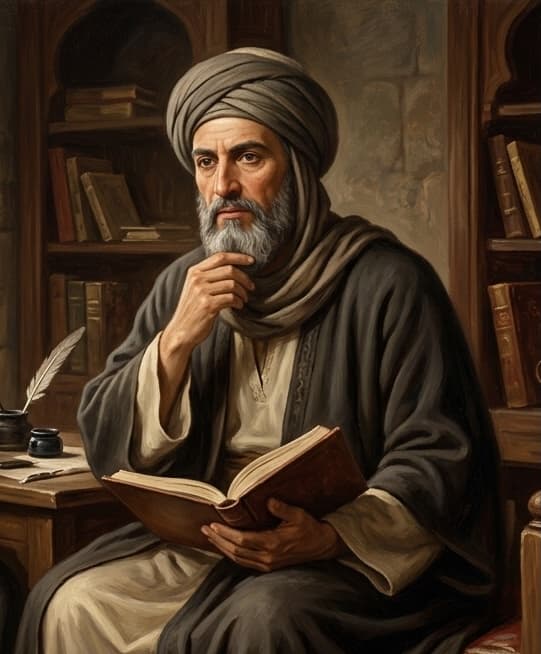
AI-assisted portrait of Ibn Sab'in.
The Philosopher of Unity
Born in Murcia during the intellectual flourishing of Al-Andalus, Ibn Sab'in emerged as one of the most enigmatic and radical thinkers of the medieval Islamic world. Living between Spain, North Africa, and ultimately Mecca, his life reflected the path of a wandering philosopher — one who was less concerned with institutions and more devoted to the pursuit of ultimate truth.
He is best known for his response to the philosophical inquiries of Frederick II, compiled in what is now called the Sicilian Questions. Yet even this exchange only scratches the surface of his intellectual world. For Ibn Sab'in was not merely answering questions — he was attempting to dissolve the very assumptions behind them.
His tendency to blur distinctions between God and creation, his abstract and often opaque style, and his unwillingness to conform to conventional frameworks led many contemporaries to view him as obscure, if not dangerous. Yet even critics acknowledged the depth of his intellect. He was, in many ways, a thinker ahead of his time.
That's the INFJ signature: Ni convergence paired with Fe universality — where many philosophers sought to explain reality, Ibn Sab'in sought to unify it.
Ni — Dominant
At the core of Ibn Sab'in's thought lies a singular conviction: that reality is not fragmented, but fundamentally one — reflecting dominant Ni.
Distinctions — between self and God, subject and object, knower and known — are, in his view, not ultimate truths but surface-level illusions. Rather than exploring multiple possibilities or constructing step-by-step arguments, his thinking moves inward, compressing complexity into essence. His writings are dense, often cryptic, and resistant to linear explanation — not because they lack clarity, but because they attempt to express insights that precede ordinary language. He does not guide the reader gradually. He presents the conclusion — and invites the reader to rise to it.
Fe — Auxiliary
Although not outwardly expressive, Ibn Sab'in's philosophy carries a fundamentally universal orientation — reflecting auxiliary Fe.
His ideas are not rooted in personal feeling or subjective interpretation. Instead, they aim toward what is true for all — a reality that transcends individual perspective. He is not concerned with his truth. He is concerned with truth itself — and its implications for all beings. In this sense, his work reflects Fe not as social warmth, but as a drive toward shared understanding and unity that extends beyond the self.
Ti — Tertiary
Ibn Sab'in's writing style is itself an extension of his cognition — revealing tertiary Ti.
His works operate through conceptual compression — ideas layered tightly, distinctions collapsed, meanings implied rather than spelled out. In place of argument, there is assertion of insight. In place of explanation, there is direction toward realization. This gives his writing a distinctly revelatory quality, shaped by the Ni–Ti axis: an internal refinement of insight, articulated with precision but without the need for external validation or accessibility.
Se — Inferior
Ibn Sab'in's philosophy shows little concern with the physical and sensory world for its own sake — reflecting inferior Se.
Where other thinkers engaged with the material world through observation or experimentation, Ibn Sab'in treated it as something to be transcended rather than explored. The world of appearances was not a domain of fascination but an illusion to be seen through. His wandering life — moving between Andalus, North Africa, and Mecca — reflects a restless spirit oriented toward essence, not toward engagement with the physical world on its own terms.
Connected Figures
Further Reading
- Islamic Intellectual Tradition in Persia — Seyyed Hossein Nasr (ed.), 1996Situates Ibn Sab'in within the broader current of Sufi metaphysics and illuminationist philosophy that ran from Al-Andalus to Persia.
- An Introduction to Medieval Islamic Philosophy — Oliver Leaman, Cambridge University Press, 1985The standard survey of the tradition; covers the rational and mystical strands that converged in figures like Ibn Sab'in.
- The Sicilian Questions of Frederick II — A.F. Mehren (trans./ed.), 1879The primary source — Frederick's philosophical queries and Ibn Sab'in's responses, the document that preserves most of what we know of his direct voice.
