 Historical Figure MBTI
5 min read
#108 · 3-13-26 · The Medieval Mediterranean
Frederick II
Holy Roman Emperor, King of Sicily, and the Wonder of the World.
1194 — 1250
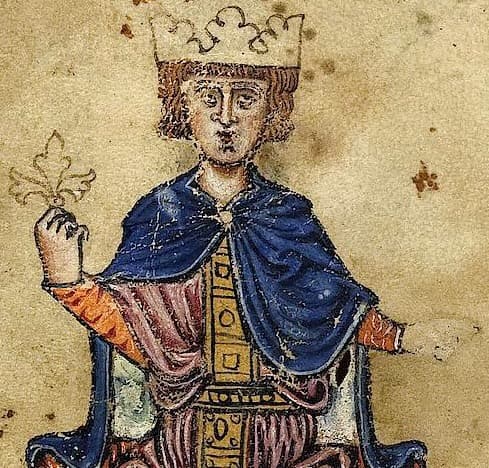
Portrait of Frederick II.
The Wonder of the World
Born on December 26, 1194, in the multicultural kingdom of Sicily, Frederick II, Holy Roman Emperor would become one of the most intellectually unusual rulers in medieval history. Known to contemporaries as Stupor Mundi — “the Wonder of the World” — Frederick stood apart from typical monarchs of his time. While most rulers devoted themselves to warfare, dynastic politics, and religious authority, Frederick displayed a restless curiosity about science, philosophy, language, and the natural world.
Raised in Palermo, a city where Latin Christians, Greeks, Muslims, and Jews lived side by side, Frederick grew up surrounded by diverse intellectual traditions. Rather than developing a rigid ideological worldview, he became fascinated by how different systems of thought interacted. This curiosity would later shape his court, transforming Sicily into one of the most intellectually vibrant centers in Europe.
Frederick was sometimes interpreted as an INTJ because of his strategic intelligence and imperial authority, or as an INTP due to his analytical curiosity. But a closer look at how he pursued knowledge suggests a different pattern: an intellectual who thrived not in solitary analysis but in gathering, challenging, and catalyzing the minds around him.
That's the ENTP signature: Ne curiosity paired with Ti analysis — he was not merely a thinker. He was an intellectual catalyst, gathering people, ideas, and perspectives into dynamic conversation.
Ne — Dominant
Frederick's defining trait was expansive intellectual curiosity — reflecting dominant Ne.
His interests ranged across zoology, astronomy, linguistics, philosophy, mathematics, and theology. Rather than focusing on a single unifying vision, he explored a wide variety of subjects, constantly probing new questions. This curiosity is evident in his scientific treatise De Arte Venandi cum Avibus, where he carefully documented bird anatomy, flight mechanics, and animal behavior through direct observation. When his findings contradicted classical authorities such as Aristotle, Frederick did not hesitate to challenge them. The pattern here is not the Ni search for a singular framework but Ne-driven exploration — asking questions, testing possibilities, and expanding understanding across many domains.
Ti — Auxiliary
Frederick's curiosity was paired with strong analytical reasoning — reflecting auxiliary Ti.
His investigations into animal behavior, language, and science were methodical and observational. He valued empirical evidence and logical analysis, frequently testing ideas against direct experience. Rather than accepting knowledge purely from tradition, Frederick preferred to analyze it independently. This combination of exploratory curiosity and analytical scrutiny reflects the Ne–Ti dynamic characteristic of ENTP.
Fe — Tertiary
Frederick's intellectual life was deeply social — reflecting tertiary Fe.
His court in Palermo became a gathering place for scholars from across the Mediterranean world — Muslim scientists, Jewish philosophers, Christian theologians, mathematicians, and translators. Rather than enforcing strict intellectual orthodoxy, Frederick encouraged discussion among them. He appeared energized by the exchange of ideas, asking questions, posing philosophical problems, and inviting debate. This environment resembles an intellectual salon more than a traditional royal court. The ability to gather people together around ideas and stimulate discussion aligns well with tertiary Fe supporting Ne exploration.
Si — Inferior
Frederick showed little reverence for tradition simply because it was tradition — reflecting inferior Si.
In an era when ancient authorities were often treated as unquestionable, he frequently challenged inherited knowledge when it conflicted with observation. His diplomatic approach during the Sixth Crusade — negotiating Jerusalem peacefully instead of fighting — also reflects a willingness to depart from historical precedent when a new possibility presented itself.
Why ENTP Over INTJ, INTP, or ENTJ
Why not INTJ?
INTJs typically pursue a clear overarching system or vision and implement it through structured planning. Frederick's intellectual behavior, however, appears far more exploratory. Rather than imposing a single ideological framework, he actively gathered scholars around him and encouraged open debate. His legacy is defined less by a unified personal vision and more by the range and restlessness of his inquiry.
Why not INTP?
Frederick clearly possessed strong analytical abilities, but his intellectual life was not primarily solitary. He did not simply study ideas privately; he actively created spaces for intellectual exchange. By gathering scholars from different cultures and traditions, he transformed his court into a living laboratory of debate and experimentation. This outward, energizing quality of his intellectual life suggests Ne leading over Ti.
Why not ENTJ?
While Frederick wielded enormous political authority, his legacy is defined less by administrative control and more by intellectual curiosity. His interests consistently gravitated toward inquiry, experimentation, and philosophical discussion rather than strategic expansion or rigid organizational power. The court he built was a place for ideas, not for command.
Connected Figures
Further Reading
- Frederick II: A Medieval Emperor — David AbulafiaThe definitive English-language biography — traces his rule, his court culture, and the legend of Stupor Mundi.
- Emperor Frederick II — Ernst KantorowiczA sweeping intellectual portrait by a great medieval historian; written in 1927, still indispensable.
- The Art of Falconry (De Arte Venandi cum Avibus) — Frederick II, trans. Casey A. Wood & F. Marjorie FyfeFrederick's own scientific treatise on falconry — reveals his empirical method and challenge to Aristotle.
- The Kingdom of Sicily 1100–1250: A Literary History — Karla MalletteExplores the multilingual literary world Frederick cultivated at his Palermitan court.
